

Yes, you can wash a car in direct sunlight, but only if you change your technique. The sun speeds up evaporation, so a leisurely wash becomes a fast, panel-by-panel job with immediate rinsing and drying. Get the timing wrong and you risk baked-on residues and water spots that need proper correction later, so a bit of planning goes a long way.
TL;DR:
- Washing a car in direct sun requires quick, panel-by-panel rinsing and drying to prevent water spots and baked-on residues.
- The best time to wash is early morning or late afternoon when surface temperatures are cooler, or under shade if possible.
- Using a pressure washer, quick-rinse sprays, and microfibre towels helps minimize drying issues caused by hot weather.
- Avoid washing during peak heat hours from 11:00 to 15:00, especially on hot days or heatwaves, to limit chemical etching and surface damage.
- Proper disposal of wash water is crucial to prevent pollution, with driveway washing on impermeable surfaces being the safest legal practice.
Table of Contents
- Why washing in direct sunlight is risky
- When to wash: timing, shade and the simple touch test
- Panel-by-panel, fast method to wash safely in direct sun
- Products and tools that actually help when washing in sun
- How to remove water spots and fix minor etching
- Short environmental and regulatory note
- Diamondbrite’s quick kit and routine for warm-weather washing
- Practitioner perspective from a detailing point of view
- Buy a ready kit from Diamondbrite
- Sources
- FAQ
Why washing in direct sunlight is risky
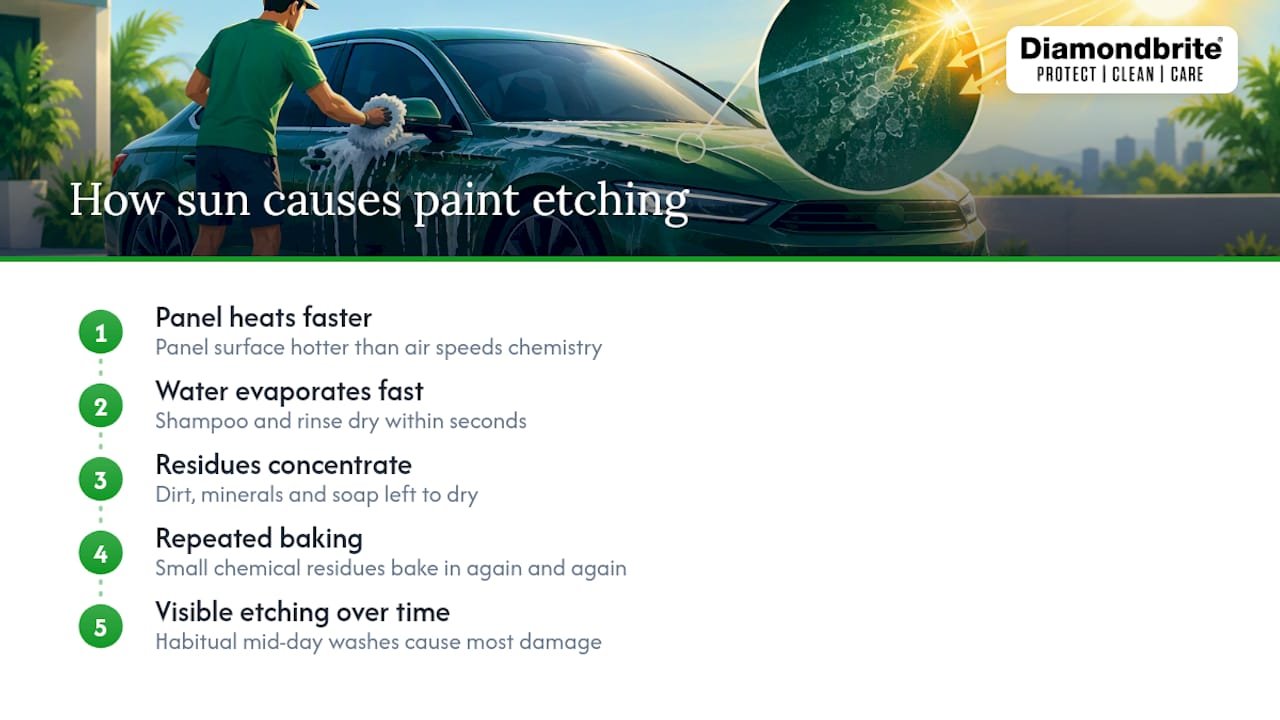
Heat changes the chemistry of a wash before you have even finished it. Water evaporates off hot paintwork within seconds, so shampoo, road grime and mineral deposits that would normally rinse away instead sit and dry onto the surface. That drying process concentrates whatever was in the water and the wash mix, and repeated exposure can etch into the lacquer over time.
The panel itself gets hotter than the air around it, which speeds up every stage of the process, from foam drying too fast to rinse water leaving tidemarks before you can wipe it off. Detailers see this as the main reason mid-day washes go wrong: not one dramatic mistake, but small chemical residues baking in again and again.
A significant share of UK drivers wash their cars during peak sun hours, according to heatwave reporting from Portsmouth, which found that mid-day washing during heatwaves causes rapid evaporation and residues that can etch into paint. That single habit, repeated over a summer, is where most of the visible damage comes from.
When to wash: timing, shade and the simple touch test
Timing matters more than any product you use. During a heatwave, avoid washing between 11:00 and 15:00, when the sun is highest and surface temperatures peak. The same reporting recommends washing before 10:00 or after 17:00, when UV intensity and panel heat have both dropped.
If you are not sure whether it is too hot, use the touch test. Rest your palm flat on the bonnet or roof for a few seconds:
- If the panel feels merely warm, you can proceed with the fast method below.
- If it is uncomfortably hot to keep your hand there, wait or find shade first.
- If you must wash now, park under a tree, carport or garage overhang to buy yourself extra working time.
- A quick, cool pre-rinse across the whole car lowers the surface temperature before you start proper cleaning.
Panel-by-panel, fast method to wash safely in direct sun
Speed and sequence do the real work here. Rather than washing the whole car at once and letting early panels dry while you finish the rest, you work in sections and rinse each one before moving on.
Before you start, gather everything within reach: two buckets, a wash mitt, a pH-neutral shampoo, microfibre drying towels, and either a pressure washer or a hose with a strong nozzle. A quick-detail spray is worth having on hand for any panel that starts to dry before you get to it.
- Give the whole car a cold-water pre-rinse to cool the panels and loosen loose grit.
- Apply snow foam or a foaming pre-wash and let it dwell briefly to lift dirt without scrubbing.
- Rinse the foam off before it dries, working from the roof downwards.
- Wash one panel at a time with your mitt, using the two-bucket method to keep grit out of your wash water.
- Rinse that same panel immediately, before moving to the next one.
- Blot the wet panel dry with a microfibre towel or drying aid while it is still cool from the rinse.
- Repeat washing, rinsing and drying panel by panel until you reach the wheels and lower sections.
- Finish with a final full rinse and a last dry pass to catch any missed streaks.
Working top to bottom keeps dirty run-off away from panels you have already cleaned. A pressure washer speeds up every rinse step, which matters most on hot days when every extra second lets water dry into spots.
Pro Tip: Keep a spray bottle of plain water nearby and mist any panel that starts to dry white before you can rinse it properly.
Products and tools that actually help when washing in sun
The right kit shrinks the drying window rather than fighting it. A few choices make a real difference once temperatures climb.
- A quick-rinse or quick-detailer spray lifts residue that has started to dry, buying you time between rinsing and drying.
- A pressure washer clears foam and grime faster than a hose, which matters because hot weather speeds up evaporation and makes water spots and streaks more likely.
- A hose with a strong spray nozzle is a reasonable substitute if you keep the stream close and constant rather than dribbling water across the panel.
- Plush microfibre drying towels or a silicone drying aid pull water off the surface without dragging grit across the lacquer.
- Avoid household detergents such as washing-up liquid, which strip protective coatings and leave the paint more exposed to the next round of heat.
- Never apply wax or sealant on a hot panel: it dries and cures unevenly, so save protection products for a cooler morning or evening session.
Professionals lean on shade and speed rather than any single miracle product, working early or late and rinsing constantly to stay ahead of the sun.
How to remove water spots and fix minor etching
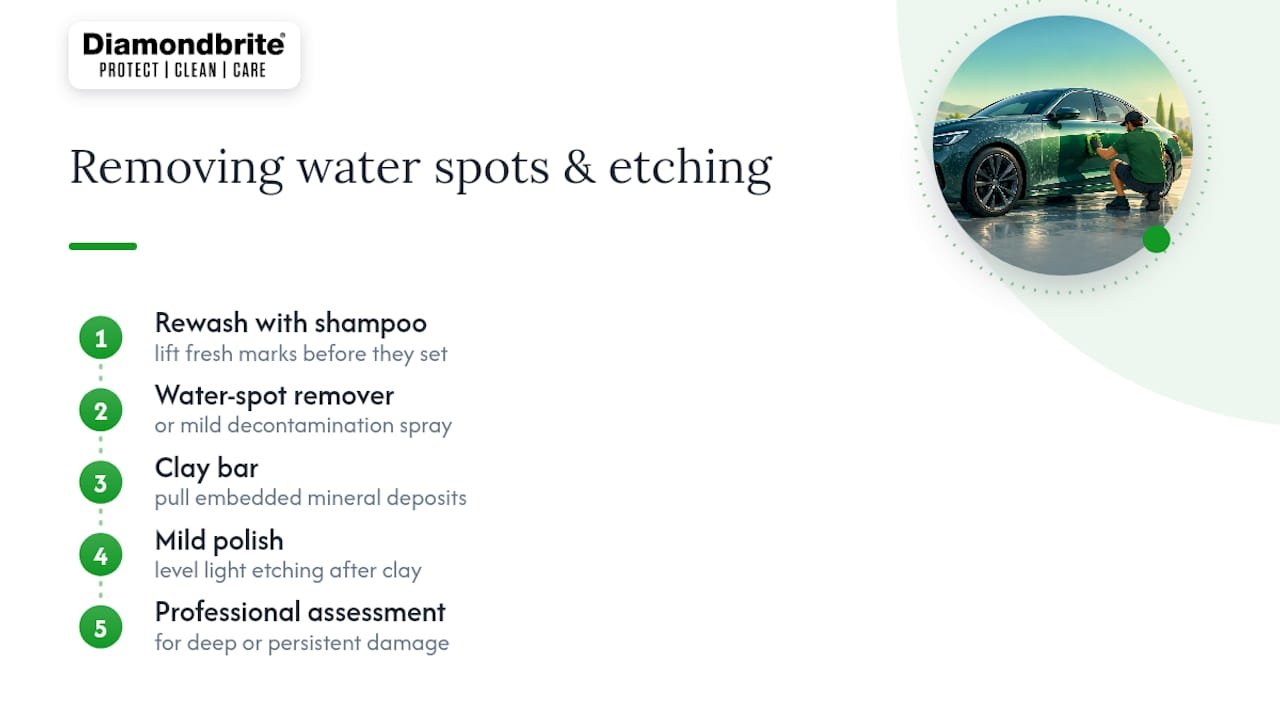
Fresh water spots are usually the easiest fix. A rewash with a proper shampoo, followed by a dedicated water-spot remover or mild decontamination spray, lifts most marks that have not had time to set.
Marks that have been baking in the sun for days or weeks are a different problem. A clay bar can pull embedded mineral deposits out of the clear coat, and a mild polish can level light etching once the residue is gone. If the marks are deep, if the paint feels rough under the clay, or if polishing does not shift the discolouration, it is worth having a professional assess it rather than risking further damage with heavier compounds. Our guide to removing swirl marks covers the same decontaminate-then-polish approach in more depth.
Short environmental and regulatory note
Where your wash water goes matters, sun or no sun. Official guidance under PPG13 advises against letting detergents and wash effluent run into surface water, and recommends checking with your sewerage provider before discharging into a foul sewer.
For most home washes on a driveway, the practical steps are straightforward:
- Wash over an impermeable surface such as a driveway rather than gravel or grass, so run-off does not soak straight into the ground.
- Where possible, direct or capture run-off away from drains that lead to rivers or streams.
- If you cannot avoid heavy chemical use, a commercial wash with proper effluent treatment is the safer option.
Commercial car washes and valeting businesses face stricter permit and drainage requirements than an occasional household wash, since they handle far higher volumes of wash water.
Diamondbrite’s quick kit and routine for warm-weather washing
The panel-by-panel method above pairs naturally with a ceramic-infused shampoo, since a shampoo formulated to bead and release grime quickly gives you less to rinse before the sun gets to it. A quick-rinse aid handles any panel that starts drying before you reach it, and a plush microfibre towel finishes the job without dragging grit across warm paint. Once the wash is done and the car has cooled, a protective glaze applied later in the evening locks in the shine without the uneven cure risk that comes from applying it on a hot panel.
Practitioner perspective from a detailing point of view
Mid-day washes rarely fail dramatically. They fail quietly, one baked-in residue at a time, until the lacquer looks tired years before it should. Speed and shade are not fussy habits, they are the difference between paint that stays glossy and paint that dulls early.
— Will
Buy a ready kit from Diamondbrite
Once you know the routine, having the right products to hand makes it far easier to stick to. There are specialized products designed for a fast, low-residue wash, quick-rinse aids for panels that dry before you reach them, and microfibre towels and protective glazes to finish the job once the car has cooled.
Browse the full Diamondbrite shop for the shampoos, drying aids and protection products that suit your routine, or read more on ceramic shampoo benefits before you choose your first kit.
Sources
- The heatwave mistake Portsmouth drivers are about to make
- Vehicle washing and cleaning PPG13: prevent pollution
- Car washing in hot weather: our dos and don’ts for the best results – Green Flag
FAQ
Can you use sunlight to wash a car?
Sunlight itself does not clean anything, but you can wash a car while it is sunny if you work fast and rinse each panel before it dries. The risk is not the light, it is the heat drying residue onto the paint before you have finished.
What temperature is too hot for a car wash?
There is no single official temperature cut-off, but if a panel feels uncomfortably hot to touch, it is too hot to wash safely without extra care. The safer approach recommended in heatwave reporting is to wash before 10:00 or after 17:00, when surface temperatures have dropped.
When should you not wash your car?
Avoid washing between 11:00 and 15:00 during a heatwave, since that is when panels are hottest and water evaporates fastest. Outside of a heatwave, the same principle still applies on any strongly sunny afternoon, so shade or an early or late slot is always the safer choice.
Does direct sunlight damage car paint?
Direct sunlight itself does not damage paint instantly, but washing in strong sun can, because water and chemicals dry onto the surface before they rinse away. Repeated over time, that baked-on residue can etch into the lacquer, which is why hot weather is linked to more water spots and streaks than cooler conditions.