

Snow foam is a touch-free pre-wash that loosens surface dirt before you touch the paint; car shampoo is the contact wash that actually removes bonded grime. They do different jobs, not the same job twice. If you’re choosing where to spend your money first, put it into a proper pH-neutral shampoo and a good mitt. Foam is the safety upgrade you add once that routine is already solid.
TL;DR:
- Snow foam mainly lifts loose dirt, removing approximately 65 to 85 percent of surface contamination, but cannot replace the cleaning power of a proper shampoo.
- A pressure washer is necessary for foam application, while a quality pH-neutral shampoo and correct technique offer reliable protection for most maintenance washes.
- Foam is most effective when used on heavily soiled cars, especially in winter, while light weekly dust can be cleaned efficiently with shampoo alone.
- Bonded dirt, like traffic film, requires added traffic film remover or contact shampoo to clean effectively, as foam alone cannot break down oily residues.
- Using stronger alkaline pre-washes or TFRs should be rare, kept short, and reserved for deep cleaning, especially on coated cars, to prevent stripping protective layers.
Table of Contents
- Snow foam vs shampoo: a quick decision guide
- The chemistry behind foam and shampoo
- A practical wash sequence that actually protects your paint
- Keeping your coating or wax safe through both stages
- Why your car still looks dirty after foaming, and how to fix it
- What Diamondbrite recommends for a coating-safe routine
- A contributor’s view on time, kit, and protection
- Get the coating-safe wash kit that matches this routine
- Sources
- FAQ
Snow foam vs shampoo: a quick decision guide
You don’t need both every single time. Match the product to what’s actually on the car.
- Weekly maintenance wash, light dust: shampoo alone is usually enough. A two-bucket contact wash removes fine grime without the extra faff of foaming and rinsing.
- Winter driving, road salt, heavy mud: foam first. It lifts loose grit before your mitt ever touches the surface, cutting the chance of dragging grit through the paint.
- Ceramic-coated or waxed cars: lean on shampoo for most washes and treat foam as an occasional, gentle first pass rather than a weekly habit.
Equipment matters here too. A foam cannon needs a pressure washer to work properly, which is a bigger outlay than a bucket, grit guard, and mitt. If you’re only set up for the basics, a quality shampoo and correct technique will protect your paint more reliably than a cheap foam cannon used badly. Before any wash, ask yourself three things: how visible is the dirt, is the car coated or waxed, and what kit do you actually own?
The chemistry behind foam and shampoo
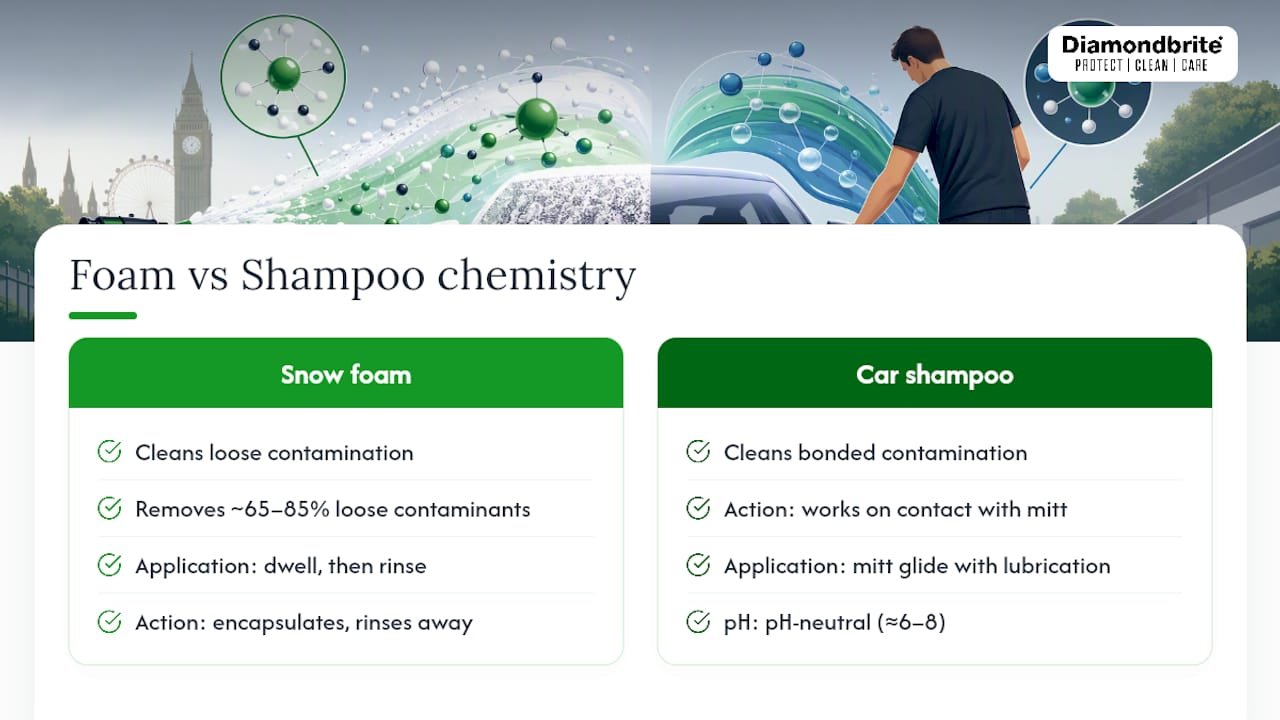
Snow foam and car shampoo clean in different ways, and that difference explains why one can’t replace the other. Snow foam is a high-foaming pre-wash designed to cling to vertical panels for several minutes, encapsulating loose contamination so it can be rinsed away with minimal contact. Tests show snow foam removes roughly 65 to 85% of loose contamination compared with water alone, which is a strong head start before you pick up a mitt.
Car shampoo works on contact. It’s formulated to be pH-neutral, typically around pH 6 to 8, giving it the lubrication needed for a mitt to glide across bonded dirt rather than grind it into the clear coat. That lubricity is the whole point: it’s what stands between a normal wash and a paint covered in fine scratches.
The pH gap has real consequences for anything you’ve applied to protect the car. Neutral formulas are gentle enough for waxes, sealants, and ceramic coatings, while more alkaline pre-washes clean harder grime but strip protection faster if you lean on them too often. Snow foam handles the loose layer; shampoo handles the bonded layer and does the job of protecting what’s underneath.
A practical wash sequence that actually protects your paint
Skipping steps is where most damage happens, not the products themselves. Follow this order and you cut the risk of swirl marks at every stage.
- Pre-rinse. Use a fan jet on a pressure washer, or a hose if that’s what you have, to knock off loose grit before any chemical touches the car. This step alone removes a surprising amount of debris that would otherwise get dragged around by a mitt.
- Apply snow foam. A foam cannon fed by a pressure washer produces the thick, clinging foam that gives you proper dwell time; a foam gun or pump sprayer works but the foam is thinner and less effective. Leave it for three to five minutes, long enough to work but not so long it dries on the panel, then rinse thoroughly from the top down.
- Contact wash with shampoo. Use the two-bucket method: one bucket for shampoo solution, one with clean water and a grit guard to rinse the mitt before it goes back into the suds. Work in straight lines, section by section, rinsing the mitt constantly.
- Final rinse and dry. Rinse the whole car again to catch any remaining suds, then dry with a plush microfibre towel or a drying aid. Check panel by panel for any dull patches, which usually means a second pass of shampoo on that spot.
Pro Tip: Never let snow foam sit until it starts turning clear and dry on the panel. That’s the point it stops lifting dirt and starts drying grit onto your paint, which is worse than skipping foam altogether.
Technique still does the heavy lifting here. Even the best foam only reduces risk; it’s the two-bucket method and straight-line strokes that actually prevent swirl marks.
Keeping your coating or wax safe through both stages
Coated cars need a slightly more careful approach, but it isn’t complicated once you know the rule of thumb. Stick to pH-neutral shampoo for the vast majority of washes and treat anything stronger as an occasional tool, not a default.
A simple 10×10 spot test tells you quickly whether a product is too aggressive: apply it to a small, discreet panel area, leave it for the dwell time on the label, then check for any change in gloss or a slippery, stripped feel once rinsed. If the coating looks or feels different, rinse immediately and dilute the product further next time.
Stronger alkaline pre-washes and Traffic Film Removers (TFRs) have their place, particularly on cars that pick up oily road grime rather than just dust. Use them sparingly, keep dwell times at the lower end of the label guidance, and rinse thoroughly. Neutral or mildly alkaline foams are the safer everyday choice for coated paint, with stronger chemistry reserved for the odd deep clean rather than the weekly routine.
Why your car still looks dirty after foaming, and how to fix it
A foamed car that still looks grubby usually means one thing: what’s on the paint isn’t loose dirt, it’s bonded traffic film. Snow foam is built to lift particles sitting on the surface, not to break down the oily residue that builds up from road spray and exhaust grime. When that’s the problem, a Traffic Film Remover applied before foam, or a proper shampoo contact wash, finishes the job foam alone can’t.
A few other habits quietly undo good work:
- Diluting foam or shampoo incorrectly, usually too weak to do anything useful.
- Letting foam dry on the panel instead of rinsing within the dwell window.
- Reusing a dirty mitt or skipping the rinse bucket, which drags grit straight back across the paint.
- Rinsing too briefly, leaving a soapy film that dries into streaks.
Never reach for washing-up liquid as a stand-in for car shampoo. It’s designed to cut through kitchen grease, and it does the same thing to wax, sealants, and coatings, stripping protection and leaving paint more exposed to the elements than before you washed it.
What Diamondbrite recommends for a coating-safe routine
Diamondbrite’s advice mirrors what detailers have found through years of trial and error: get the shampoo and mitt routine right first, then add foam as your extra layer of safety once budget allows.
For dwell times, stay conservative. A few minutes of foam contact is plenty for most weekly grime; longer dwell doesn’t clean more, it just raises the risk of the product drying before you rinse. The same logic applies to any pre-wash chemistry stronger than neutral: shorter, more frequent, careful applications beat long soaks used occasionally.
Will, a Diamondbrite contributor, has spent years testing wash routines across daily drivers and coated enthusiast cars, and the pattern holds regardless of the vehicle: technique and product pH matter more than how much kit you own.
A contributor’s view on time, kit, and protection
Will skips foam on quick weekly washes where the car is only dusty; a properly diluted shampoo does the job faster with less setup. He always foams after motorway trips, muddy tracks, or anything with visible grit. Before starting, he checks three things: how dirty the car actually looks, whether it’s coated, and how much time he’s got. For casual owners, a good shampoo pays off every wash. For enthusiasts protecting a coating, the extra ten minutes for foam is cheap insurance against swirl marks.
— Will
Get the coating-safe wash kit that matches this routine
You can find products designed to help run the routine above without guessing at dilution ratios or risking your coating on the wrong chemistry. Where a generic supermarket shampoo forces you to choose between cleaning power and coating safety, Diamondbrite’s Ceramic Shampoo is formulated to clean and top up protection in the same pass, so every contact wash reinforces the work your coating is already doing.
Start with the shampoo for your weekly contact wash, diluted per the bottle’s guidance, and bring in a neutral pre-wash foam only when the car is genuinely caked in road grime or winter salt. If you’re maintaining an existing coating, pair your wash routine with the ceramic coating maintenance guide for the full aftercare picture. Ready to build your kit? Head to the Diamondbrite shop and pick up the shampoo and pre-wash bundle that matches your car’s finish.
Sources
For deeper testing on foam versus shampoo performance, see Two Bucket Club’s comparison and Auto Care HQ’s real-world testing. On heavier contamination and TFR use, MossChem’s guide explains why foam alone sometimes isn’t enough.
- Snow Foam vs Car Shampoo: What’s the Difference? | Two Bucket Club
- Is Snow Foam Actually Worth It? (Real Testing) | Auto Care HQ
- Can you use washing up liquid to wash your car? | Used Car Sales Direct
FAQ
Is snow foam really worth it?
Yes, as an added safety margin. It removes a large share of loose contamination before contact, which reduces the risk of swirl marks during the shampoo wash that follows.
Should you jet wash your car before applying snow foam?
Yes. A pressure washer or hose rinse removes loose grit first, so the foam is working on what’s left rather than fighting through a layer of debris.
Why is my car still dirty after using snow foam?
It’s likely bonded traffic film rather than loose dirt. Foam isn’t designed to break down oily road residue, so a Traffic Film Remover or a full shampoo contact wash is usually needed to finish the job.
Can you use washing-up liquid as snow foam?
No. Washing-up liquid strips wax, sealant, and ceramic protection, leaving paint more vulnerable than a proper pH-neutral car shampoo or foam would.