

Leave snow foam on for roughly 5 to 10 minutes, and rinse it off before it starts to dry. That is the sweet spot for most UK cars and most products. Car Magazine notes that manufacturers usually print a dwell time on the bottle, typically between three and ten minutes, so the label is always your first reference. Below you will find what changes that number, how to work out the right time on the day, and what to do if your foam collapses early.
TL;DR
- Aim for 5 to 10 minutes of dwell, or follow the time on your bottle if it is shorter.
- Rinse while the foam is still wet. Foam that dries on paint is the real risk, not foam that sits a little less.
- Heat, wind and direct sun shorten your safe window, so wash in shade and on a cool panel.
- Apply from the bottom up so the dirtiest areas get the longest soak.
- Snow foam is a pre-wash. It softens grime, then a contact wash finishes the job.
Table of Contents
- What dwell time actually does
- How long to leave snow foam: a practical guide
- What shortens or lengthens your dwell time
- A simple routine, step by step
- Why your car is still dirty after snow foam
- Dwell time on ceramic-coated paint
- Our view on dwell time
- Pair your foam with ceramic-infused care
- FAQ
- Sources
What dwell time actually does
Dwell time is the period between applying the foam and rinsing it off. During it, the surfactants in the foam cling to the paint and loosen dirt so it can slide away. Carwow compares it to leaving pots and pans to soak in the sink after dinner: you give the suds a few minutes to do the work rather than scrubbing straight away.
That loosening is the point. The less grit you drag across the paint with a mitt later, the fewer fine swirl marks you add. If you want the full routine, our guide to washing a car without scratching it covers a two-bucket wash alongside a 5 to 10 minute pre-wash.
How long to leave snow foam: a practical guide
There is no single number that suits every day, car and product. Use this as a starting point.
| Situation | Suggested dwell | Why |
|---|---|---|
| Light, regular dirt on a maintained car | 3 to 5 minutes | Little to loosen, so a short soak is enough |
| Typical weekly grime | 5 to 10 minutes | The usual window for a thick, stable foam |
| Heavy road film, lower panels, wheel arches | Up to 10 minutes, applied first | Gives the dirtiest areas the longest soak |
| Warm, windy or sunny day | 2 to 4 minutes, watch it closely | Foam thins and dries faster |
| Cold, damp, overcast day | Full 10 minutes is usually fine | Slower evaporation |
These are working guides drawn from typical bottle guidance, not guarantees. Your product’s label always wins.
Watch the foam, not just the clock
A timer is useful, but the foam tells you more. Thick, clinging foam that is sliding slowly down the panel is working. When it turns thin, streaky, or starts to look patchy and dull at the edges, it is drying. Rinse straight away, even if you are only at three minutes.
What shortens or lengthens your dwell time
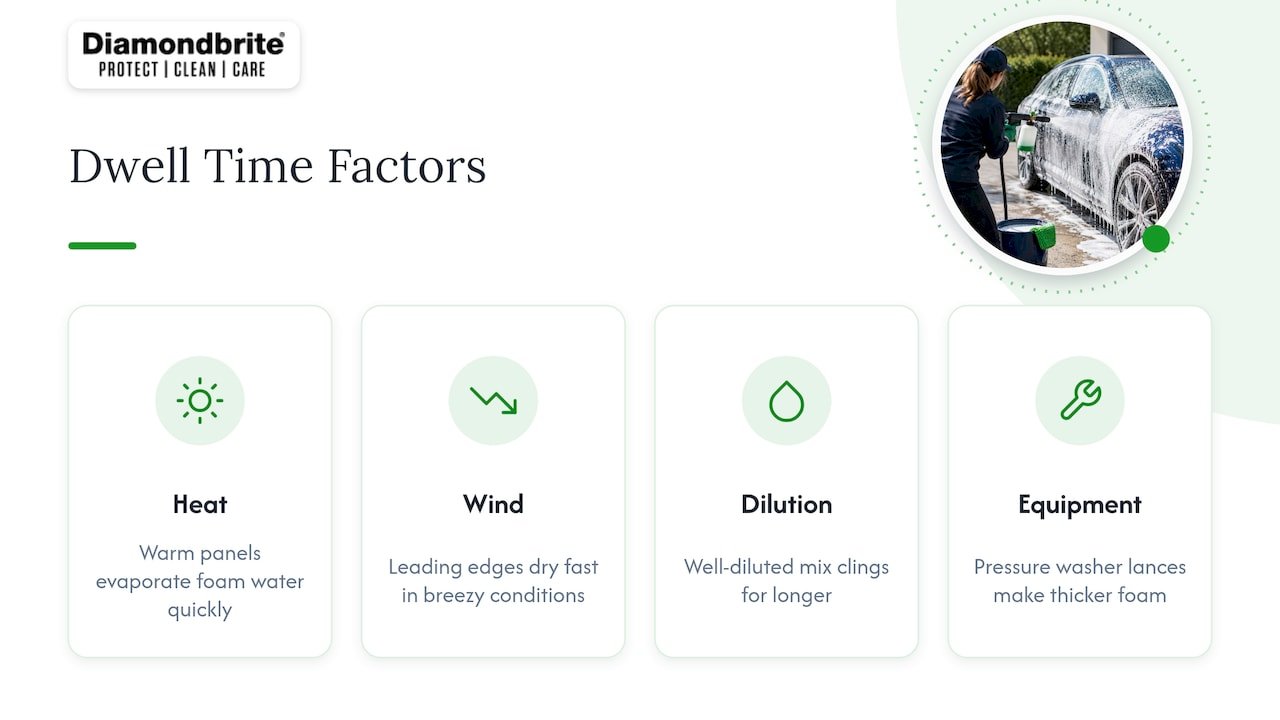
Temperature and sun. Warm panels evaporate the water in the foam quickly. Park in shade, and let a car that has just been driven cool down first. In a UK summer, a black bonnet in the afternoon sun is the classic trouble spot.
Wind. A breezy driveway dries the leading edges of foam surprisingly fast, especially on the roof and tops of doors.
Dilution. A weak mix gives thin foam that collapses early. A well-diluted mix clings for longer. If yours slides off in a minute, check the ratio before blaming the product. Our guide to snow foam dilution ratios shows how to get clinging foam in 30 to 60 seconds.
Your equipment. Foam lances on a pressure washer usually produce thicker foam than a pump sprayer. If you do not own a pressure washer, there are cheap ways to foam your car without one, though the foam will often be wetter and shorter-lived, so shorten your dwell accordingly.
Product quality. A snow foam that only manages a couple of minutes before collapsing will not loosen much. If a product cannot hold a stable foam for several minutes, the dwell time on the label is probably short for a reason.
A simple routine, step by step
- Pre-rinse. Knock off loose grit and mud with plain water.
- Foam from the bottom up. Car Magazine advises working from the bottom to the top, including glass and wheels, because the wheels and lower body are usually the dirtiest. The lower panels then soak longest.
- Set a timer. Start with 5 minutes. Stay with the car and keep an eye on the foam.
- Rinse from the top down. Work steadily so no panel dries before you reach it. Take your time over sills, grilles and shut lines.
- Contact wash. Follow with a gentle mitt wash. Snow foam softens dirt but does not replace this step.
- Dry. Use a clean microfibre towel or a blower.
If you are unsure about order, our car wash sequence explains why wheels and arches matter for keeping grit off your paint.
Why your car is still dirty after snow foam
This is one of the most common complaints, and it usually comes down to expectations. Carwow describes foam as clinging to the car and dissolving dirt, but it is a pre-wash, not a no-touch miracle. Baked-on tar, bug remains and old road film need a contact wash, and sometimes a dedicated remover.
Leaving the foam on for 30 minutes will not fix that. Longer dwell only increases the chance of it drying. If the car is still grubby after a proper 5 to 10 minutes, the answer is a better mitt wash, not more waiting.
Dwell time on ceramic-coated paint
If your car has a ceramic coating, the same principle applies, with a few extras. Choose a pH-neutral pre-wash, keep it off hot panels and never let it dry. Our page on a pre-wash for ceramic coatings sets out why the pH range matters. Regular gentle washing is what keeps a coating performing, and a hydrophobic wash routine can cut wash-induced abrasion further.
In winter, salt is the other reason not to rush. Two weeks can be too long between washes on gritted roads, as we explain in our winter washing guide. A short foam dwell on a cold day is far better than skipping the wash.
Our view on dwell time
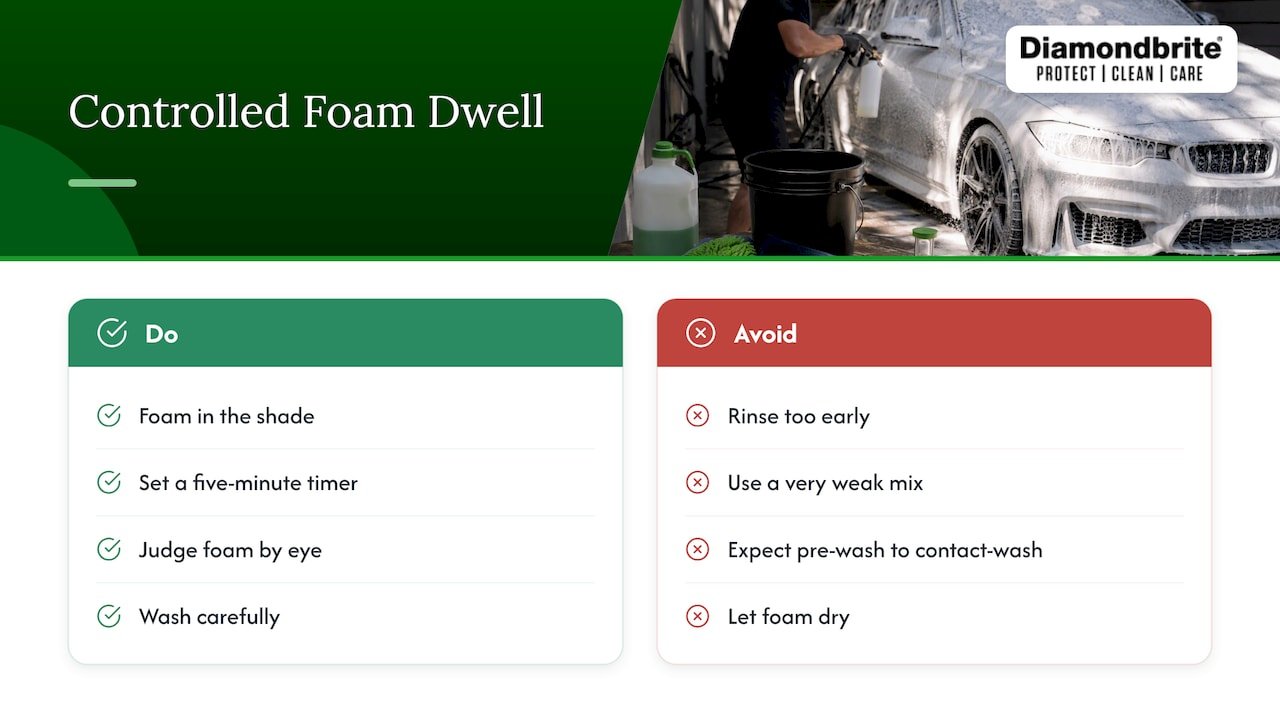
We see dwell time as a matter of control rather than minutes. Most owners who tell us foam “does nothing” are either rinsing too early, using a very weak mix, or expecting a pre-wash to do a contact wash’s job. The safest habit is simple: foam in the shade, set a timer for five minutes, and judge the foam by eye. A short, well-controlled dwell followed by a careful wash protects your paint, and your coating, better than a long dwell that dries.
We also think gentler, ceramic-infused care makes sense for people who want a durable shield without spending every weekend on the car. Wash less aggressively, protect the finish, and the results last.
— Will
Pair your foam with ceramic-infused care
If you want a routine that cleans and protects in the same session, browse the Diamondbrite range, including our ceramic shampoos, snow foams and protection products for cars, motorcycles, leisure vehicles and boats. To see what a ceramic shampoo adds to a wash, read about ceramic shampoo benefits.
FAQ
How long should I leave foam on my car?
Five to ten minutes suits most cars, or the time printed on your bottle if it is shorter. Rinse sooner if the foam thins out or starts to dry. Never let it dry on the paint.
What happens if snow foam dries on the car?
Dried foam can leave residue and marks that are harder to remove, and it is more awkward to rinse evenly. If it starts drying, re-wet the panel with water and rinse straight away. Washing in shade and on cool panels helps avoid it.
Should I jet wash before snow foam?
Yes, a quick pre-rinse removes loose grit and mud so the foam can work on the bonded dirt. It is the first step in the usual sequence: rinse, foam, dwell, rinse, then contact wash.
Is snow foam better than shampoo?
They do different jobs. Foam loosens dirt before you touch the paint, while shampoo lubricates the mitt during the contact wash. Our comparison of snow foam versus shampoo explains when you can skip foam on a weekly wash.