

Wash your car regularly through salt season, always with an underbody blast, and apply a protective coating before the first grit lorry rolls out. That combination stops salt sitting on metal long enough to bite. For paint and wheels, a ceramic layer such as Diamondbrite’s Ceramic Glaze keeps salt from bonding to the surface in the first place, which makes every wash after it far more effective.
TL;DR:
- Regular washing every one to two weeks, especially underbody cleaning, is essential to remove salt and prevent corrosion buildup on vulnerable areas.
- Applying a hydrophobic protective coating like ceramic glaze before winter significantly reduces salt bonding to paint and wheels, making subsequent cleaning easier.
- Metal components, particularly wheel arches, sills, brake lines, and welded joints, are the most susceptible to salt damage and should be prioritized in inspections and treatments.
- Layered protection, combining professional underseal for metal and ceramic coatings for paint and wheels, offers the most comprehensive defense against winter salt effects.
- Post-winter deep cleaning and reapplication of protective layers are crucial, as salt residues and minor damage can worsen if left untreated after the season ends.
Table of Contents
- Why does road salt damage cars?
- Which parts of your car does salt attack first?
- What is the best winter car wash routine?
- Which protective coatings actually stop salt damage?
- What should be on your winter inspection checklist?
- What types of road salt are used, and how corrosive are they?
- How should you care for your car once winter ends?
- How does road salt affect metal, paint and rubber differently?
- Are there environmentally friendly alternatives to road salt?
- Why ceramic care and salt protection go together
- Get your winter defence sorted before the first grit lorry runs
- Sources
- FAQ
Why does road salt damage cars?
Road salt works by lowering the freezing point of water on the tarmac, which is exactly why councils spread it. The trouble starts once that same salt gets flicked onto your wheel arches and underbody, mixes with moisture and trapped grit, and creates a small, constant electrochemical reaction against bare metal. That process is oxidation, and it does not need much encouragement once salt and water are both present.
Corrosion rates on salted roads run significantly higher than on unsalted ones, according to controlled testing reported by CarRust. That is not a marginal difference. It is the gap between a sill panel lasting a decade and one needing repair after three winters.
The practical fallout is predictable: rusted sills, seized suspension bolts, corroded brake lines, and MOT failures that catch owners off guard because the damage was hidden underneath, out of sight, for months.
Which parts of your car does salt attack first?
Salt does not damage a car evenly. It concentrates in a handful of predictable places, so your cleaning and inspection effort should concentrate there too.
- Wheel arches and sills trap salty mud against the metal for weeks at a time.
- Brake lines run close to the road surface and corrode from the outside in, which is why mechanics flag them as a recurring failure point.
- Exhaust joints sit low, stay damp, and rust from repeated splash exposure.
- Suspension bolts and fasteners seize when salt works into the threads, turning a five-minute job into a stripped-bolt nightmare for a mechanic.
- Underbody seams and welded joints hold salt in crevices that never fully dry out.
Wheel-arch liners are part of the problem rather than the solution. They trap salty mud against the bodywork, so removing them once a season to clean out what has collected underneath closes off one of the most common hidden corrosion routes.
Early damage rarely looks dramatic. Watch for small paint bubbles near seams, a rough or gritty texture on exposed metal, or a fastener that suddenly needs more force than usual. Any of those is your cue to get underneath the car with a torch rather than wait for the MOT to find it for you.
What is the best winter car wash routine?
A weekly or fortnightly wash through the coldest months, with the underbody included every time, is the single habit that does more for corrosion prevention than anything else you can buy. Here is the order that works:
- Rinse the wheels first, before you touch the bodywork, so brake dust and salt do not splash back onto panels you have already cleaned.
- Apply a dedicated alloy or wheel cleaner to lift baked-on salt and brake dust. Testing by CAR Magazine found that cleaning wheels in this order genuinely speeds up the rest of the wash and gets them cleaner.
- Pre-wash or snow foam the whole car to loosen grime before anything touches the paint with a mitt.
- Rinse thoroughly, then wash with a proper car shampoo, working from the roof down.
- Direct a jet or underbody lance at the arches, sills and underside if you are using a hand car wash with that facility; it is the step most owners skip and the one that matters most.
- Dry the car and reapply a sacrificial layer, a quick wax or spray sealant, so the next round of road spray has something to bead off rather than cling to.
Pro Tip: Avoid washing in genuinely freezing conditions. Water can refreeze in door seals and locks within minutes, and after a long motorway trip, wash sooner rather than later. Salt spray builds up fast at speed, and it works quicker on warm metal than cold.
Which protective coatings actually stop salt damage?
Different treatments protect different parts of the car for different lengths of time, and understanding that trade-off stops you from buying the wrong thing.
- Wax and topical sealants give short-term protection to paint, typically needing reapplication every few weeks through winter as washing wears them down.
- DIY underbody sprays cover exposed metal cheaply, but coverage depends entirely on how thoroughly you clean and reach every seam first. Removing loose mud and debris before spraying lets the product actually penetrate the gaps rather than sit on top of the dirt.
- Professional underseal costs more but reaches into box sections and seams a spray gun at home rarely does. Haynes notes that this is worth the outlay on older cars or anything already showing surface corrosion.
- Ceramic coatings work differently again. They make paint and wheels hydrophobic, so salt spray beads and runs off rather than drying onto the surface, and testing confirms treated finishes resist contaminants and are noticeably easier to keep clean through winter. Ceramic coatings will not protect the underbody the way underseal does. They are a surface solution, not a substitute for it.
The strongest approach is layered rather than singular: a ceramic or wax barrier on the paint and wheels, professional underseal or cavity wax underneath, and the washing routine above tying both together. No single product does the whole job on its own.
What should be on your winter inspection checklist?
Two different checklists apply here, and mixing them up is how owners miss things. One is what you do before winter starts. The other is what you check while it is under way.
Before the season begins, get any paint chips touched in, since bare metal under a chip is where corrosion starts fastest. Pull the wheel-arch liners and clean out what has built up behind them. If the car already shows surface rust, a professional underseal appointment now is far cheaper than a sill repair in spring, and it is worth photographing existing rust so you can track whether it is spreading.
Once winter is under way, keep the underbody wash going every one to two weeks and watch specifically for pitting or bubbling paint around seams and wheel arches. If a fastener will not turn with normal effort, stop. Forcing it once it has seized is how a five-minute job becomes a garage bill.
| Do this | When | Why |
|---|---|---|
| Touch in paint chips | Before winter | Stops bare metal being the first point of attack |
| Remove and clean wheel-arch liners | Before winter, once a season | Clears trapped salt reservoirs |
| Book professional underseal | Before winter, on older or already-corroded cars | Reaches seams a home spray can’t |
| Underbody wash | Every 1 to 2 weeks in season | Removes salt before it has time to work |
| Check for pitting or bubbling paint | Weekly visual check in season | Catches damage before it needs a mechanic |
What types of road salt are used, and how corrosive are they?
Most UK councils grit with rock salt, which is largely sodium chloride mined or imported for exactly this purpose. It is cheap and effective at lowering the freezing point of surface water, but sodium chloride is also highly conductive once dissolved, which is precisely what accelerates the electrochemical corrosion process on exposed metal.
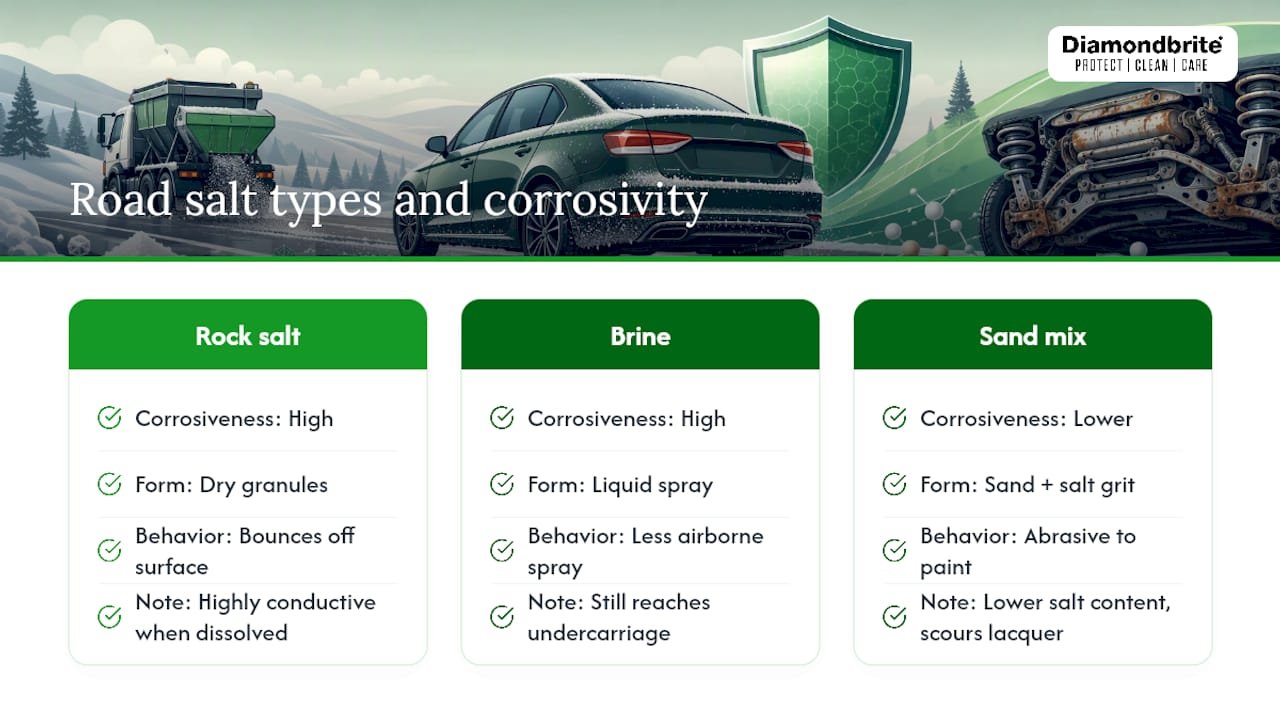
Some authorities use treated salts, brine solutions sprayed pre emptively ahead of forecast frost, or additives that help the salt stick to the road surface rather than bouncing off. Brine tends to produce less airborne spray than dry granules because it is already dissolved, but it still ends up on your car’s underside once traffic churns it up.
A smaller amount of grit used on rural roads and pavements is a sand or grit and salt mix, with lower salt content and correspondingly lower corrosive potential, though it brings its own problem: an abrasive quality that can scour paint and lacquer if it is left to sit rather than washed off promptly.
The practical point for car owners is that all of these variants share the same core mechanism. Whether it arrives as dry granules, brine spray, or a sand mix, sodium chloride dissolved in road moisture is what drives the corrosion, so the type of salt spread matters less than how often you remove it from the car. Frequency of washing beats trying to identify which product the council used.
How should you care for your car once winter ends?
The temptation every spring is to relax once the gritters stop running, but the weeks after the last cold snap matter almost as much as the months during it. Salt residue does not disappear on its own, and it can sit in seams and crevices for months if nobody goes looking for it.
Give the car one thorough deep clean once temperatures settle, with particular attention to the underbody, wheel arches and sills where salt has had all winter to accumulate. This is the point to pull the wheel-arch liners again, clear out anything trapped behind them, and check for any corrosion that started without you noticing.
Spring is also the right time for a proper paint inspection. Look for etching, dulling, or small rust spots that winter grime may have masked, and deal with any chips or scratches before they have a full summer of UV exposure and road grime to worsen them. If you applied a wax or sealant through winter, this is a natural point to strip it back and reapply a fresh protective layer, ceramic or otherwise, so the car heads into summer with a clean base rather than months of degraded protection still sitting on the paint.
Treat post-winter care as the bookend to your pre-season preparation. Skipping it means the next winter starts on top of whatever salt residue and minor damage got left behind, and that compounding effect is exactly how a car that looked fine in March needs sill repairs by the following January.
How does road salt affect metal, paint and rubber differently?
Salt does not attack every material on your car the same way, and knowing the difference helps you prioritise where to spend your effort.
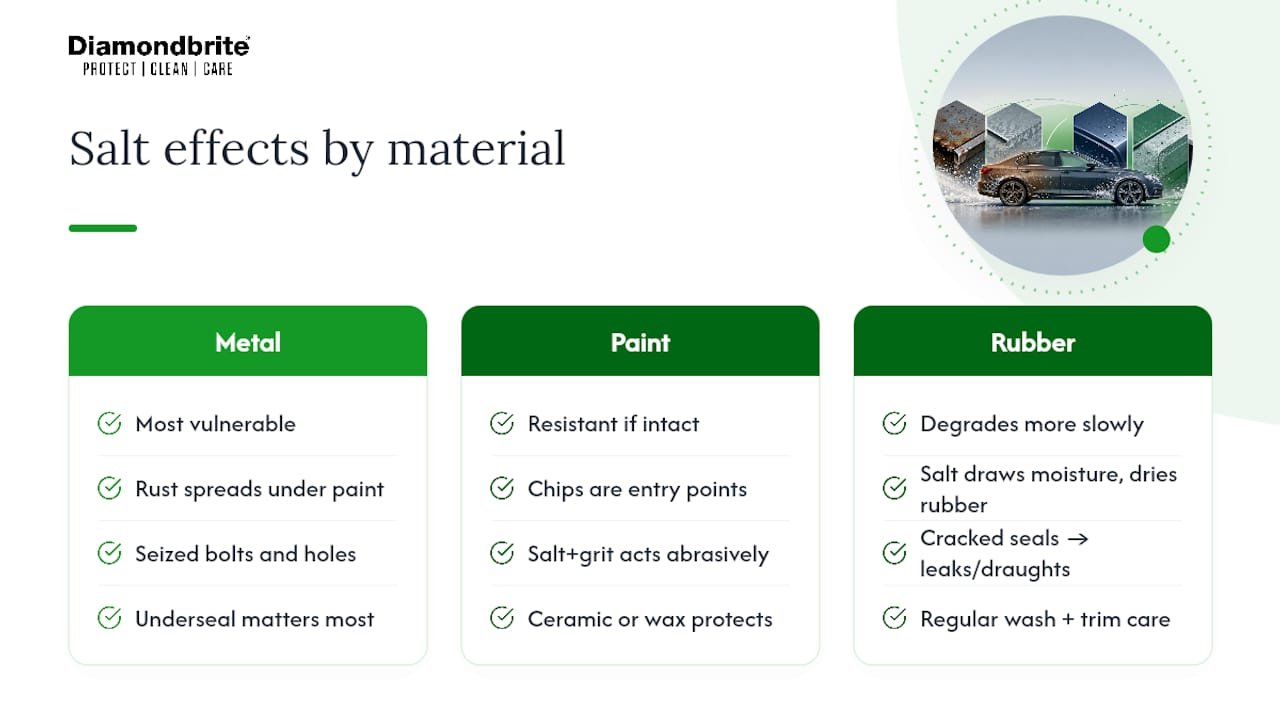
Metal is the most vulnerable. Bare or exposed steel corrodes fastest, and once rust starts, it spreads under paint and coatings rather than staying contained to the original spot. This is why welded joints, fasteners and brake lines feature so heavily in mechanic reports. Surface rust on its own is not always structural, but left unaddressed, corrosion on fasteners and welded joints escalates into seized bolts and, eventually, holes.
Paint suffers differently. Intact, well-maintained paint is fairly resistant to salt in isolation, but salt combined with grit acts almost abrasively during washing, and any existing chip becomes the entry point for the corrosion that follows. A ceramic layer’s main contribution here is reducing how much salt actually clings to the surface, which cuts down the abrasive contact time.
Rubber and plastic trim degrade more slowly but are not immune. Salt draws moisture and speeds up the drying and cracking of door seals, trim, and rubber suspension bushes over several winters, which is part of why older cars start to develop water leaks and cabin draughts that were not there a few years earlier.
Understanding which material you are protecting changes what treatment makes sense. Underseal matters most for metal. Ceramic and wax matter most for paint. Regular washing and occasional trim conditioning matter most for rubber.
Are there environmentally friendly alternatives to road salt?
Rock salt is corrosive to more than car bodies. Runoff affects soil, waterways and roadside vegetation, and that environmental cost is part of why several councils and highways researchers have looked at alternatives over the past decade.
Beet juice and other agricultural byproducts have been trialled as additives that let councils spread less salt while keeping the same de-icing effect, since they help the salt stick to the road surface rather than bouncing into verges. Calcium magnesium acetate is another option researched as a less corrosive alternative, though it costs considerably more than rock salt, which has limited how widely it has been adopted.
Pre-wetted salt, brine sprayed ahead of frost rather than dry granules applied after ice has formed, is already used by many UK authorities. It generally uses less total salt for the same effect because it does not bounce or scatter the way dry granules do.
None of this changes what you need to do as a car owner in the near term. Whatever mix ends up on the road surface near you, it still needs removing from your car regularly. The environmental conversation about road salt is one for councils and policymakers. Your defence stays the same: wash it off before it has time to work.
Why ceramic care and salt protection go together
Salt protection and paint care are usually treated as separate jobs, and that is a mistake. A hydrophobic ceramic layer changes how salt behaves on the surface before it ever gets the chance to sit and corrode. Ceramic-treated finishes resist contaminants and are noticeably easier to clean, which means the salt you wash off actually comes off, rather than leaving a film behind that slowly etches the clear coat over a winter of repeated exposure.
That is where a product like Diamondbrite’s Ceramic Glaze and Ceramic Shampoo earns its place in the routine described above. Applied before the season starts, the glaze gives salt less to bond to. The shampoo then keeps reinforcing that barrier on every wash rather than stripping it away, which is the opposite of what a harsh, generic shampoo does over a winter of repeated use.
— Will
Get your winter defence sorted before the first grit lorry runs
Everything above works best when the products doing the job are actually built for it, not a generic all-purpose shampoo that strips protection as fast as you apply it. Diamondbrite’s ceramic range is designed specifically to keep salt from bonding to paint and wheels in the first place, which is the part of winter protection most owners get wrong: they wash hard but protect lightly.
Start with Ceramic Glaze applied before the first cold snap, so your paint has a hydrophobic barrier in place before any salt reaches it. Pair it with a proper pre-wash to lift grime before it scratches the surface, and use a safe wheel cleaning routine to protect coated alloys through the grittiest months. If you already run a ceramic finish, keep it performing with the right maintenance routine rather than letting winter washes wear it down unchecked. Head to the Diamondbrite shop to build a kit around your car before the gritters start running.
Sources
- Road salt: how does it affect your car? | CarRust
- Gritted roads: how to protect your car from winter salt | Haynes
- Potholes and road salt: the hidden winter damage to your car | Your Local Mechanic
- CAR’s top rated car cleaning products 2026 – all tested by experts | CAR Magazine
FAQ
How do you protect a car against road salt?
Wash the car every one to two weeks through salt season with a full underbody blast, and apply a protective coating such as ceramic glaze or wax before winter starts so salt has less chance to bond to the surface.
What is the best way to protect my car from salt?
The most reliable approach combines regular underbody washing with a layered defence: professional underseal for hidden metal, and a hydrophobic surface protection like Diamondbrite’s Ceramic Glaze for paint and wheels.
What time of year should you rustproof your car?
Rustproof or underseal your car in autumn, before the first grit lorries run, so the protective barrier is already in place when salt exposure begins.
What are the downsides of using road salt?
Road salt accelerates metal corrosion by three to four times compared with unsalted roads, damages roadside soil and waterways through runoff, and can dry out rubber seals and trim over successive winters.