

Traffic Film Remover is safe to use on modern vehicle surfaces when you choose the right formulation, dilute it correctly, and rinse it off thoroughly before it dries. Three conditions govern that safety: the formulation type (non-caustic versus caustic), the dilution ratio you mix, and how you apply and remove it. Get those three right, and TFR is one of the most effective pre-wash tools available. Get them wrong, and even a well-regarded product can dull paintwork or strip protective coatings.
The sections below walk you through the chemistry, surface compatibility, a step-by-step safe-use procedure, UK regulatory considerations, and guidance on which product types suit coated vehicles.
Key takeaways
TFR is safe for modern vehicle surfaces when you use a non-caustic formulation, dilute it correctly, and rinse thoroughly before it dries.
| Point | Details |
|---|---|
| Choose non-caustic as default | Neutral-pH TFR is generally safer for routine use on various sensitive vehicle surfaces. |
| Dilute accurately | Dilution should be done according to product instructions, considering soiling levels. |
| Spot-test unfamiliar surfaces | Always test on an inconspicuous area using the most dilute recommended solution before full application. |
| Never let product dry on panels | Work carefully to keep dwell time brief and rinse thoroughly to prevent drying. |
| Consult SDS and COSHH guidance | Always review safety data and comply with relevant handling and documentation requirements. |
| Diamondbrite for coated vehicles | Diamondbrite’s pH-neutral car care range is designed to be safe with ceramic and polymer coatings. |
Table of Contents
- What is traffic film, and what does TFR actually remove?
- How does TFR chemistry work, and why does dilution matter?
- Which surfaces is TFR safe on, and where do you need to be careful?
- How to use TFR safely: dilution, application, and rinse
- PPE, SDS/COSHH, and UK environmental rules
- Is TFR safe on ceramic coatings and specialist finishes?
- The case for caution over confidence
- Diamondbrite’s pH-neutral options for safe vehicle cleaning
- Sources
- FAQ
What is traffic film, and what does TFR actually remove?
Traffic film is the grey-brown layer of bonded contamination that builds up on vehicle surfaces during normal road use. It is not simply dirt. The deposit is a mixture of road grime, brake dust, diesel soot, tyre rubber particles, atmospheric oils, and mineral deposits from road spray. Left untreated, it bonds to paintwork and accelerates corrosion, particularly around wheel arches and lower panels.
TFR products are formulated specifically to break down and lift this bonded layer. The main types you will encounter are:
- Standard-strength TFR — ready-to-use or lightly concentrated; suitable for routine washing on most vehicle types.
- Concentrated TFR — requires dilution before use; more economical for fleet operations, but demands accurate mixing.
- Neutral-pH / non-caustic TFR — the safest option for regular use, particularly on coated, aluminium, or sensitive surfaces.
- Caustic / heavy-duty TFR — contains strong alkalis and cuts through severe grease and industrial deposits; requires tighter handling controls and is not recommended for routine washing.
The practical safety trade-off is straightforward: non-caustic TFRs are generally safer for routine use and more forgiving on sensitive paintwork, aluminium, and protective coatings, while caustic products are more aggressive and demand stricter controls.
How does TFR chemistry work, and why does dilution matter?
TFR products lift road contamination through a combination of alkaline chemistry and surfactant action. The alkaline component raises the pH of the solution, which breaks the bond between oily, greasy deposits and the vehicle surface. Surfactants then surround the loosened particles and hold them in suspension so they rinse away cleanly.
pH is the practical measure you need to understand. A neutral pH sits at 7. Most non-caustic TFRs sit in the mildly alkaline range, which is effective on road grime without posing a significant risk to clear-coat or protective layers. Caustic products sit much higher on the pH scale, which is why the main chemical distinction centres on the presence of strong alkalis such as sodium hydroxide — caustic products remove heavy grease effectively but raise the risk to delicate finishes if misused.
Dilution controls both the cleaning action and the risk. A concentrated TFR at full strength is not inherently more damaging than a diluted one — the damage risk comes from applying it at the wrong concentration for the surface. Mixing too strong a solution, or using a caustic product where a neutral one would do, is where most problems begin. For routine fleet washing and owner use, a non-caustic or neutral-pH formulation is the sensible default.
Which surfaces is TFR safe on, and where do you need to be careful?
TFR is safe on various vehicle materials including paint, glass, plastic, and metal when the product is chosen correctly and applied per manufacturer guidance. The table below gives a quick-reference compatibility summary.
| Surface | Risk level | Key caveat |
|---|---|---|
| Modern clear-coat paintwork | Safe | Use non-caustic; rinse before drying |
| Glass | Safe | Avoid prolonged dwell time |
| Plastic trims | Safe with caution | Test spot first; avoid caustic products |
| Powder-coated wheels | Safe with caution | Short dwell time; rinse thoroughly |
| Bare/untreated aluminium | Caution | Caustic TFR can etch; use neutral pH only |
| Ceramic or polymer coatings | Caution | pH-neutral only; short dwell; check SDS |
| Vinyl wraps | Caution | Low-pressure application; avoid caustic |
| Matte finishes | Caution | Non-caustic only; no abrasive rinsing |
| Fresh wax or sealant layers | Caution | TFR may strip; check product compatibility |
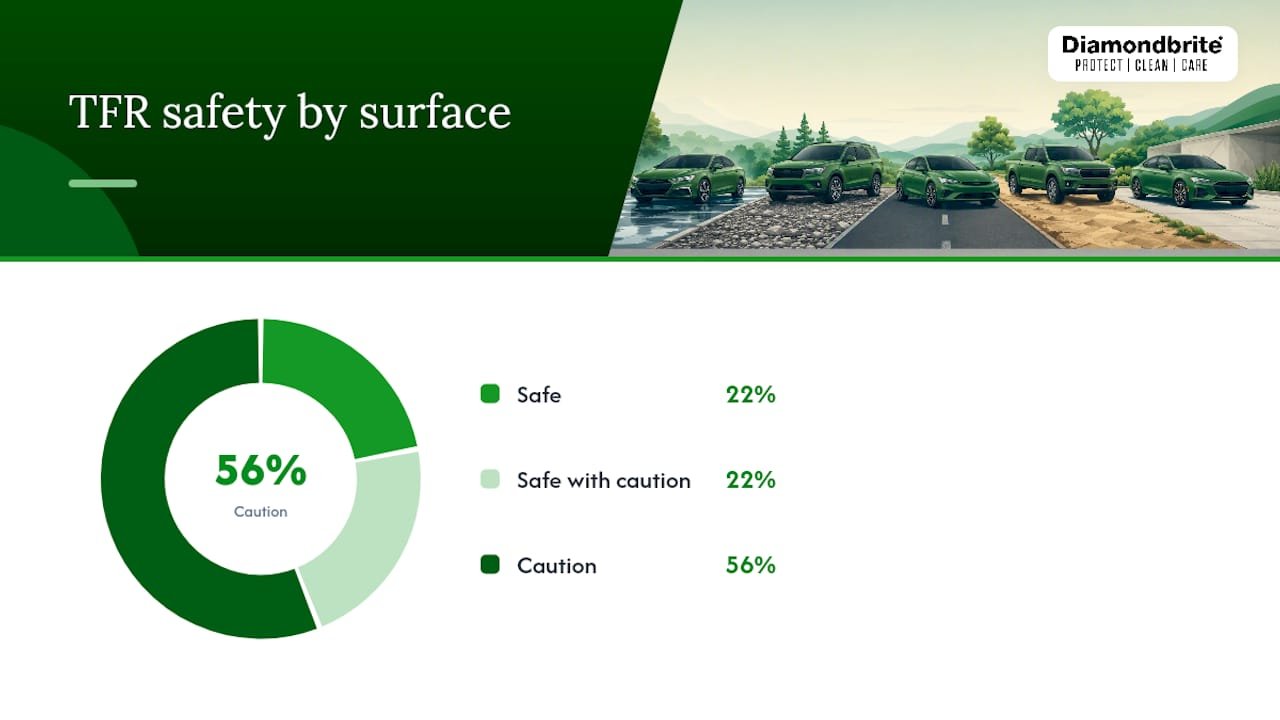
Higher-risk scenarios deserve a specific mention. Untreated aluminium reacts with strong alkalis, so caustic TFR can cause surface etching. Matte finishes and vinyl wraps are sensitive to both chemistry and pressure, so a non-caustic product at a conservative dilution is the only appropriate choice. Vehicles with a fresh wax or sealant layer may lose that protection after TFR treatment, which is worth factoring into your maintenance schedule.
Spot-test protocol
Before applying any TFR to an unfamiliar surface or a new product for the first time, run a quick spot test:
- Mix the TFR at the manufacturer’s most dilute recommended ratio.
- Apply a small amount to an inconspicuous panel area (inside a door jamb or lower sill).
- Leave for no more than 60 seconds, then rinse thoroughly.
- Inspect for any colour change, dulling, or surface texture change once dry.
- If no adverse reaction appears, proceed with the full wash at that dilution.
How to use TFR safely: dilution, application, and rinse
Used at the correct dilution and with proper technique, TFR is one of the safest and most effective pre-wash options available. The steps below apply to both fleet operations and single-vehicle use.
Dilution reference
| Application type | Typical dilution ratio | Notes |
|---|---|---|
| Light soiling / routine wash | 1:80 to 1:100 | Most non-caustic products; safe for coated vehicles |
| Moderate soiling | 1:80 | Standard fleet pre-wash |
| Heavy soiling / fleet | 1:20 | Caustic products only where necessary; strict controls |
All ratios are typical and product-dependent. Always follow the manufacturer’s TDS/SDS for the specific product you are using.
Step-by-step safe application
- Check the vehicle and conditions. The panels must be cool to the touch and out of direct sunlight. Never apply TFR to a hot surface.
- Pre-rinse the vehicle. A thorough rinse with clean water removes loose debris and cools the surface, reducing the risk of the product drying prematurely.
- Mix the solution. Measure the TFR concentrate and water accurately using the dilution ratio from the product TDS. Add concentrate to water, not the reverse.
- Apply evenly. Use a foam lance attached to a pressure washer, a low-pressure fan nozzle, or a manual pump sprayer. Work from the bottom of the vehicle upwards to prevent streaking.
- Allow dwell time. Leave the product on the surface for 1–5 minutes, depending on soiling level and product instructions. Do not let it dry. In warm weather, work in smaller sections.
- Agitate if needed. For stubborn deposits on wheel arches or lower sills, a soft brush can help lift contamination without scratching.
- Rinse thoroughly. Use a pressure washer at a safe working distance (typically 30–50 cm) to remove all product residue. Work from the top of the vehicle downwards. A second rinse pass is good practice.
- Inspect the surface. Check that no product remains in recesses, door shuts, or around trim edges.
Correct dilution, cool and wet panels, and controlled dwell time are the keys to safe use — problems most often arise from over-concentration, letting product dry, or applying to hot panels.
Equipment checklist
- Foam lance or low-pressure fan nozzle
- Pressure washer set to a safe working pressure (typically 80–120 bar for vehicle washing)
- Chemical-resistant gloves and safety glasses
- Accurate measuring jug or dosing pump for concentrates
- Soft detailing brush for wheel arches and recesses
Pro Tip: Never apply TFR in direct sunlight or on panels that are warm from driving. Even a non-caustic product can dry faster than expected in summer conditions, leaving residue that is harder to remove and may mark the surface.
PPE, SDS/COSHH, and UK environmental rules
Any concentrated TFR product used in a professional or fleet setting falls under the Control of Substances Hazardous to Health (COSHH) Regulations 2002, which require you to assess and manage the risks of chemical exposure before use. Even for private owners, reading the Safety Data Sheet (SDS) before handling a concentrated product is straightforward good practice.
PPE and first aid basics:
- Wear chemical-resistant gloves (nitrile or neoprene) and safety glasses whenever handling concentrate.
- If product contacts skin, rinse with plenty of clean water for at least 10 minutes.
- If product enters the eyes, irrigate immediately with clean water and seek medical advice.
- In the event of inhalation of spray mist, move to fresh air. If symptoms persist, seek medical attention.
- Store concentrates in original, labelled containers away from children and foodstuffs.
Environmental and disposal considerations:
Runoff from vehicle washing containing TFR must not enter surface water drains directly. In the UK, the Environmental Permitting (England and Wales) Regulations 2016 and equivalent Scottish and Northern Irish legislation govern trade effluent discharge. For fleet wash bays, a trade effluent consent from your local water company is typically required. For private use, washing on a permeable surface such as grass or gravel allows natural filtration. Choosing a biodegradable, non-caustic TFR reduces the environmental load of any unavoidable runoff.
Regular fleet use of TFR, supported by documented dilution standards and SDS/COSHH records, keeps vehicles in good condition and demonstrates due diligence to operators and site managers.
Is TFR safe on ceramic coatings and specialist finishes?
Yes, provided you use a pH-neutral or non-caustic product and keep dwell times short. Ceramic and polymer coatings are chemically stable, but repeated exposure to high-pH chemistry can gradually degrade the coating’s hydrophobic properties. A neutral-pH TFR avoids that risk entirely.
Neutral TFR formulations made from bio-based cleaners with anti-deposition agents are non-corrosive to both ferrous and non-ferrous metals, and manufacturers publish TDS/PDS documents confirming non-caustic status — always check these before applying any product to a coated vehicle.
Compatibility checklist for coated vehicles:
- Use a pH-neutral or non-caustic TFR only.
- Dilute at the conservative end of the manufacturer’s recommended range (1:80 to 1:100 for routine use).
- Apply with a foam lance at low pressure; avoid high-pressure direct jets on coated panels.
- Keep dwell time to 1–3 minutes maximum.
- Rinse thoroughly and follow with a pH-neutral car shampoo to maintain coating integrity.
- Limit TFR pre-wash to when soiling genuinely requires it — weekly or fortnightly for fleet vehicles, less frequently for private cars.
Diamondbrite’s pH-neutral car care range is formulated to work safely alongside ceramic coatings, making it a trusted choice for owners who have invested in long-term paint protection. For matte-finish vehicles, the same principles apply with even greater care; you can find specific guidance in Diamondbrite’s matte paint ceramic coating guide.
The case for caution over confidence
There is a tendency among vehicle owners to treat TFR as a catch-all solution — spray it on, leave it, rinse off, done. The chemistry is effective enough that this often works without visible harm. But “no visible harm” and “no harm” are not the same thing.
The surfaces most at risk are the ones owners are least likely to test: a fresh ceramic coating applied six months ago, a vinyl wrap on a company van, or bare aluminium on a leisure vehicle. These surfaces do not show damage immediately. By the time a matte finish starts to look patchy or a coating loses its beading, the product has already done its work.
The practical answer is not to avoid TFR — it is genuinely one of the most effective pre-wash tools available, and when used correctly and diluted to manufacturer instructions, it is safe for modern vehicle paintwork. The answer is to treat the SDS as a starting point rather than a formality, to spot-test on unfamiliar surfaces, and to default to non-caustic, neutral-pH options unless the soiling level genuinely demands something stronger. That approach protects the vehicle and builds the kind of repeatable, documented practice that fleet managers can rely on.
Diamondbrite’s pH-neutral options for safe vehicle cleaning
If you want a pre-wash and maintenance routine that works safely on coated, wrapped, or sensitive vehicle surfaces, Diamondbrite’s pH-neutral car care products are a practical, trusted starting point.
Diamondbrite formulates its cleaning products specifically for vehicles with ceramic and polymer protection, so you get effective grime removal without the risk of stripping your coating or dulling your finish. Every product comes with clear application guidance, and the technical data is available directly from the Diamondbrite shop before you buy. Browse the range, check the TDS for the product that suits your vehicle type, and order with confidence that the formulation has been developed with British chemistry and real-world vehicle care in mind.
Sources
For product-specific safety information, the manufacturer’s Technical Data Sheet (TDS) or Product Data Sheet (PDS) is the most reliable starting point — it confirms whether a TFR is caustic or non-caustic, its recommended dilution ranges, and any material-specific warnings. The Safety Data Sheet (SDS) covers health, PPE, and disposal requirements and is a legal requirement for any product classified as hazardous.
For UK environmental obligations, the relevant legislation is the Environmental Permitting (England and Wales) Regulations 2016 and equivalent devolved legislation for Scotland and Northern Ireland. Your local water company can advise on trade effluent consent requirements for commercial wash bays.
Diamondbrite’s product pages and technical support are available at Diamondbrite, where you can access application guidance and product-specific information for the full ceramic car care range.
- How to Use Traffic Film Remover Safely on Vehicle Paintwork — LPW Fleet Care
- What is TFR cleaner? | Guide and FAQs — Chela
- Caustic and Non Caustic TFR – What’s the difference??? — HLS Supplies
FAQ
Is TFR cleaner safe to use on my car?
Yes. TFR is safe on modern vehicle paintwork, glass, plastic, and metal when diluted correctly and rinsed off before it dries. Choose a non-caustic, neutral-pH product for routine use.
What chemicals are in TFR?
Most TFR products contain alkaline builders, surfactants, and water. The key distinction is whether the product contains strong alkalis such as sodium hydroxide — caustic products include these and are more aggressive; non-caustic versions use milder alkaline chemistry.
Is TFR the same as a pre-wash?
TFR is a type of pre-wash, but not all pre-wash products are TFR. TFR is specifically formulated to break down bonded traffic film and road contamination before the main wash stage.
Does TFR damage paintwork?
Not when used correctly. Problems arise from over-concentration, applying to hot or dry panels, or using a caustic product on a sensitive surface. Correct dilution, cool panels, and controlled dwell time prevent damage.
Will TFR strip my ceramic coating?
A pH-neutral or non-caustic TFR used at the correct dilution and with a short dwell time will not strip a ceramic coating. High-pH caustic products used repeatedly at strong concentrations can degrade coating performance over time, so always check the product SDS and default to neutral-pH options for coated vehicles.