

Most ceramic sprays protect your paintwork for 1 to 6 months, with premium hybrid or graphene formulas stretching towards 12 months under ideal conditions. The single biggest factor is how and where you wash your car: a garage-kept vehicle washed gently will comfortably outlast one that lives outside and goes through brush car washes. Watch for beading on the bonnet, and top up the moment it starts to fade.
TL;DR:
- Ceramic spray protection typically lasts 1 to 6 months, with premium formulas reaching up to 12 months only under optimal conditions.
- Exposure to UV rays, harsh washes, and chemical contaminants can accelerate the wear of the spray film, reducing its lifespan significantly.
- Beading and slickness tests are more reliable indicators of protection loss than wash counts, which vary depending on washing habits.
- Most daily drivers should reapply ceramic top-ups every 2 to 4 months, with professional coatings suited for multi-year protection.
- A consistent routine of gentle washing and periodic topping with specific products like Diamondbrite Ceramic Shampoo and Glaze can extend spray effectiveness.
Table of Contents
- How long does ceramic spray last by product type?
- What makes ceramic spray protection wear off faster?
- Signs your ceramic spray has worn off
- A maintenance routine that stretches your ceramic spray’s life
- How Diamondbrite fits into a spray maintenance routine
- The short version: what most owners should do
- Why realistic expectations matter more than marketing claims
- Keep the protection going with the right products
- Sources
- FAQ
How long does ceramic spray last by product type?
Not all ceramic sprays are built the same, and the bottle on the shelf next to yours might be protecting a car for half as long, or twice as long, as the one you bought. Understanding which category you own is the first step to setting realistic expectations.
Entry-level spray waxes sit at the bottom of the durability scale, typically lasting 1 to 3 months on a car driven daily. These are quick, easy, and great for a top-up before a show or a sale, but they were never designed for the long haul.
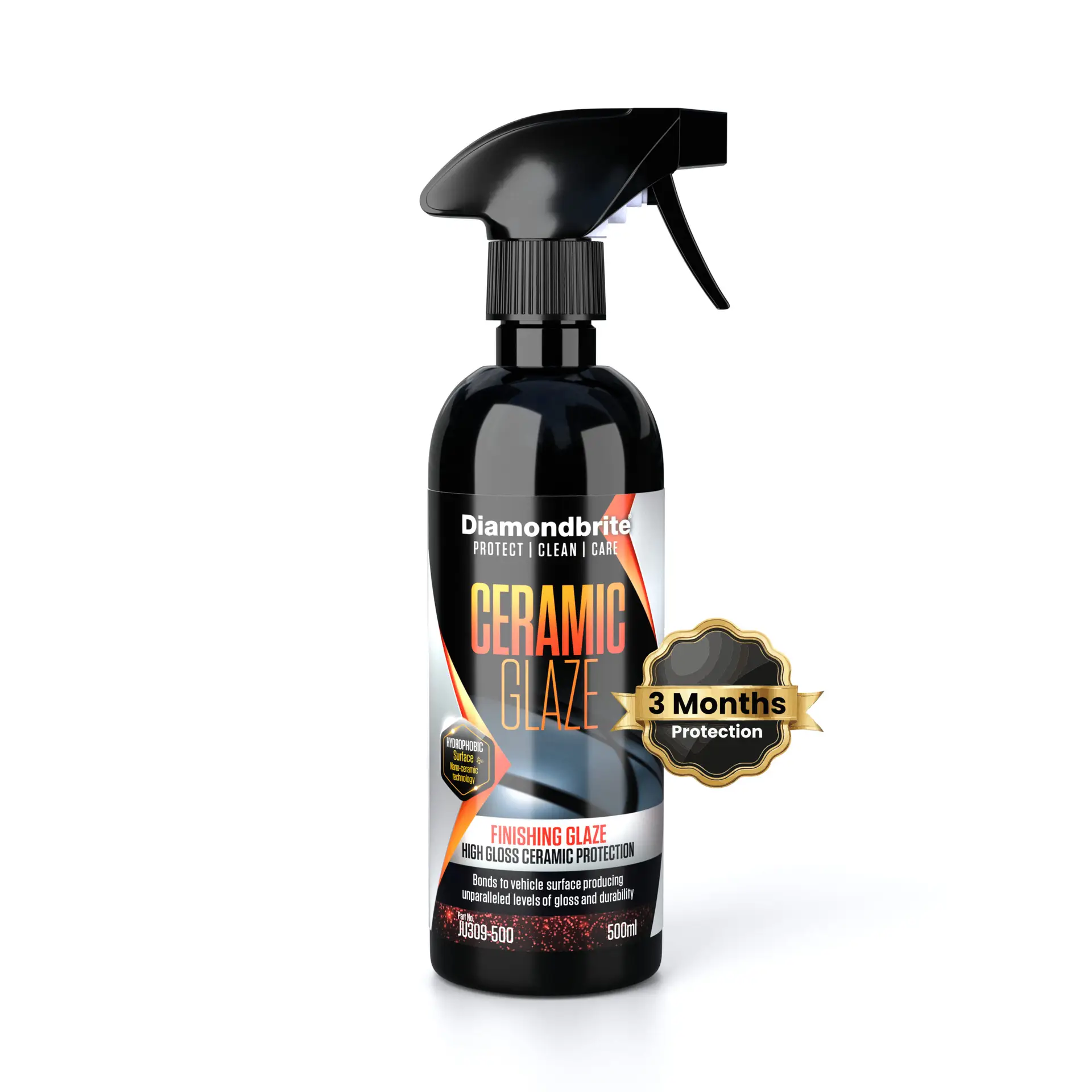
Standard SiO2 sprays, the most common type on UK shelves, usually hold their protective qualities for 3 to 6 months under normal driving and washing conditions. This is the sweet spot most owners land in, and it’s a fair benchmark if you’re trying to work out your own reapplication rhythm.
Premium hybrid and graphene sprays push furthest, with some formulas managing 6 to 12 months in low-wear, garage-kept conditions. That 12-month figure is genuinely achievable, but only under ideal circumstances rather than as a guaranteed baseline.
- Entry-level spray wax: 1 to 3 months
- Standard SiO2 spray: 3 to 6 months
- Hybrid or graphene spray: 6 to 12 months in ideal conditions
The reason for this spread comes down to chemistry, not marketing. A spray deposits a film roughly 0.1 to 0.3 microns thick, compared with the 1 to 3 microns a professionally applied coating builds up. That thinner film, carried mostly by polymers rather than dense SiO2 content, simply has less material to wear through before it gives up its protective qualities.
What makes ceramic spray protection wear off faster?
Two cars using the identical spray, applied on the same day, can end up with wildly different results three months later. The gap almost always comes down to exposure and handling, not the product itself.
- Environmental exposure: UV rays, road salt, bird droppings, and general pollution all break down the protective film over time.
- Mechanical wear: frequent washing, however gentle, still involves contact, and abrasive sponges or dirty mitts accelerate the process further.
- Chemical exposure: strong wheel cleaners and acidic iron removers can strip protection from nearby panels if they’re not rinsed away promptly.
Pro Tip: If you only remember one rule, make it this: skip the automatic brush wash. It’s the fastest way to strip a ceramic spray, and a fortnightly hand wash will do far more for your paintwork’s longevity than any premium product choice.
Signs your ceramic spray has worn off
Your car will tell you when protection is fading, if you know what to look for. The good news is you don’t need lab equipment, just a hose and a bit of attention on a Sunday morning.
- Watch the beading. Water should sit in tight, rounded beads and roll off the panel. Flat sheeting, or water that clings and spreads, is the clearest sign the film has thinned out.
- Run a slickness test. Wipe a clean, dry palm across the bonnet. A properly protected surface feels glassy and slippery; a worn one feels slightly tacky or rough.
- Time your reapplication around real conditions, not a fixed wash count. Garage-kept cars can usually stretch to 3 to 6 months between applications, daily outdoor drivers should think in terms of 1 to 3 months, and cars going through frequent brush washes may need topping up every 4 to 8 weeks.
Wash-count claims on product packaging (“lasts 50 washes”) are notoriously unreliable, since nobody washes identically. Your own beading and slickness checks are a far better guide than any number on a label.
A maintenance routine that stretches your ceramic spray’s life
Getting the most from a spray application is less about the product and more about the habits around it. A consistent, gentle routine will comfortably push your protection towards the top of its realistic range.
- Wash weekly or fortnightly using the two-bucket method with a pH-neutral shampoo, keeping grit out of your wash mitt and away from the paint.
- Use a spray topper between full reapplications to restore beading and gloss without stripping back to bare paint first.
- Avoid automatic brush washes entirely, and steer clear of aggressive degreasers or acidic wheel cleaners on panels near your paintwork.
- Spot-treat contaminants quickly, especially bird droppings and tar, which etch into the film the longer they sit.
If you’re finding yourself reapplying every few weeks no matter how careful you are, that’s often a sign a spray is being asked to do a job better suited to a professional ceramic coating. Sprays work brilliantly as toppers and refreshers between proper applications, but they were never meant to be a permanent, standalone solution.
How Diamondbrite fits into a spray maintenance routine
Diamondbrite’s own range is built around exactly this kind of gentle, repeatable routine. Ceramic Shampoo is formulated as a pH-neutral wash that cleans without stripping existing protection, making it a natural fit for the weekly or fortnightly wash stage described above. Ceramic Glaze, meanwhile, works well as the topper that restores beading between fuller reapplications.
A simple, sustainable schedule many owners settle into looks like this:
- Fortnightly: wash with Ceramic Shampoo using the two-bucket method.
- Quarterly: apply Ceramic Glaze to refresh slickness and beading.
- As needed: spot-clean contaminants the same day they appear.
Diamondbrite reports strong user satisfaction with this kind of routine, with owners noting improved shine and easier upkeep once the habit sticks. Full product details sit on the Diamondbrite shop.
The short version: what most owners should do
For most daily drivers, plan to reapply ceramic spray every 2 to 4 months, treating it as a topper rather than a permanent fix. If you’re reapplying more often than that despite careful washing, or you want protection measured in years rather than months, a professional ceramic coating is the next sensible step. Either way, check your beading this weekend and pencil in your next top-up.
Why realistic expectations matter more than marketing claims
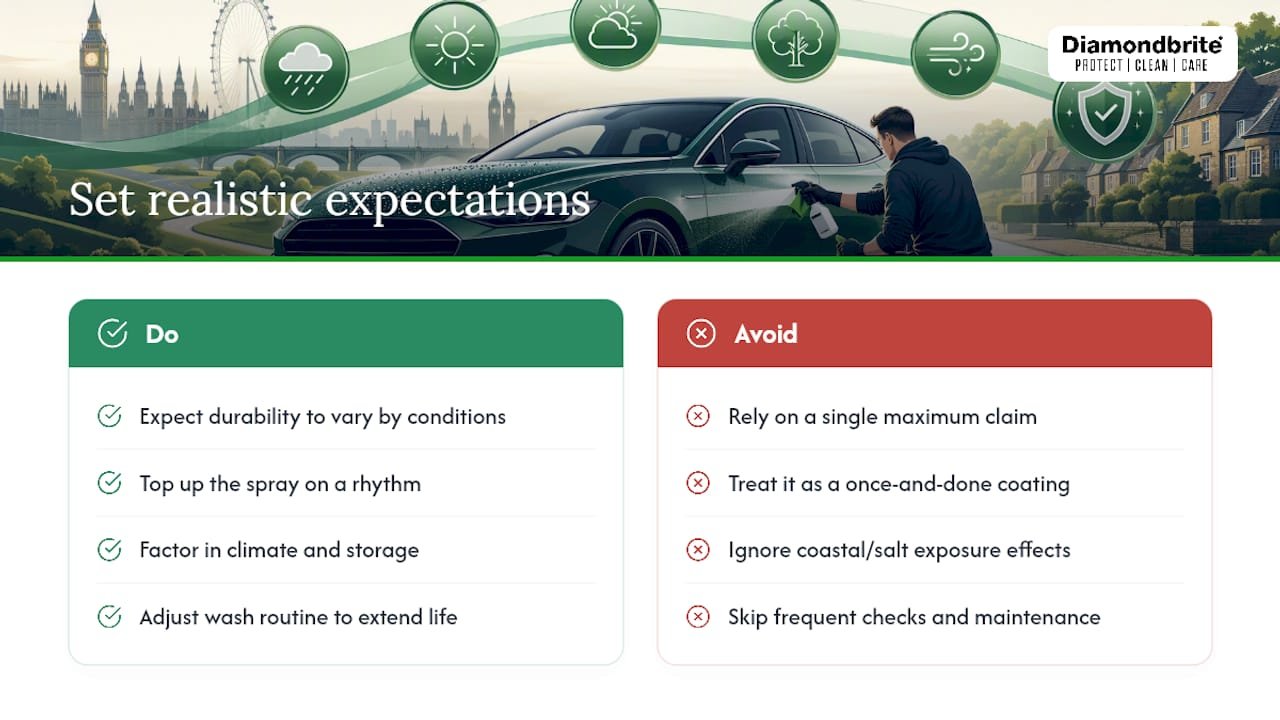
Every bottle wants to tell you its formula lasts longer than the one next to it on the shelf, and technically some of them aren’t lying, they’re just describing a best-case scenario that rarely matches how most of us actually park and wash our cars. The gap between a 12-month claim and a 3-month reality isn’t dishonesty so much as selective framing.
What the evidence actually supports is more useful than any single number: durability is a variable outcome shaped by your climate, your driveway, and your washing habits, not a fixed figure printed on packaging. A car in a coastal, salt-heavy region with no garage will always demand more frequent attention than one tucked away overnight in a dry, temperate spot. Credentials and specific case comparisons will be added here as they become available, but the honest summary holds regardless: ceramic sprays are maintenance tools you top up on a rhythm, not a coating you apply once and forget.
— Will
Keep the protection going with the right products
Diamondbrite gives you a straightforward way to stretch your ceramic spray’s protection without booking in for a professional respray every few months. Where budget haircare-style top-ups leave you guessing at compatibility, Diamondbrite’s Ceramic Shampoo and Ceramic Glaze are designed to work together as a wash-and-topper pair, so you’re not mixing unrelated products and hoping for the best.
A practical starting kit pairs the pH-neutral Ceramic Shampoo for your regular wash with Ceramic Glaze as your quarterly topper, giving you a routine that matches the maintenance schedule set out above. Browse the full range on the Diamondbrite shop and build a kit around your own washing frequency and parking situation.
Sources
FAQ
What are the downsides of ceramic spray?
Ceramic spray wears off far faster than a professional coating, typically within 1 to 6 months depending on conditions, and it won’t correct swirls or deep paint defects since it only adds gloss and hydrophobic performance on top of existing paintwork. It also demands more frequent reapplication than most owners expect from marketing claims.
Is ceramic spray as good as ceramic coating?
No. Sprays deposit a much thinner film, around 0.1 to 0.3 microns compared with 1 to 3 microns for a professional coating, so they can’t match the multi-year durability. Sprays work best as toppers between professional applications rather than replacements for them.
Can I just rinse off my ceramic coated car?
A rinse alone won’t remove bonded contaminants like tar, iron deposits, or bird droppings, which can etch into any protective film if left untreated. A gentle two-bucket wash with a pH-neutral shampoo, such as Diamondbrite Ceramic Shampoo, is a safer routine than rinsing alone or using an automatic brush wash.
How much does it cost to get a 5-year ceramic coat on a car?
Professional ceramic coating pricing varies widely by installer, vehicle size, and paint preparation, so it’s best checked directly with a detailing specialist rather than quoted as a flat figure. If you’re weighing up the cost against ongoing spray maintenance, Diamondbrite’s current product pricing is listed on its shop page.