

You can wash your car with hard water safely, provided you follow one non-negotiable rule: never let tap water dry on the paint. Hard water carries dissolved calcium and magnesium that leave mineral deposits on your clear coat when the water evaporates, and those deposits can bond with and eventually etch into the finish. The practical fix is a spot-free final rinse using deionised (DI) water, followed by immediate drying with a quality microfibre towel.
Three things to do right now:
- Use a pH-neutral, ceramic-safe shampoo every wash to protect any existing coating and reduce mineral adhesion.
- Finish with a DI or distilled water rinse to bring dissolved solids close to zero before drying.
- Dry immediately in the shade. Sun and heat bake mineral residues into paint, turning a simple rinse mark into a stubborn etch.
Key takeaways
A pH-neutral shampoo, a DI final rinse, and immediate drying are the three steps that prevent hard-water spots from forming on your car’s paint.
| Point | Details |
|---|---|
| Use a spot-free final rinse | DI or distilled water (0–5 ppm TDS) prevents mineral deposits forming as the car dries. |
| Choose pH-neutral shampoo | Alkaline products strip coatings; Diamondbrite pH Neutral Car Shampoo cleans safely on coated and uncoated paint. |
| Dry immediately in the shade | Sun and heat bake mineral residues into paint; a microfibre drying towel or blower removes water before spots can form. |
| Protect with a ceramic coating | A hydrophobic layer reduces mineral adhesion and makes spot removal significantly easier between washes. |
| Know when to call a professional | Deep-etched spots that survive light polishing need professional paint correction, not more DIY product. |
Table of Contents
- What does a hard-water car wash checklist look like?
- Why does hard water cause spots and reduce cleaning power?
- How do you test your tap water hardness at home?
- How should you wash your car when your water is hard?
- Which spot-free rinse option suits your situation?
- How do you remove existing hard-water spots safely?
- How does long-term protection reduce hard-water spotting?
- Why do pH-neutral and ceramic-safe shampoos matter?
- What should you buy for a hard-water wash kit?
- An editorial perspective on hard water and realistic expectations
- Diamondbrite products built for hard-water areas
- Sources
- FAQ
What does a hard-water car wash checklist look like?
Follow this sequence every time you wash in a hard-water area and you will cut spotting risk dramatically.
- Prepare your kit: two buckets with grit guards, pH-neutral shampoo, a microfibre wash mitt, a clean drying towel (or blower), and a separate container of DI or distilled water for the final rinse.
- Pre-rinse: rinse the whole car top to bottom with a hose or pressure washer to remove loose grit before any contact wash.
- Two-bucket wash: fill one bucket with shampoo solution, one with plain rinse water. Rinse your mitt in the rinse bucket after every panel.
- Work in sections: wash one panel at a time, top to bottom, so no soapy water sits long enough to dry.
- Rinse thoroughly: flush each panel with fresh water as you go, then do a full final rinse.
- Spot-free final rinse: follow with DI or distilled water over the whole car.
- Dry immediately: use a plush microfibre drying towel or a car blower. Never leave the car to air-dry.
Pro Tip: Keep a 5-litre container of distilled water (available from most UK supermarkets and motor factors) solely for the final rinse. It costs very little per wash and removes the last variable that causes spots, without buying a full DI unit.
Why does hard water cause spots and reduce cleaning power?
Hard water is tap water that contains elevated levels of dissolved calcium and magnesium, picked up as rainwater passes through chalk and limestone geology. When that water evaporates off a car panel, those minerals stay behind as white or chalky deposits. Over time, the deposits bond with the clear coat and can etch into the paint surface, making them progressively harder to remove with a simple wash.
There is a secondary problem that many owners overlook. Calcium and magnesium ions react with the surfactants in car shampoo, reducing foam and cleaning performance. You end up using more product for less result, and any residue left on the panel adds to the mineral load.
Hard-water spotting is most visible on:
- Dark and black paint, where white mineral rings stand out sharply.
- Glass, particularly windscreens and rear screens, where deposits scatter light and reduce visibility.
- Piano black trim and gloss plastic, which shows every mark with no forgiveness.
The UK context matters here. Much of southern and eastern England sits on chalk and limestone, and water hardness in those regions commonly runs well above 200 mg/l (ppm). If you live in London, the East Midlands, or East Anglia, hard-water car detailing is not an occasional concern; it is a routine one.
How do you test your tap water hardness at home?
Knowing your water hardness tells you how aggressive your spot-prevention routine needs to be.
- TDS meter: a handheld total dissolved solids meter (widely available online for under £15) gives an instant reading in ppm. It measures all dissolved solids, not just calcium, but it is a reliable proxy for spotting risk.
- Water hardness test strips: purpose-made strips (sold by aquarium and pool suppliers) give a colour-coded calcium hardness reading in minutes.
- Water authority lookup: every UK water company publishes hardness data by postcode allowing you to check local water values. Search your supplier’s website for “water hardness” and enter your postcode for a precise figure.
What the numbers mean for your wash routine:
| Hardness (mg/l / ppm) | Classification | Spotting risk | Recommended action |
|---|---|---|---|
| Below 50 | Soft | Low | Standard wash; dry promptly |
| 50–100 | Moderately soft | Low–moderate | pH-neutral shampoo; dry promptly |
| 100–200 | Hard | Moderate–high | DI final rinse recommended |
| Above 200 | Very hard | High | DI final rinse every wash; consider sealant or ceramic coating |
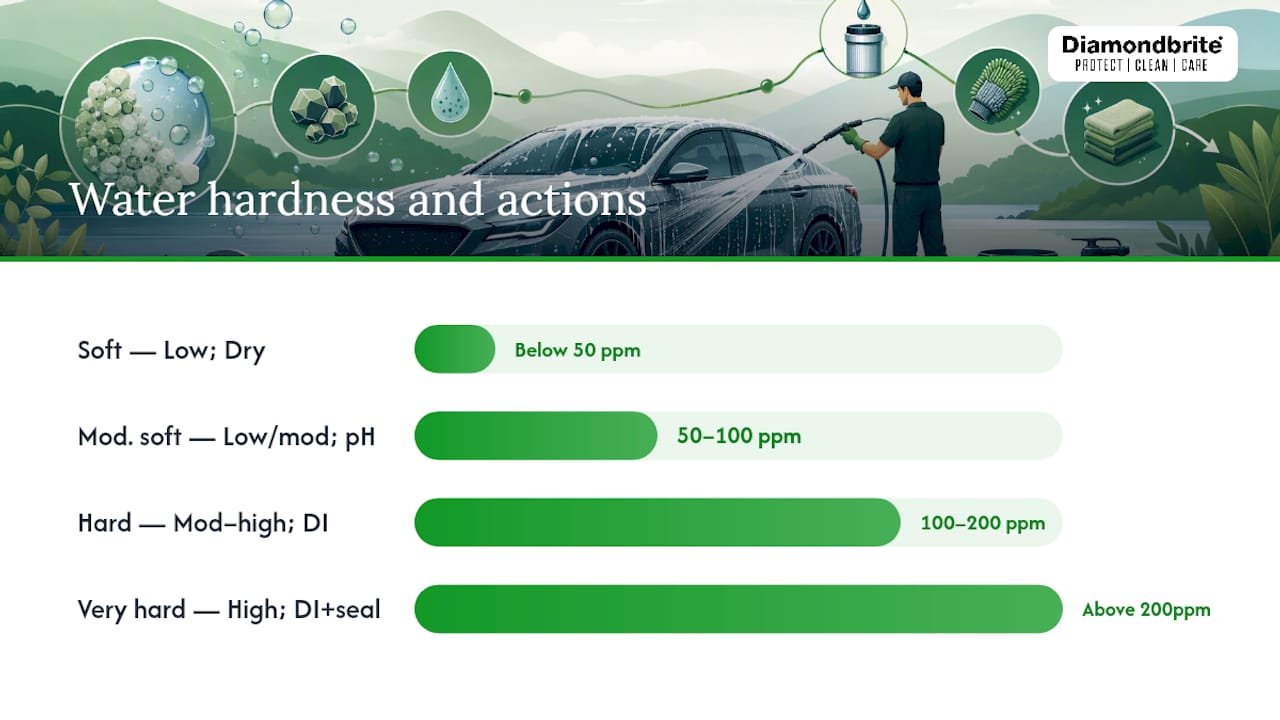
Much of southern England has water hardness levels generally considered very hard. If your TDS meter reads above the moderate to hard range, treat a spot-free final rinse as standard practice rather than optional.
How should you wash your car when your water is hard?
A two-bucket method with grit guards and a pH-neutral shampoo is the foundation of any hard-water wash routine. Here is the full sequence.
- Park in the shade. Direct sun raises panel temperature and speeds evaporation, giving minerals less time to drain away before they bond.
- Pre-rinse top to bottom. Flush loose dirt and grit from the roof down. This prevents abrasive particles from scratching paint during the contact wash.
- Mix your shampoo solution. Use a pH-neutral shampoo at the manufacturer’s recommended dilution in your wash bucket. Overly concentrated solution is harder to rinse fully and leaves more residue.
- Wash one panel at a time. Start at the roof and work down. After each panel, rinse your mitt in the clean-water bucket before reloading with shampoo solution.
- Rinse each panel before moving on. Do not let soapy water sit and dry. A quick flush with the hose after each section keeps the surface wet and mineral-free.
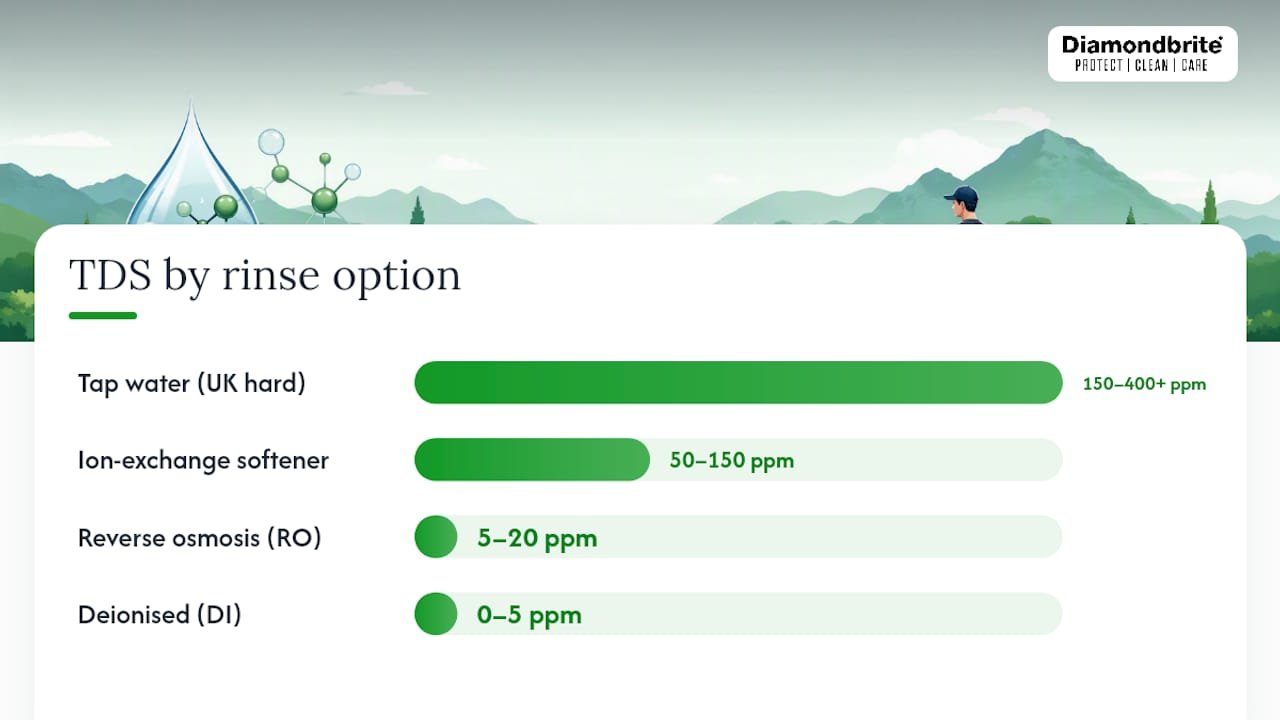
- Full rinse, then spot-free final rinse. After washing the whole car, do a thorough hose rinse, then follow with DI water for the final pass. DI water typically reads 0–5 ppm TDS, compared with 150–400+ ppm in many UK tap supplies.
- Dry immediately. Use a large, plush microfibre drying towel in straight, overlapping passes. A car blower is even better as it eliminates contact entirely.
A few things to avoid:
- Washing in direct sunlight or on a hot bonnet.
- Leaving rinse water to sheet off and air-dry.
- Using washing-up liquid or household cleaners, which strip protective coatings and leave their own residues.
Pro Tip: If you only have a limited supply of DI water, use it for the final rinse on the roof, bonnet, and boot lid first. These horizontal panels collect the most standing water and are where spots form fastest.
Which spot-free rinse option suits your situation?
Not all “soft” water alternatives deliver the same result. Here is how the main options compare.
| Option | Typical TDS output | Spot-free result | Practical notes |
|---|---|---|---|
| Tap water (UK hard areas) | 150–400+ ppm | No | Baseline; causes spots |
| Ion-exchange softened water | 50–150 ppm | Partial | Reduces calcium but leaves sodium ions; better lather, not truly spot-free |
| Reverse osmosis (RO) water | 5–20 ppm | Good | Requires a plumbed RO unit; slower flow rate |
| Deionised (DI) water | 0–5 ppm | Excellent | Best for final rinse; portable DI units available |
| Distilled water (bottled) | Near 0 ppm | Excellent | Convenient for small volumes; cost rises with frequency |
A key point worth noting: ion-exchange softeners reduce calcium hardness but leave sodium ions and other dissolved solids in the water. They improve shampoo lathering but do not deliver a truly spot-free final rinse the way DI or reverse osmosis does.
- Portable DI units (resin-filled canisters that attach to a hose) are the most practical choice for regular home washers. Replace or regenerate the resin when your TDS meter reads above 5 ppm; in very hard-water areas, that can mean every 40–50 final rinses.
- Bottled distilled water suits owners who wash fortnightly or less. A 5-litre bottle covers one full final rinse comfortably.
- Mobile DI services (where a detailer brings a DI rig to you) make sense for occasional deep cleans or before applying a new coating.
Pro Tip: Always monitor your DI unit’s output with a TDS meter. Resin exhausts gradually and silently; by the time you see spots returning, the resin has been spent for several washes.
How do you remove existing hard-water spots safely?
Before reaching for an abrasive, identify what type of spot you are dealing with. The treatment differs significantly.
Type 1: Surface mineral deposits. These sit on top of the clear coat and have not yet etched into it. They feel slightly rough to the touch but the paint underneath is intact.
Type 2: Etched spots. These have chemically bonded with or physically damaged the clear coat. They appear as dull rings or craters that remain visible even after washing.
Work through these steps in order, stopping as soon as the spots clear:
- Thorough pH-neutral wash. Sometimes fresh deposits lift with a proper wash and DI rinse alone.
- Diluted white vinegar solution. A 50/50 mix of white vinegar and DI water applied with a microfibre cloth can dissolve surface calcium deposits. Work on a cool panel, leave for 30–60 seconds, then rinse thoroughly. Do not use on bare metal or matte finishes.
- Clay bar treatment. A detailing clay bar removes bonded surface contamination that washing and mild acids cannot shift. Use with a clay lubricant and light pressure.
- Dedicated water-spot remover. Purpose-made products contain mild acids or chelating agents formulated for paint-safe use. Follow the product instructions carefully.
- Light machine polish. For persistent Type 1 spots or early Type 2 etching, a light polish with a dual-action polisher removes a very thin layer of clear coat to level the surface. Use the least abrasive compound that works.
When to stop and call a professional:
- Deep etching that remains after light polishing.
- Spotting that covers large areas of the bonnet or roof.
- Any uncertainty about the depth of damage before polishing further.
A note on glass: 0000-grade steel wool is sometimes used on glass (not painted surfaces) to remove mineral deposits, but always test a small, inconspicuous area first and use with a dedicated glass cleaner.
How does long-term protection reduce hard-water spotting?
A hydrophobic protective layer changes how water behaves on your paint. Instead of sheeting flat and leaving a mineral film as it evaporates, water beads up and rolls off, carrying minerals away. The stronger and more durable the protection, the less opportunity minerals have to bond.
- Wax provides a basic hydrophobic layer and makes spot removal easier, but it degrades within weeks in UK weather and needs regular reapplication.
- Paint sealants last longer than wax (typically several months) and offer better chemical resistance, making them a practical step up for hard-water areas.
- Ceramic coatings build a durable, semi-permanent shield that repels water and contaminants far more effectively than wax or sealant. A well-maintained ceramic coating means mineral deposits sit on the coating surface rather than bonding with the clear coat, so they wipe away more easily. Ceramic coatings also make the ceramic coating maintenance routine simpler between full washes.
Maintenance cadence matters. Even the best ceramic coating loses hydrophobic performance if it is washed with alkaline or harsh shampoos. Use a pH-neutral, ceramic-safe shampoo every wash, and apply a ceramic maintenance spray (such as Diamondbrite Ceramic Glaze) every few weeks to top up the water-beading effect. Check the beading behaviour after each wash; if water no longer beads sharply, it is time for a maintenance top-up.
Why do pH-neutral and ceramic-safe shampoos matter?
Alkaline shampoos strip protective coatings. Even a single wash with a high-pH product can degrade a wax or sealant layer, and repeated use shortens the life of a ceramic coating measurably. In hard-water areas, where you are already fighting mineral adhesion, stripping your protection at the same time is a costly mistake.
Diamondbrite formulates pH-neutral, ceramic-safe shampoos specifically to clean without attacking protective layers. Here is how to use the key products correctly:
- Diamondbrite pH Neutral Car Shampoo: dilute as directed (check the product label for the current ratio), apply with a microfibre mitt using the two-bucket method, and rinse thoroughly. Its neutral pH means it lifts dirt without softening or stripping any underlying coating.
- Diamondbrite Ceramic Shampoo: formulated for cars with an existing ceramic coating. It cleans and deposits a light ceramic-infused layer with each wash, maintaining the hydrophobic surface between full coating applications. Use at the recommended dilution and rinse fully.
- Diamondbrite Ceramic Glaze: a spray-on maintenance product applied after washing and drying. It refreshes the water-beading performance of a ceramic coating and adds a layer of gloss. Apply to a clean, dry panel, spread evenly, and buff lightly.
Pro Tip: After a DI final rinse, apply Diamondbrite Ceramic Glaze while the panel is still slightly damp. The product bonds well to a clean, mineral-free surface and the result is noticeably sharper beading on the next wash.
What should you buy for a hard-water wash kit?
A focused shopping list keeps costs down and avoids the common mistake of buying products that work against each other.
Essentials:
- Diamondbrite pH Neutral Car Shampoo — the foundation of every wash; safe on coatings and effective in hard water.
- Two wash buckets with grit guards — non-negotiable for a scratch-free contact wash.
- Microfibre wash mitt — softer on paint than sponges and holds more shampoo solution.
- Large microfibre drying towel — a plush, high-GSM towel lifts water without dragging minerals across the surface.
Recommended additions:
- Portable DI canister or 5-litre distilled water — for the spot-free final rinse.
- TDS meter — to monitor your DI resin and tap water hardness (under £15 online).
- Clay bar kit — for periodic decontamination of bonded surface deposits.
- Dedicated water-spot remover — for tackling Type 1 deposits between full decontamination sessions.
- Diamondbrite Ceramic Glaze — maintenance spray to keep hydrophobic performance high between full coating applications.
What to avoid: household washing-up liquid (strips coatings and leaves residues), strong acid-based wheel cleaners on painted surfaces, and any shampoo with a pH above 9 if your car has a wax, sealant, or ceramic coating.
An editorial perspective on hard water and realistic expectations
There is a gap between what most car care guides promise and what a typical UK owner can realistically achieve on a Sunday morning. The advice to “always use DI water for the whole wash” sounds ideal in theory, but carrying 50 litres of deionised water to a driveway wash is not how most people actually work.
The practical truth is that the final rinse is where DI water earns its keep. Everything before that, the pre-rinse, the two-bucket wash, the full hose rinse, can use tap water without disaster, provided you work quickly and in the shade.
The other thing guides underplay is protection. Owners who invest in a quality ceramic coating and maintain it with a pH-neutral shampoo find that hard-water spotting becomes a minor inconvenience rather than a recurring battle. Mineral deposits simply do not grip a well-maintained hydrophobic surface the way they grip bare or wax-stripped paint. The coating does not eliminate the problem, but it changes the scale of it entirely.
Realistic expectation for a DIY owner: with a good routine, the right shampoo, and a DI final rinse, you can keep your car spot-free between washes. Deep etching from years of neglect is a different matter and genuinely needs professional paint correction. Know which problem you have before spending money on products.
Diamondbrite products built for hard-water areas
Hard-water spotting is one of the most common complaints from UK car owners, and the solution does not require an expensive professional visit every time. Diamondbrite’s ceramic-safe, pH-neutral range is built precisely for this situation: products that clean effectively without stripping the protection you have already invested in.
The Diamondbrite pH Neutral Car Shampoo is the right starting point for any coated or uncoated car in a hard-water area. Pair it with Diamondbrite Ceramic Glaze to maintain hydrophobic performance between washes, and your panels will shed water and minerals far more readily after every rinse. Both products are available directly from the Diamondbrite online shop, alongside the full ceramic care range. Browse the product pages, check the dilution guidance, and pick up the combination that fits your current protection setup.
Sources
FAQ
Is it safe to wash a car with hard water?
Yes, provided you do not let the water dry on the paint. Use a pH-neutral shampoo, rinse thoroughly, follow with a DI or distilled water final rinse, and dry immediately to prevent mineral deposits forming.
How do you treat hard water for washing a car?
The most effective approach is a deionised water final rinse, which brings dissolved solids to 0–5 ppm and allows the car to dry without leaving mineral residue. For the main wash, a pH-neutral shampoo such as Diamondbrite pH Neutral Car Shampoo reduces the impact of hard water on foam and cleaning performance.
Can a regular car wash remove hard-water spots?
A standard wash removes fresh, surface-level deposits. Older or etched spots need a dedicated treatment: a diluted white vinegar solution for surface deposits, a clay bar for bonded contamination, or light polishing for early etching. Deep etching requires professional paint correction.
What is the best car wash soap for hard water?
A pH-neutral, ceramic-safe shampoo is the right choice for hard-water areas. It cleans effectively without stripping protective coatings, reducing the mineral adhesion that causes spotting. Diamondbrite pH Neutral Car Shampoo and Diamondbrite Ceramic Shampoo are both formulated with this in mind.