

Rinse top to bottom, wash with a caravan-safe pH-neutral shampoo, then dry and protect while the caravan sits in shade. Skip household detergents and go easy with the pressure washer, especially around seals. That single sequence, backed by the two-bucket method and a proper ceramic finish, will get your caravan looking showroom-fresh in under an hour.
- Rinse first to lift loose grit before it scratches the panels.
- Wash roof to wheels using a pH-neutral shampoo like Diamondbrite pH Neutral Car Shampoo.
- Dry in shade, then seal the finish with a ceramic protectant.
Key Takeaways
A clean caravan exterior depends on rinsing top to bottom, washing with a caravan-safe pH-neutral shampoo, and protecting the finish with a ceramic layer while working in shade.
| Point | Details |
|---|---|
| Rinse before washing | Removes loose grit that would otherwise scratch panels during the wash. |
| Use the two-bucket method | Keeps gritty rinse water separate from your wash solution to prevent swirl marks. |
| Avoid pressure washers on seals | High pressure can force water past seals and cause delamination over time. |
| Treat problem spots individually | Black streaks, algae and bird droppings each need their own targeted treatment. |
| Protect with Diamondbrite ceramic products | Diamondbrite pH Neutral Shampoo and Ceramic Glaze build lasting protection into the routine. |
Table of Contents
- How do you prepare to clean a caravan exterior?
- What is the correct step-by-step method to clean caravan exterior panels?
- How do you remove black streaks and other stubborn marks?
- How should you dry and protect a caravan after washing?
- How do you clean caravan wheels and the undercarriage safely?
- How often should you clean a caravan exterior?
- Which products actually belong in a caravan cleaning kit?
- Editorial take: what the standard advice gets wrong
- Get the right products for your next caravan wash
- Sources
- FAQ
How do you prepare to clean a caravan exterior?
Pick a shaded, level spot with decent drainage before you touch a hose. Direct sun bakes shampoo onto the panels and leaves streaks that take twice the effort to shift. Close all windows, roof vents and locker doors, and switch off anything electrical, including the fridge on gas or mains, before water starts flying.
Gather your kit before you start rather than halfway through:
- Hose with an adjustable nozzle
- Two buckets (one wash, one rinse)
- Soft wash mitts or a caravan-specific brush
- An extendable handle for roof reach
- A stable ladder or platform if you need to get up top
- Microfibre cloths and a squeegee
- Gloves and non-slip footwear
Roof work is where most accidents happen, and it’s also where most caravan damage gets done through carelessness. Never step directly on solar panels or roof vents, and always have someone nearby if you’re working at height.
Pro Tip: Test your ladder’s footing on the actual pitch you’re washing on, not on flat tarmac at home. A caravan parked on grass or gravel shifts the whole calculation.
What is the correct step-by-step method to clean caravan exterior panels?
Work top-down, panel by panel, rather than trying to blast the whole side at once.
- Rinse the entire caravan with a hose to remove loose dirt, dust and grit. Skipping this step means you grind abrasive particles into the paint the moment your mitt touches it, which is exactly why trade guides insist on rinsing first.
- Start at the roof and work down in overlapping sections, rinsing each area before moving to the next so dirty run-off never dries on a clean panel below.
- Wash with the two-bucket method. Fill one bucket with a diluted caravan shampoo and one with clean rinse water. Dunk your mitt in the wash bucket, clean a small section, then rinse the mitt in the second bucket before reloading it with shampoo. This is standard detailing practice because it stops grit that’s already come off the caravan from being dragged straight back across the paintwork.
- Dilute according to the bottle, not by eye. Most caravan shampoos, including pH-neutral formulas, are concentrated and only need a capful or two per bucket.
- Move to the sides, then the skirts and lower panels last, since these collect the heaviest road grime.
For the roof itself, use a soft-bristle brush on an extendable pole rather than climbing across the whole surface. Keep well clear of solar panel edges and vent seals, where aggressive scrubbing can lift sealant.
Acrylic windows need a different touch entirely. They scratch far more easily than glass, so:
- Use a dedicated acrylic-safe cleaner, never a household glass spray with ammonia.
- Wipe with a clean, soft microfibre cloth using straight, gentle strokes rather than circular scrubbing.
- Avoid squeegees with hard rubber blades that can nick the surface.
While you’re working panel by panel, run a soft brush along seams, trims and window seals to lift trapped grime before it hardens. Never take a pressure washer to these joints. As caravan maintenance specialists warn, high-pressure jets can force water past seals and cause delamination, a repair far costlier than the ten minutes a hand wash saves you.
How do you remove black streaks and other stubborn marks?
Black streaks, algae and bird droppings each need their own approach rather than a single all-purpose spray.
- Black streaks (usually run-off from roof fittings) respond best to a dedicated black streak remover left to dwell for a few minutes before a gentle wipe. Scrubbing hard rarely helps and can dull the gelcoat around the mark.
- Algae and mould, common in roof gutters and seam lines, need a caravan-safe mould treatment rather than bleach, which can degrade sealant over time.
- Bird droppings and tar should come off as soon as you spot them. Both are acidic or oily enough to etch a finish within days if left, so soak with warm water first, then lift with a soft cloth rather than scraping.
- Chalky, oxidised gelcoat signals sun damage rather than dirt. Light cases lift with a cutting polish; heavier oxidisation is a job for a professional buffer, since DIY abrasion risks thinning the gelcoat permanently. Always test any new product on a small hidden patch first.
How should you dry and protect a caravan after washing?
Dry with a squeegee first to lift the bulk of the water, then finish with clean microfibre towels. Never let shampoo or rinse water dry in direct sun. It flash-dries into mineral streaks that are harder to remove than the dirt you just washed off.
Once dry, you’ve got three real options for protection:
- Traditional wax gives decent shine but breaks down fast under UK weather, often needing reapplication within weeks.
- Polymer sealants last longer than wax and shrug off light rain better.
- Ceramic shampoos and glazes lay down a hydrophobic film during the wash itself, which is why products like TENZI’s ceramic camper shampoo have become popular for reducing how often you need to wash at all.
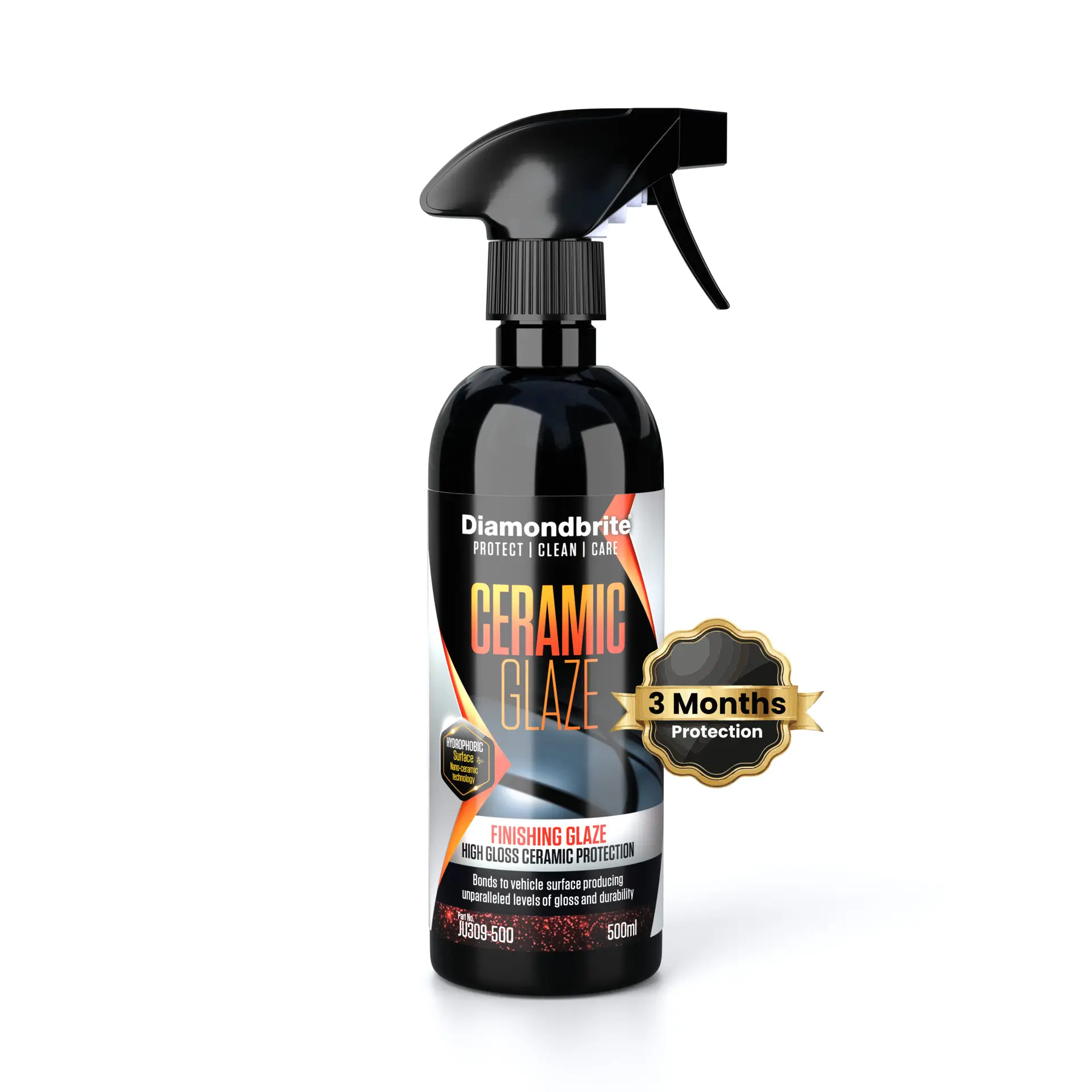
For a routine that combines cleaning and protection in one pass, Diamondbrite pH Neutral Car Shampoo followed by Diamondbrite Ceramic Glaze gives you a caravan-safe wash and a durable, glossy barrier in the same session, cutting future cleaning time significantly.
Pro Tip: Apply ceramic glaze in small overlapping sections and buff before it fully hazes over. Rushing the whole side at once is the most common reason people end up with patchy finish.
How do you clean caravan wheels and the undercarriage safely?
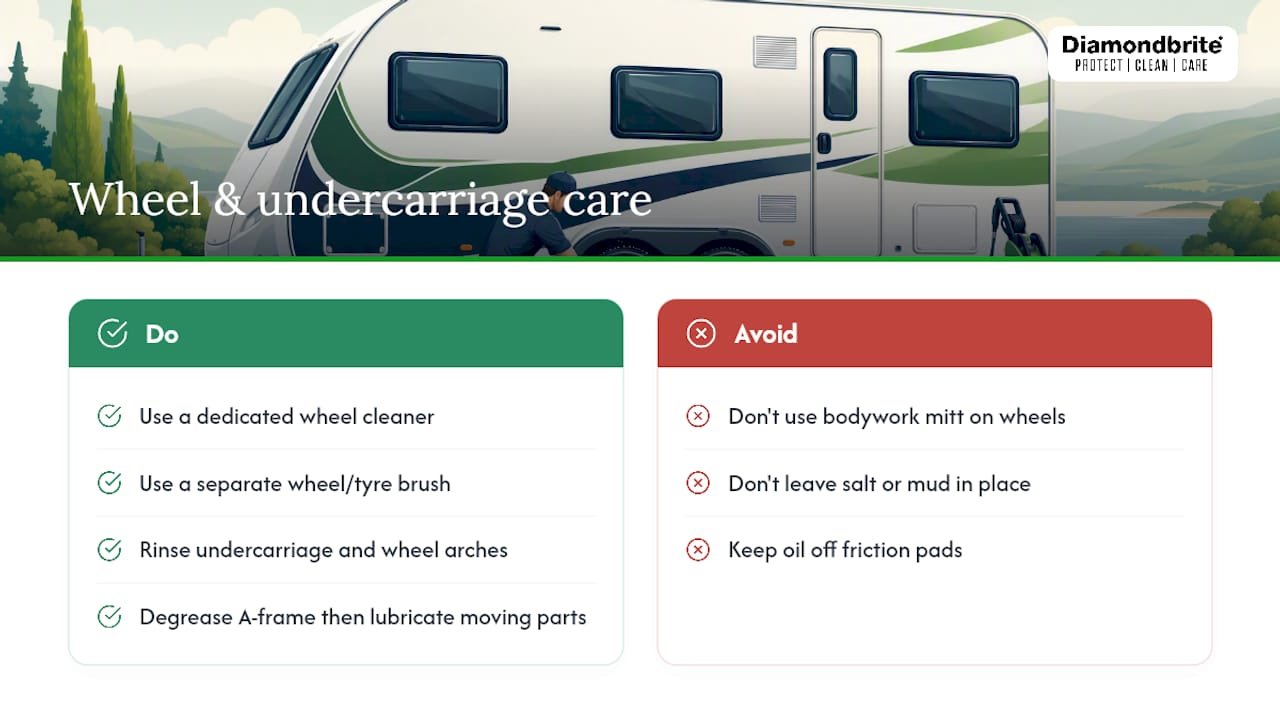
Use a dedicated wheel cleaner and a separate brush for wheels and tyres, never the mitt you used on the bodywork, to avoid dragging brake dust onto your paintwork. After coastal or muddy trips, rinse the undercarriage and wheel arches thoroughly, since salt and mud left in place accelerates chassis corrosion. Degrease the A-frame and apply a light lubricant to moving parts, keeping oil well away from any friction pads.
How often should you clean a caravan exterior?
A simple rhythm keeps the job small instead of letting it become a weekend project.
- Rinse after every long trip, especially coastal or muddy routes.
- Give it a full wash monthly during the touring season.
- Do a thorough clean and protect before winter storage.
Before setting off or tucking it away, run a quick check: lights and reflectors working, seals intact, roof drains clear, tyres at correct pressure. Before storage, make sure everything is completely dry, protected and well ventilated to avoid damp and mould over winter. For seasonal routines beyond the exterior, Escape Campers’ maintenance checklist covers the wider checks worth doing alongside a wash.
Which products actually belong in a caravan cleaning kit?
A caravan-safe shampoo and a proper ceramic finish do more work than a cupboard full of random sprays. Diamondbrite pH Neutral Car Shampoo lifts dirt without stripping existing sealant or attacking rubber seals, and Diamondbrite Ceramic Shampoo builds protection into the wash stage itself. Follow with Diamondbrite Ceramic Glaze for a longer-lasting barrier against UV, tree sap and road film.
- Wash with pH-neutral shampoo to protect seals and existing coatings.
- Use ceramic shampoo on routine washes to top up protection gradually.
- Apply ceramic glaze after a full wash for maximum durability between cleans.
Diamondbrite has spent over three decades formulating car care products in its Loughborough lab, with its ceramic systems now protecting more than two million vehicles across cars, motorcycles, leisure vehicles and marine craft.
Editorial take: what the standard advice gets wrong
Most caravan cleaning guides treat every panel the same way, and that’s the mistake. The roof, the skirts and the acrylic windows each fail differently, so treating them with one shampoo and one technique is why so many owners end up with dull patches or hairline scratches they can’t explain.
Conventional advice also underplays how much a pressure washer costs you long-term. It looks efficient in the moment, but the seal damage it causes rarely shows up until months later, when you’re chasing a damp patch you can’t trace. A hand wash with the two-bucket method takes fifteen minutes longer and avoids the problem entirely.
What deserves more attention than it gets is ceramic protection during the wash itself, not just as an occasional add-on treatment. A caravan sits outside far more than a car does, exposed to UV and grime for weeks at a stretch. Building protection into every wash, rather than bolting it on twice a year, is the difference between a caravan that still looks sharp at ten years old and one that’s chalky by year five.
Get the right products for your next caravan wash
You’ve now got the method. The only variable left is what’s in the bucket, and that’s where most caravan owners undercut their own effort by reaching for whatever’s under the kitchen sink. Diamondbrite pH Neutral Car Shampoo is formulated specifically to protect seals and existing coatings rather than strip them, and it pairs directly with Diamondbrite Ceramic Glaze for a finish that shrugs off road grime and UV for months, not weeks.
If you’re washing regularly through the season, Diamondbrite Ceramic Shampoo builds that same hydrophobic protection into every wash rather than leaving it as a one-off job. Start with the pH neutral shampoo for your next wash, then browse the full ceramic range on the Diamondbrite shop to build a kit that keeps your caravan looking right between trips.
Sources
- How to Clean the Outside of a Caravan (2026 UK Step-by-Step Guide)
- How to clean a caravan – Halfords
- Caravan exterior cleaning advice
- How to clean your caravan – Practical Caravan
FAQ
What’s the best thing to clean the outside of a caravan?
A caravan-specific, pH-neutral shampoo used with the two-bucket method is the safest and most effective choice, since it lifts dirt without stripping seals or existing protection.
Can I use fairy liquid to wash my caravan?
No. Washing-up liquid is too harsh for caravan exteriors and can strip protective coatings and damage rubber seals over repeated use.
How do I make a caravan shine like new?
Wash with a pH-neutral shampoo, dry fully in shade, then apply a ceramic glaze such as Diamondbrite Ceramic Glaze, which builds a glossy, hydrophobic layer that also slows future dirt buildup.
How do I remove black streaks from a caravan?
Apply a dedicated black streak remover, let it dwell for a few minutes, then wipe gently rather than scrubbing, which can dull the surrounding gelcoat.
Is a pressure washer safe to use on a caravan?
Only with caution. Keep the pressure low and the nozzle well away from seals and panel joins, since forceful jets can push water past seals and cause long-term damage.