

Layering ceramic sealant works when each coat goes onto clean paint, in thin films, in the right order, and with the label’s waiting times respected. Sealants are made of polymers that bond well to themselves, so a second coat usually adds durability. The mistakes happen underneath (wax, oils, residue) and in between (rushed coats). This guide gives you the routine for a car, motorbike or leisure vehicle, and where our ceramic range at Diamondbrite fits into it.
TL;DR
- Prep decides the result: wash, decontaminate and strip old oils or wax before the first coat.
- Two thin coats beat one heavy coat. Follow the product’s flash and cure times between layers.
- Sealant bonds to sealant. Wax and show-style oils underneath are what weaken the bond.
- Order matters: polish, then glaze, then sealant, then any wax on top once the sealant has cured.
- Maintain with a gentle ceramic-infused wash and an occasional top-up rather than starting again.
Table of Contents
- What layering actually means
- Step 1: Prepare the paint
- Step 2: Choose the order of products
- Step 3: Apply thin and respect the timing
- How many layers are enough?
- Wax on top of a sealant: yes or no?
- Maintaining your layers
- Our view on layering
- Build your routine with Diamondbrite
- FAQ
- Sources
What layering actually means
Layering means applying more than one coat of the same product, or several different products, on top of each other. With a sealant, the point is durability and resistance. DetailingWiki explains that sealants adhere to themselves because of their polymer make-up, so a second coat usually improves how long they last. Waxes behave differently: extra coats mainly help fill light swirls rather than add life.
A ceramic sealant is a spray or liquid protection that is easier to apply than a full professional coating and lasts weeks to months rather than years. If you are weighing the two, our guide to sealant versus ceramic coating for UK cars compares them.
Step 1: Prepare the paint
Every layer is only as good as the surface under the first one. A sealant bonds to bare, clean paint, and anything sitting between the two (old wax, polish oils, traffic film) becomes the weak link.
- Wash properly. Use a pH-balanced shampoo and clean the wheels first so grit does not reach the paint. Our wash sequence guide shows the order.
- Decontaminate. Use a clay bar or clay mitt to lift bonded grit. If the paint feels rough through a plastic bag, it needs it.
- Correct if needed. Polish out swirls before you seal, because you are locking in whatever finish is there.
- Wipe down. Remove polishing oils so the sealant meets bare paint.
Older paint can take a ceramic finish too, provided you prepare it well: see how to prepare old paint. On motorcycles, the same sequence applies to painted tanks and fairings, with extra care around hot or heavily oiled parts.
Step 2: Choose the order of products
The general principle runs from the product that improves the paint to the product that protects it:
| Order | Product | Job |
|---|---|---|
| 1 | Polish | Removes swirls and oxidation |
| 2 | Glaze | Adds depth and gloss |
| 3 | Ceramic sealant (1st coat) | Bonds and protects |
| 4 | Ceramic sealant (2nd coat) | Builds durability |
| 5 | Optional wax or topper | Adds warmth of finish, sacrificial layer |
Glaze is the step people most often ask about. Layering glaze under a sealant is an old detailing question, and the practical rule is to use a glaze that is designed to be topped, and to follow the label on cure time before sealing. Our ceramic glaze benefits guide explains what it does for paint, and how to apply ceramic glaze covers the technique.
Step 3: Apply thin and respect the timing
Most layering failures are about thickness and impatience, not the product.
- Work panel by panel. One bonnet, one door, one side of a fairing at a time, so you can level the product before it dries.
- Use a little product. A thin, even film flashes (changes appearance as the carrier evaporates) and wipes off cleanly. Heavy film leaves high spots and streaks.
- Overlap your passes. Missed edges show as patches later.
- Wait between coats. The gap between the first and second coat is set by the manufacturer. Read the label, because it varies by formula and by temperature and humidity.
- Work out of direct sun and off hot panels, in a garage or shade where possible.
For spray-on products, a panel-by-panel method keeps coverage even. Our spray and rinse coating guide shows how to avoid streaks.
How many layers are enough?
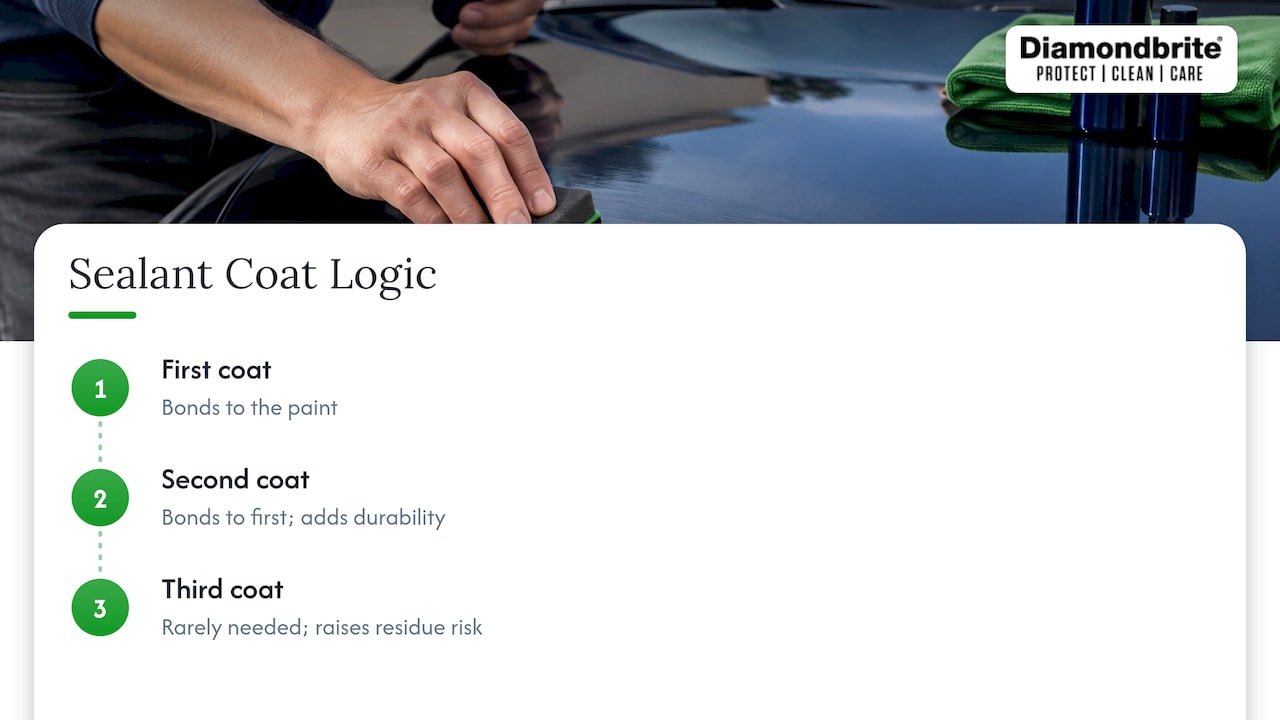
For a sealant, two coats is the sensible target for most owners. The first coat bonds to the paint; the second bonds to the first, which is where the durability gain from the polymer chemistry shows up. Adding a third is rarely needed and increases the risk of residue, so stop when the surface is uniformly slick and beads water evenly.
A check you can do at home: after the final coat has cured, rinse the panel. Even, tight beads across the whole surface mean coverage is consistent. A bare patch where water sheets flat usually means a missed spot or a thin area that you can top up.
Wax on top of a sealant: yes or no?
You can put wax over a cured sealant, and some owners do it for a deeper, warmer look. Two cautions keep the result predictable. First, wait until the sealant has fully cured. Second, avoid oily show waxes under a sealant: DetailingWiki notes that they make an unstable base that can reduce a sealant’s durability. Wax goes on top, never underneath.
If you already have a full ceramic coating and wonder whether wax is necessary, it usually is not. Our guide on keeping gloss without waxing a ceramic coating covers it.
Maintaining your layers
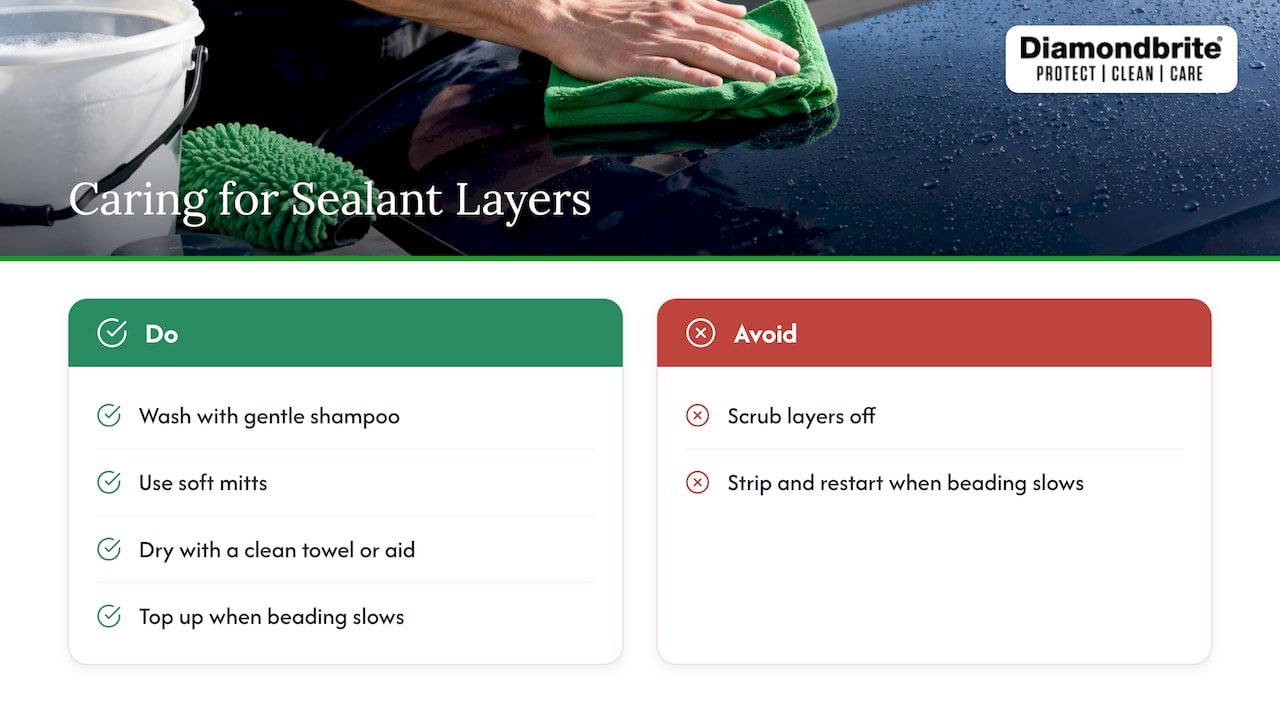
Layers last longest when you do not scrub them off. Wash with a gentle shampoo, use soft mitts and dry with a clean towel or a drying aid. Our ceramic shampoo is made to be used regularly on protected paint, and it also suits paint that has no coating. When beading slows, you do not need to strip and start again: a quick top-up restores it, and the wash routine for ceramic-coated cars shows how often to refresh.
Before winter, a fresh layer is a sensible habit. Salt and grime attack protection fastest between November and March, as our winter paint protection guide explains.
Our view on layering
We design our ceramic-infused products to work as a system, so that layering feels simple rather than technical. Our approach is to keep prep easy, keep the coats thin and let each layer build on the last.
The result we aim for is a durable shield that you can maintain with a regular wash instead of a full weekend of work. That suits the busy owner as much as the enthusiast, and it works across cars, motorcycles, leisure vehicles and boats.
If you take one habit from this guide, make it patience: clean paint, thin coats, proper cure times.
Will
Build your routine with Diamondbrite
If you are ready to layer, our shop carries ceramic glazes, shampoos, packs and snow foams, plus paintwork, wheel, glass and interior products for cars, motorcycles, leisure vehicles and marine use. Start with the range that matches your vehicle and build up from there.
Browse the full range at diamondbrite.shop.
FAQ
Can I apply ceramic sealant over an existing coating?
Yes. A sealant is often used over a coating to protect it while it is new and most sensitive to water spots, and it works best when the products are chemically compatible. Follow the label of both products for cure time before you apply.
Does glaze go under or over a sealant?
Under. Glaze improves depth and gloss, then the sealant goes on top to protect it. Let the glaze settle as its instructions say before sealing.
How long should I wait between coats?
The time is set by the product, so follow the label. Temperature and humidity change it, so allow longer in cold or damp garages rather than shorter.
Is ceramic sealant the same as a ceramic coating?
No. A sealant is simpler to apply and is generally topped up more often, while a coating is a longer-term, more demanding job. Our comparison of sealants and coatings sets out the differences.