

A ceramic glaze gives your paintwork a deeper gloss, makes water bead and roll off, and makes the next wash quicker. It does this in a single, quick application you can do at home. For most UK owners, that makes it the simplest way to add a ceramic-infused layer to paint, trim and glass without the cost or time of a full coating job. At Diamondbrite we make ceramic glazes and shampoos for exactly this kind of maintenance.
TL;DR
- Ceramic products use silicon dioxide (SiO2) to bond to the surface, giving gloss, water beading and easier cleaning.
- A glaze also helps hide fine imperfections, which a plain wax or sealant does not set out to do.
- Application is simple: wash, decontaminate, apply thinly, buff, then let it cure.
- Cars, motorcycles, leisure vehicles and boats can all benefit, provided you check the surface first.
- Regular washing keeps the effect going, so pair the glaze with a ceramic shampoo.
Table of Contents
- What ceramic glaze does for paintwork
- Why a glaze rather than a wax
- Glaze, coating or shampoo: which does what
- How to apply ceramic glaze
- Choosing the right glaze
- Motorcycles, leisure vehicles and boats
- Glaze on glass
- Perspective
- Get started with Diamondbrite
- FAQ
- Sources
What ceramic glaze does for paintwork
Ceramic products are built around liquid silicon dioxide. CAR magazine’s paint protection guide describes these SiO2 polymers as forming a very strong bond to the surface, with longevity and UV protection as their strengths. The same guide notes that sprays are easy to apply and can be used on glass, plastic trim, wheels and headlights as well as paint.
In practice, that gives you four benefits you can see and feel:
- Gloss and depth. The cured layer is hard and glass-like, so light reflects more evenly and colour looks richer.
- Water beading. Fisher Research’s explainer says hydrophobic behaviour raises the water contact angle, so water beads and rolls off carrying dirt with it.
- A sacrificial layer. The same source describes ceramic protection acting as a sacrificial layer against UV, bird droppings, road salt, traffic film and acid rain, so the layer takes the wear rather than the paint.
- Easier cleaning. Motor1 notes that road grime bonds less readily and that bird droppings and bugs are easier to remove before they sit for long.
For a busy owner, the fourth point is the one you notice most. A wash takes less effort, and the car stays cleaner between washes.
Why a glaze rather than a wax
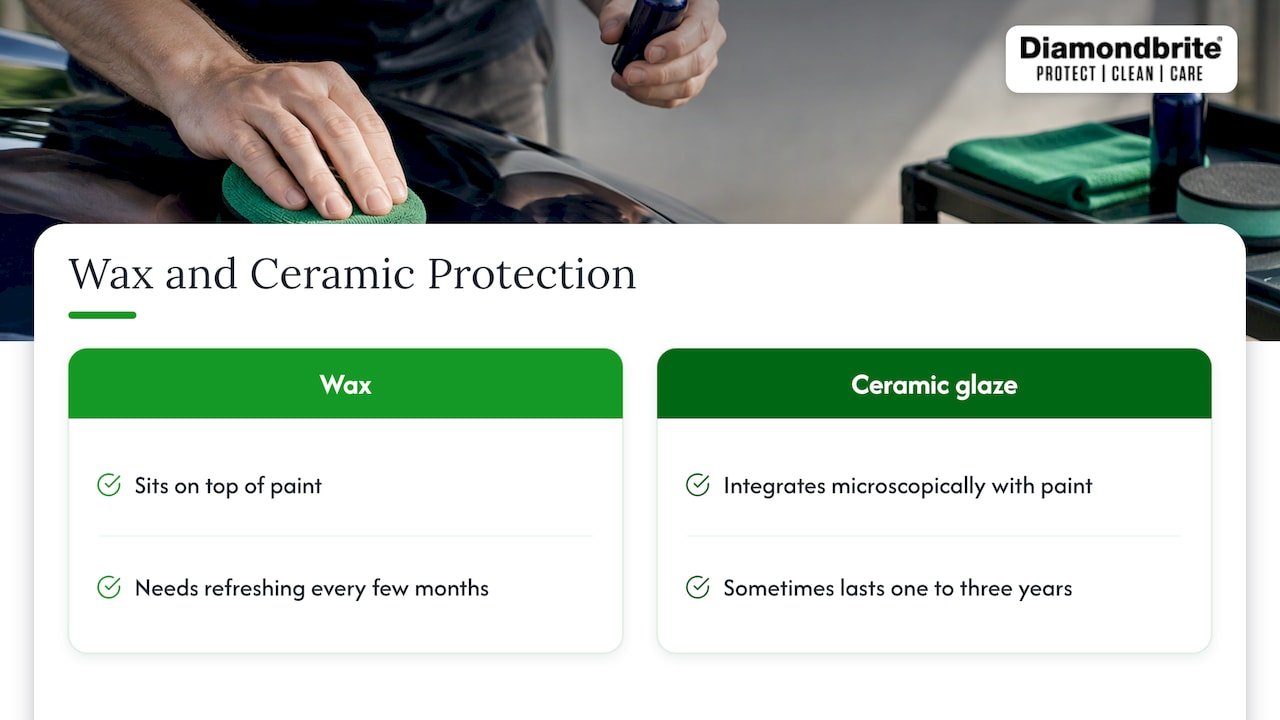
Wax sits on top of the paint and needs topping up every few months. Auto Express’s 2026 ceramic coating test found traditional waxes need refreshing every few months, while coatings sometimes last one to three years. Fisher Research describes ceramic protection as integrating with the paint at a microscopic level rather than simply sitting on it like wax.
A glaze has an extra job. Torque’s detailing explainer explains that glazes were traditionally made to fill minor scratches and reduce the look of imperfections, while sealants lock in the finish. Modern products combine both roles. That is why a ceramic glaze suits owners who want the finish to look better today and be protected tomorrow.
If swirl marks are your main concern, our guide to using glaze to hide swirls explains how it works and how long it lasts.
Glaze, coating or shampoo: which does what
| Product | Main job | Effort | Best for |
|---|---|---|---|
| Ceramic glaze | Gloss, beading, fills fine marks | Low, one quick application | Regular owners and enthusiasts |
| Ceramic coating | Longer-term protective layer | Higher, needs careful prep | Owners planning a full treatment |
| Ceramic shampoo | Cleans while topping up the ceramic effect | Lowest, part of your wash | Every wash |
| Wax | Short-term gloss | Low, but frequent | Occasional shine |
Auto Express (2023) puts ceramic coatings at around £50 to £100 and says they last a little longer than traditional wax. If you are weighing the two routes, see sealant vs ceramic coating for UK cars and what DIY owners should budget. Our ceramic shampoo benefits guide shows how the wash step supports the glaze.
How to apply ceramic glaze
Preparation decides the result. Torque’s view is that proper surface prep and clean cloths matter more than the label on the bottle. Work in the shade on a cool panel, and follow the directions on your bottle closely, as The Drive advises for DIY applicators.
- Wash thoroughly. Remove dirt and traffic film. Our ceramic shampoo dilution guide covers how much to use per bucket. A pH neutral shampoo is gentle on a protected finish: see pH neutral car shampoo for ceramic-coated cars.
- Decontaminate. If the paint feels rough after washing, a clay bar lifts bonded particles. The 30-second bag test tells you whether you need it.
- Dry completely with a clean microfibre towel.
- Apply thinly. Work one panel at a time, using a clean applicator or cloth. A thin, even layer is easier to buff than a thick one.
- Buff off with a fresh, clean microfibre before the product dries hard.
- Let it cure. Keep the car dry for the time stated on the label. Auto Express found that one of the coatings it tested needed the car kept dry for at least four hours, so always check your product’s instructions.
- Maintain. Wash regularly. Our wash routine for ceramic-coated cars and maintenance guide explain how to keep beading strong.
For the full walkthrough, including trim, read how to apply ceramic glaze to your car’s paint and trim. Older paint can also take a ceramic layer once it is properly prepared: see ceramic coating on old paint.
Choosing the right glaze
Auto Express tested coatings on a machine-polished bonnet left outdoors for six months, judging water beading, swirls, value and ease of application. Those are sensible criteria for you too:
- Ease of application. If a product is simple, you will actually use it regularly.
- Beading and gloss. Look for a product designed to give both.
- Surfaces covered. A glaze that works on paint, trim and glass saves buying several products.
- Upkeep. Pick a range with a matching shampoo, so every wash supports the finish.
Beading is not the whole story. Motor1’s Dan Mihalascu points out that water behaviour is one benefit of ceramic protection, not the entire reason to use it. Look at the gloss, the ease of cleaning and how the finish holds up through the seasons. A ceramic layer also gives you a good base for winter paint protection, and a regular wash after bird droppings or bugs keeps paint in good order: see preventing bug etching.
Good habits matter alongside any product. If you want your car to stay in top shape, these tips to extend your car’s life fit well with a regular care routine.
Motorcycles, leisure vehicles and boats
Ceramic care is not only for cars. Our range includes lines for motorcycles, leisure vehicles and marine use. Before you start, check that the surface is clean, smooth and suitable for the product in question, and read the label for the surfaces it covers. For bikes, our guide to protecting motorcycle paint from UV is a good start. For boats, see gelcoat protection. Rubber and vinyl trim have their own routine: see protecting vinyl and rubber. If your car has a matte finish, use the matte paint ceramic coating guide, because gloss products suit gloss paint.
Glaze on glass
The word glaze also means something different in pottery. If you have heard of ceramic glaze on glass, our explainer on pottery vs car glass coatings separates the two.
Perspective
We built our range around one idea: a car that is easy to keep clean stays in better shape for longer. A ceramic-infused glaze fits that idea because it takes minutes, not days, and you can repeat it whenever the finish needs a lift.
Our ceramic glaze and ceramic shampoo are designed to work as a pair. The glaze builds a durable shield with a sparkling finish, and the shampoo keeps that finish topped up at every wash. That is cost-effective care for the everyday motorist, and professional-level results for the enthusiast.
The best protection routine is the one you will actually keep up. Our products aim to make that easy.
Will
Get started with Diamondbrite
Our Automotive Ceramic and Paintwork ranges cover glazes, shampoos and packs for cars, plus lines for motorcycles, leisure vehicles and marine use. Choose the glaze and shampoo for your vehicle, and you have a simple routine from the first wash.
If you want to keep the gloss going, our guide to topping up ceramic coating in under an hour shows how quick a refresh can be.
FAQ
How long does ceramic glaze last?
It depends on the product, the preparation and how often you wash the car. Auto Express found traditional waxes need topping up every few months, while coatings sometimes last one to three years. Regular washing and occasional top-ups help keep the effect going.
Can I use wax over ceramic glaze?
Yes, many owners add a layer for extra gloss. Our guide to waxing over ceramic explains how to keep the gloss going for months.
Do I need a ceramic shampoo as well?
A ceramic shampoo is designed to support the glaze at every wash. See how often to use it, and whether it is worthwhile on non-coated paint.
Will ceramic glaze protect against stone chips?
No paint treatment stops impacts. The Drive notes ceramic coatings are not a shield against rock chips, so the benefit is in gloss, cleaning ease and everyday environmental protection.
Sources
- CAR magazine: Guide to Paint Protection
- Fisher Research: The science of ceramic protection
- Motor1: What Is Ceramic Coating, And Is It Worth It?
- Auto Express: Best ceramic coatings 2026
- Auto Express: Car paint protection, films and ceramic coatings explained
- Torque: Sealants and glazes
- The Drive: What Is Ceramic Coating?