

Use a non-acid wheel cleaner for routine maintenance, and save acid formulas for heavily baked-on deposits or specialist restoration work. Non-acid, pH-balanced or iron-reactive products are the safer default for almost every wheel, while acid cleaners strip stubborn mineral scale but bring real risks to your finish and your skin. If you ever reach for acid, check compatibility first and wear proper protection.
TL;DR:
- Acid wheel cleaners effectively remove heavy mineral deposits but pose risks of etching and discoloration on polished, anodized, or chrome finishes if misused.
- Routine cleaning should prioritize pH-balanced, non-acid products paired with iron removers for stubborn brake dust to avoid damaging wheel surfaces.
- Always test cleaning products on a hidden area first and rinse thoroughly before any residue dries to prevent etching and protect wheel coatings.
- Use protective equipment, work on cool wheels, and follow dwell time instructions precisely to minimize chemical risks during cleaning.
- For coated wheels, regular maintenance with gentle, pH-neutral cleaners and iron removers usually eliminates the need for acid cleaners entirely.
Table of Contents
- Acid wheel cleaners: chemistry, uses and hazards
- Non-acid and iron-reactive cleaners: how they work and when they win
- Checklist: choose the right cleaner for your wheel and situation
- Pro tips and common mistakes to avoid
- Authoritative guidance and Diamondbrite’s practical recommendations
- Diamondbrite: a recommended maintenance route for coated wheels
- Why the safer chemistry usually wins
- Sources
- FAQ
Acid wheel cleaners: chemistry, uses and hazards
Acid cleaners work by dissolving mineral and iron oxide deposits on contact, which is exactly why they cut through neglected wheels so fast. Phosphoric and citric acids are the most common active ingredients, though older formulas relied on hydrofluoric acid derivatives, chemistry that carries genuine acute health hazards and demands full protective controls.
Where do acids actually earn their place? Think fleet vehicles left uncleaned for months, wheels caked in mineral scale from hard water, or restoration jobs where years of neglect have baked contamination into the surface. On a wheel you clean every fortnight, acid is simply overkill.
The bigger issue is what acid does to certain finishes. Polished or bare aluminium, anodised trims, and chrome are all vulnerable to etching and discolouration, sometimes within seconds of contact. Clear-coated alloys have more of a buffer, but even they aren’t immune if the acid sits too long or gets applied too concentrated.
Pro Tip: If you’re not certain what finish your wheels have, treat them as if they were bare metal. It costs you nothing extra to be cautious, but a misjudged guess can cost you a full respray.
Safe handling with acid-based products means:
- Full PPE: chemical-resistant gloves, eye protection, and good ventilation
- Cool wheels only, never in direct sun or after a motorway run
- Short dwell time, applied in sections rather than all at once
- Immediate, thorough rinsing before the product has a chance to dry
Some acid products historically contained ammonium bifluoride, which can release hydrofluoric acid on dilution. That single fact explains why professional guidance treats these chemistries with real caution rather than casual confidence.
Non-acid and iron-reactive cleaners: how they work and when they win
Surfactant-based, non-acid cleaners lift and emulsify road grime and fresh brake dust through detergency rather than chemical burn. That’s the key difference. They loosen contamination and float it off the surface instead of eating into it, which means there’s no etching risk on painted, lacquered, or clear-coated wheels.
Iron-reactive cleaners take a different but equally clever route. They target embedded iron particles, the ones flaking off your brake pads and bonding onto the wheel face, and dissolve them through a colour-change reaction rather than acid attack. You’ll see the product turn deep purple or red as it works, which is oddly satisfying and genuinely useful: it shows you exactly where the contamination sits.
Because most wheels sold today are clear-coated as standard, a pH-balanced cleaner paired with an iron remover handles the vast majority of routine cleaning without any of the compatibility guesswork that acid demands.
Many experienced detailers have quietly replaced routine acid use with this exact two-step approach: non-acid cleaner first to shift general grime, then an iron remover for whatever brake dust remains bonded on.
Follow non-acid cleaner with an iron remover when:
- You still see rust-coloured speckling after the first wash
- Your wheels haven’t been cleaned in more than a month
- You drive mostly in town, where brake dust builds up fastest
Pro Tip: Run your finger lightly over a “clean” wheel. If it feels gritty rather than smooth, embedded iron is still there, and an iron remover will finish the job an ordinary cleaner can’t.
Checklist: choose the right cleaner for your wheel and situation
Work through this in order rather than jumping straight to the strongest bottle on the shelf.
- Identify the finish. Clear-coated alloy, painted, polished, anodised, or chrome each behave differently under acid, so know which you have before opening anything.
- Start with non-acid. It handles the majority of dirt safely and gives you a clean baseline to judge what’s left.
- Add an iron remover if rust-coloured speckling remains after rinsing, watching for the colour-change reaction as your guide.
- Reserve acid only for finishes that permit it, and only after every gentler option has failed.
- Escalate to a professional if scale or contamination has clearly bonded into pitting or corrosion rather than sitting on the surface.
Before you buy anything, check the label for its stated pH range and any explicit “safe for” or “not suitable for” wording; routine wheel washing should sit close to neutral, broadly pH 6.5 to 8.5, with anything stronger flagged as specialist use only.
Application rules apply regardless of chemistry:
- Cool wheels, never straight after driving
- One section at a time, not the whole wheel at once
- Short dwell, matched to the label
- Full rinse before any product dries or “flashes” on the surface
- Test on a hidden spot first, every single time you try a new product
Pro tips and common mistakes to avoid
The single most common mistake is letting cleaner dry on the wheel. Once that happens, the chemistry keeps working with nothing to stop it, and that’s when etching and discolouration set in on finishes that would otherwise have coped fine.
- Work one wheel, then one section, rinsing before anything has a chance to flash dry
- Choose an iron-reactive colour-change product over acid whenever the wheel finish allows it
- Wear nitrile or chemical-resistant gloves and eye protection with any stronger chemistry, acid or alkaline
- Test in a hidden spot, such as the inner barrel, before committing to a full wheel
- Clean on a regular cycle. Wheels you maintain every two to three weeks never build up the baked-on grime that pushes you towards acid in the first place
Pro Tip: Keep a small notebook or phone note of which product you used on which car. If a finish reacts badly, you’ll know exactly what caused it rather than guessing after the fact.
Authoritative guidance and Diamondbrite’s practical recommendations
UK government toxicology guidance is unambiguous about the acute risks of hydrofluoric acid derivatives, historically found in some acid wheel cleaners, and calls for proper handling controls whenever they’re used. Environmental guidance for vehicle cleaning echoes the same caution, recommending pH-neutral or minimally acidic products for everyday washing and reserving strong acids for controlled, specialist jobs with proper rinse and disposal practice.
Diamondbrite’s own guidance for coated wheels follows the same principle: a 2 to 5 minute dwell time is enough to lift brake dust safely without stressing the coating underneath.
| Situation | Recommended approach | Key safety point |
|---|---|---|
| Routine weekly or fortnightly wash | Non-acid pH-balanced cleaner | Cool wheel, short dwell, full rinse |
| Persistent brake dust speckling | Iron-reactive colour-change product | Watch for colour change as your guide |
| Heavy mineral scale or neglected wheels | Acid cleaner, finish permitting | Full PPE, test spot, immediate rinse |
| Ceramic-coated wheels | pH-balanced cleaner, 2 to 5 minute dwell | Never let product dry on the coating |
For a full walkthrough tailored to coated finishes, Diamondbrite’s guide to cleaning ceramic coated wheels sets out the routine in more detail.
Diamondbrite: a recommended maintenance route for coated wheels
If you’ve got a ceramic-coated finish, you’re in the fortunate position of rarely needing acid at all. A consistent, gentle maintenance routine keeps brake dust and road grime from ever bonding hard enough to demand stronger chemistry, which is a far less stressful way to care for your wheels than reaching for acid every few months.
Diamondbrite’s guide to cleaning ceramic coated wheels walks you through exactly that low-risk approach, built around the coating rather than against it. Pair it with the wider ceramic coating maintenance guide to keep beading and shine consistent between washes, and you’ll find the whole car benefits, not just the wheels. If flash rust on rotors has ever caught you out after a wash, it’s worth understanding why that happens before you assume your cleaning product is at fault. Browse the full range in the Diamondbrite shop and build a maintenance kit that keeps your wheels looking sharp without ever needing to open a bottle of acid.
Why the safer chemistry usually wins
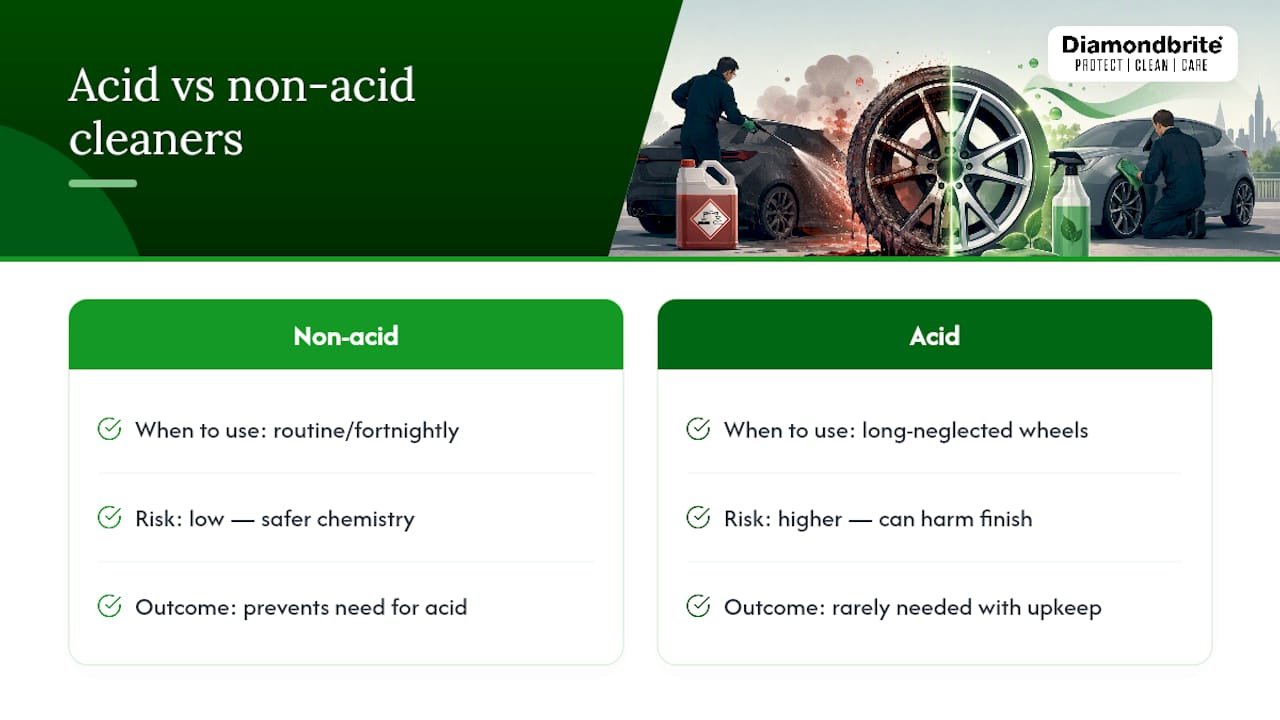
Acid gets treated online as the “proper” detailer’s choice, and that reputation is doing car owners a disservice. In most cases you’re solving a problem that a decent non-acid cleaner and a bit of consistency would have prevented from ever developing. The wheels that genuinely need acid are usually the ones nobody’s touched in a year, not the ones you wash every fortnight.
Test on a hidden spot, wear gloves, and stick to a proper cleaning schedule; that combination will keep the vast majority of readers out of acid territory entirely. For the routine that keeps you there, the Diamondbrite maintenance guides and the FAQ below cover what you need.
— Will
Sources
- Gov
- Wheel & Tire Cleaner Chemistry: Acid vs. Non-Acid Explained | Sky Blue Chemical
- Vehicle cleaning including wheel washing — netregs
FAQ
Is acid wheel cleaner good?
Acid cleaners work well on heavy mineral scale and neglected wheels, but they carry real risks to polished, anodised, and chrome finishes and should be used with PPE and a test spot first.
What do professional detailers use to clean wheels?
Many now use a two-step approach: a pH-balanced non-acid cleaner for general grime, followed by an iron-reactive colour-change product for embedded brake dust.
What is a good non-acidic car wheel cleaner?
Look for a pH-balanced formula stating a pH range around 6.5 to 8.5 and clear “safe for” labelling for your wheel finish, paired with an iron remover for stubborn brake dust.
What is the best non-acid wheel and tyre cleaner?
The best choice for most owners is a pH-neutral cleaner used with a short dwell time and full rinse; for ceramic-coated wheels specifically, Diamondbrite recommends a 2 to 5 minute dwell to protect the coating.