

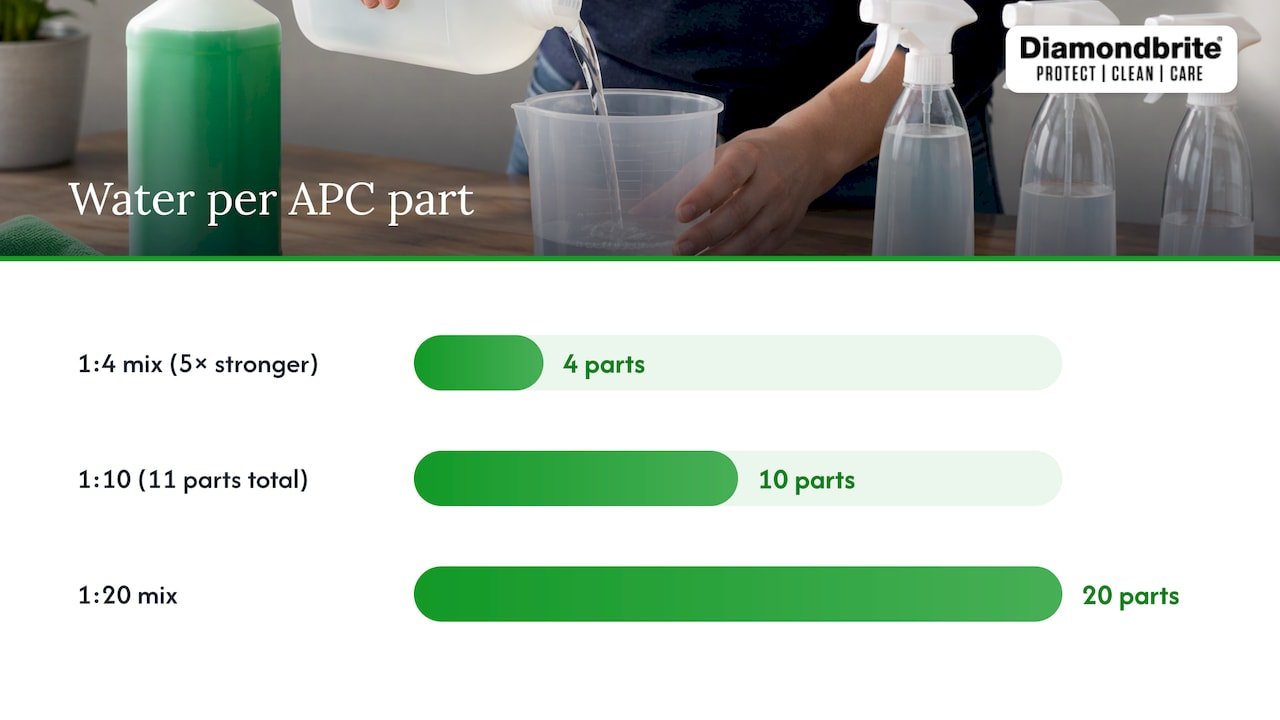
Most all-purpose cleaner (APC) is mixed somewhere between 1:4 and 1:20, which means one part concentrate to between four and twenty parts water. Light interior dust sits at the weak end, door shuts and arches sit in the middle, and greasy engine bays sit at the strong end. Work out the right ratio for the surface first, then measure it properly, because most paint, trim and coating problems come from guessing. If you would rather skip the mixing for interior cleaning, our Universal Interior Cleaner comes ready to use.
TL;DR
- A ratio of 1:10 means 1 part APC to 10 parts water, so 11 parts in total. Always check which way round your brand writes it.
- Start weak and go stronger only if the dirt stays: roughly 1:20 for light interior work, 1:10 for general jobs, 1:4 for heavy grease.
- A 1 litre bottle at 1:10 takes about 91 ml of concentrate and 909 ml of water.
- The product label always outranks a general chart. Test on a hidden spot first.
- Rinse APC off paint and coatings, and use a dedicated shampoo for routine washing.
Table of Contents
- What a dilution ratio actually means
- Which ratio for which job
- How to measure a batch without guessing
- Mixing and using it safely
- APC and paint protection
- When the label and the chart disagree
- Perspective
- Ready-to-use options from Diamondbrite
- FAQ
- Sources
What a dilution ratio actually means
A dilution ratio compares parts of concentrate with parts of water. The “part” can be a millilitre, a capful or a cup, as long as you use the same one for both. At 1:10 you use 1 part APC and 10 parts water. At 1:4 you use 1 part APC and 4 parts water, which is five times stronger per spray than 1:20.
The confusion is the order. Some brands write water first (10:1 meaning 10 parts water), others write concentrate first (1:10). Both usually describe the same mix. If a label says “dilute 1:10”, read the instructions beside it for whether that means 1 part cleaner to 10 parts water. When in doubt, use the example the maker prints, such as a figure in millilitres per litre.
The other trap is total volume. 1:10 does not mean 100 ml of concentrate in a litre of water. It means 1 part in 11 in total, so the maths changes slightly with the size of the bottle.
Which ratio for which job
Manufacturers differ, so treat this as a starting point for a typical mid-strength APC, not a rule. Begin at the weaker figure for the surface and step up only if it does not lift the dirt.
| Job | Typical starting ratio (concentrate:water) | Notes |
|---|---|---|
| Light interior dust, plastics, vinyl | 1:15 to 1:20 | Spray onto a cloth, not the surface |
| General interior grime, door shuts, rubber seals | 1:10 | Wipe and rinse or wipe with a damp cloth |
| Fabric seats and carpets (pre-treatment) | 1:10 | Test first, avoid soaking |
| Wheel arches, mud flaps, exterior plastic trim | 1:6 to 1:10 | Rinse thoroughly |
| Engine bay, heavy grease, tyres | 1:4 to 1:6 | Keep off paint, rinse well |
| Motorcycle chain area, lower panels | 1:6 to 1:10 | Avoid brakes and discs |
| Caravan or motorhome exterior grime | 1:10 | Rinse and dry afterwards |
Stronger is not better. A stronger mix does not clean much faster on light dirt, and it raises the risk of dulling plastics, drying rubber and leaving residue. It also uses the bottle up quicker.
How to measure a batch without guessing
The formula is simple. Add 1 to the second number to get the total parts, divide your bottle size by that total to get the concentrate, and the rest is water.
- Decide the ratio, for example 1:10.
- Total parts: 1 + 10 = 11.
- Concentrate: bottle volume ÷ 11.
- Water: bottle volume minus the concentrate.
This is the same method used by dilution calculators, which give about 90.9 ml of concentrate and 909.1 ml of water for a 1000 ml bottle at 1:10. Those calculators also use a default batch of 500 ml for a motorcycle, 1000 ml for a saloon, 1500 ml for an SUV and 2000 ml for a truck. Vehicle size changes how much you mix, never the ratio.
| Bottle size | 1:20 | 1:10 | 1:4 |
|---|---|---|---|
| 500 ml | 23.8 ml APC, 476.2 ml water | 45.5 ml APC, 454.5 ml water | 100 ml APC, 400 ml water |
| 1000 ml | 47.6 ml APC, 952.4 ml water | 90.9 ml APC, 909.1 ml water | 200 ml APC, 800 ml water |
In practice, round to a sensible figure: 45 ml in a 500 ml bottle, 90 ml in a litre. Measure the concentrate with a marked syringe or measuring cup rather than a capful, because caps vary a lot. Then fill with water to the mark.
Mixing and using it safely
Pour the water in first and add the concentrate second, which avoids a bottle full of foam. Swirl gently rather than shaking, label the bottle with the ratio and the date, and keep it out of reach of children and pets. Never store it in a drinks bottle.
Wear gloves and eye protection, particularly when you are pouring concentrate, as many cleaners irritate skin and eyes. Ventilate the space when working inside a car, and never mix different cleaning products together. If a splash gets in your eyes or you feel unwell, follow the first aid advice on the product label and contact a doctor or NHS 111.
Two habits prevent most damage:
- Spray the cloth, not the dash. On interiors, overspray ends up on screens, switchgear and stitching. Our guides to using APC on an interior and cleaning a dashboard properly cover this in more detail.
- Test and work in sections. Try the mix on a hidden area, wait a few minutes, then wipe. Do not let it dry on the surface, particularly in sunshine.
APC and paint protection
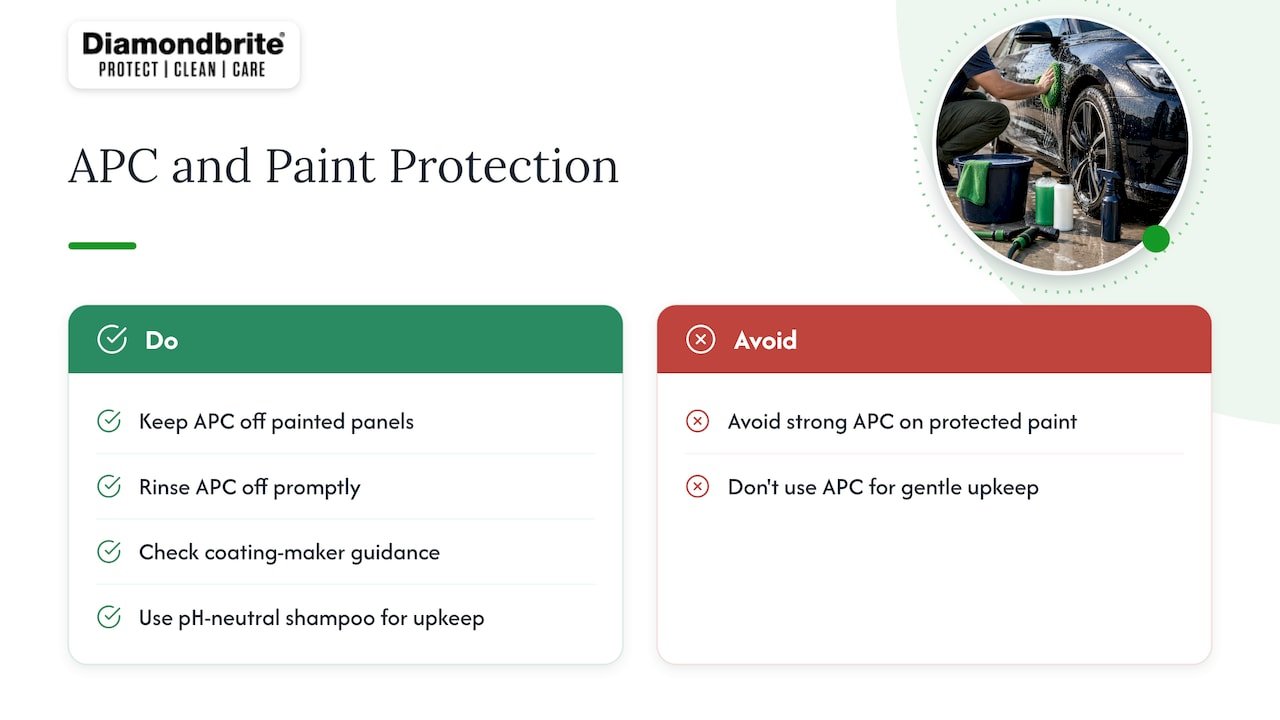
APC is a strong cleaner, so it is built for dirt and grease, not for gentle upkeep. If you have wax, a sealant or a ceramic coating on the paint, a strong or concentrated mix can reduce its life. Keep APC away from painted panels where you can, rinse it off promptly where you cannot, and check your coating maker’s guidance for any cleaner stronger than a shampoo.
For regular washing, a pH neutral shampoo is the better tool. Our guides to ceramic shampoo dilution, car shampoo dilution and coating safe ratios and snow foam ratios give the mixes to use on the paint, so the APC can stay on the jobs it suits.
When the label and the chart disagree
You will find different ratios for the same product from different sources. The order of authority is simple:
- The label or data sheet for your exact product. Concentrations differ between brands, so 1:10 of one is not 1:10 of another.
- The surface. Delicate or unknown materials get the weakest mix, whatever the chart says.
- The dirt. Move one step stronger only if the weaker mix fails after a second pass with agitation.
A soft brush and a bit of dwell time usually do more than extra concentrate. If the maker gives a range, such as 1:10 to 1:20, start at the weak end.
Perspective
Most dilution mistakes come from one habit: reaching for the strongest mix on every job. In our experience of car care, the cleaner that is easy to use correctly is the one people actually keep using.
That is why our range is built around products that suit specific jobs. Our ceramic infused shampoo and snow foam are for washing paint, and our interior cleaner comes ready to use, so there is no ratio to get wrong when you are wiping a dashboard or door card. We think a measured, surface-by-surface routine protects your finish better than one strong bottle for everything.
Keep the heavy mixes for arches and engine bays, and let the products designed for paint and trim do the regular work.
Will
Ready-to-use options from Diamondbrite
If you want the interior cleaned without measuring anything, the Universal Interior Cleaner is a ready-to-use product. For the paint, the Ceramic Infused Shampoo and Ceramic Blast Snow Foam are made for washing, and the Ceramic Pack bundles ceramic products together. We also make products for motorcycles, leisure vehicles and marine use, all available from the Diamondbrite shop.
Not sure whether APC or a dedicated interior cleaner fits your job? Our guide to APC versus interior cleaner helps you choose.
FAQ
What does a 4:1 dilution ratio mean?
It usually means 4 parts water to 1 part concentrate, or 5 parts in total. In a 500 ml bottle that is 100 ml of concentrate and 400 ml of water. Some labels write it the other way round, so confirm against the example on the bottle.
What is the recommended dilution ratio for all-purpose cleaner?
There is no single figure. Around 1:10 is a common general-purpose starting point, with 1:15 to 1:20 for light interior work and 1:4 to 1:6 for heavy grease. Your product label is the final word.
What does a 20:1 dilution ratio mean?
It means 20 parts water to 1 part concentrate, 21 parts in total. In a litre bottle that is roughly 47.6 ml of concentrate and 952.4 ml of water. It is a gentle mix, suited to light dust and routine interior wipes.
How do I work out a dilution ratio for any bottle size?
Add the parts together, divide the bottle volume by that total to find the concentrate, then subtract it from the bottle volume to find the water. For 750 ml at 1:10, that is 750 ÷ 11, about 68 ml of concentrate and 682 ml of water.
Can I use APC on a ceramic-coated car?
Use it sparingly and keep it to arches, trim and grime that shampoo will not shift. Rinse it off well and check your coating maker’s advice first. For ordinary washing, use a pH neutral shampoo.