

Use an all-in-one (AIO) polish when your paint is in fair condition and you want more gloss, a lighter haze removed and some protection in a single pass. Use a compound when the paint has defects deep enough to cut out, such as scratches you can feel with a fingernail or dull, oxidised patches. The rule that settles most cases: start with the least aggressive product that clears the defect, then step up only if it does not.
TL;DR
- An AIO polish combines a light polish with a wax or sealant, so it is built for shine and speed, not for heavy correction.
- A compound cuts. It abrades the clear coat to level deeper defects, then needs a finer polish to restore clarity.
- Test a small area first, with the gentlest product and pad, and move up only when needed.
- Whatever you choose, protect the finish afterwards, because correction removes what was on the paint.
- Look after the paint between sessions and you will need the stronger option far less often.
Table of Contents
- What each product actually does
- AIO polish vs compound at a glance
- Which defects need which
- Why you should not jump straight to compound
- When to use both
- Applying either one safely
- Does an AIO give lasting protection?
- Keeping the finish after you polish
- Our view
- Protect the finish you have just corrected
- FAQ
- Sources
What each product actually does
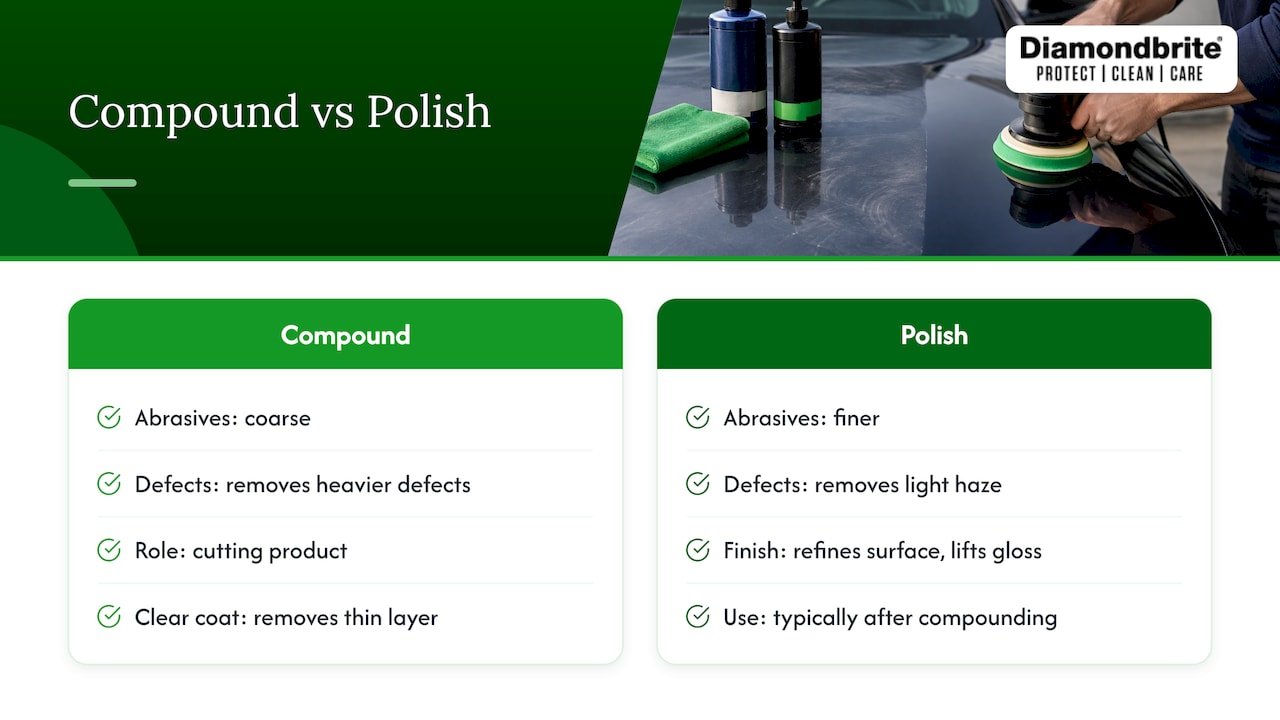
A compound is a cutting product. Its abrasives are coarse, and it is designed to remove heavier defects by taking away a thin layer of clear coat. A polish uses finer abrasives to refine the surface, lift gloss and remove light haze, typically after compounding. Some modern products blur the line and offer a good cut with a high-gloss finish, depending on the pad and the machine you pair them with (New Again Car Care describes the same spectrum).
An AIO sits at the gentle end. It folds a finishing polish and a wax or sealant into one product, so you clean up the surface and add a layer of protection in one go. A one-step correction is different: it is a polishing stage followed by a separate protection stage, which gives you more defect removal. A one-step versus AIO comparison makes the same point: an AIO is meant to add shine and gloss quickly, not to correct the paint.
AIO polish vs compound at a glance
| AIO polish | Compound | |
|---|---|---|
| Main job | Gloss, light haze, quick protection | Removing deeper defects |
| Cut level | Light | Heavy |
| Steps needed | One, protection included | Compound, then finishing polish, then protection |
| Time | Short | Long |
| Best on | Paint in fair condition, regular upkeep | Neglected, oxidised or visibly scratched paint |
| Clear coat removed | Minimal | Measurably more |
Which defects need which
The quickest way to decide is to look at the paint in strong, angled light, then run a fingernail across any scratch.
- Fine swirl marks, light holograms, dull but even paint: an AIO or a finishing polish on a soft foam pad will usually be enough.
- Light water spots: start gentle. Our guide to removing water spots from your car shows the safe steps before you reach for abrasives.
- Scratches your nail catches in, heavy swirling, oxidation: this is compound territory, followed by a finishing polish to remove the marks the compound leaves.
- Scratches through the clear coat to the colour or primer: no polish or compound will fix these, and they need a paint repair rather than more abrasion.
An AIO can look as if it has fixed swirls because the oils and fillers in some formulas mask them. If you want them gone rather than hidden, you need a cutting stage. Our page on how to remove swirl marks walks through the options, and the piece on glaze to hide swirls explains what a cosmetic fix can and cannot do.
Why you should not jump straight to compound
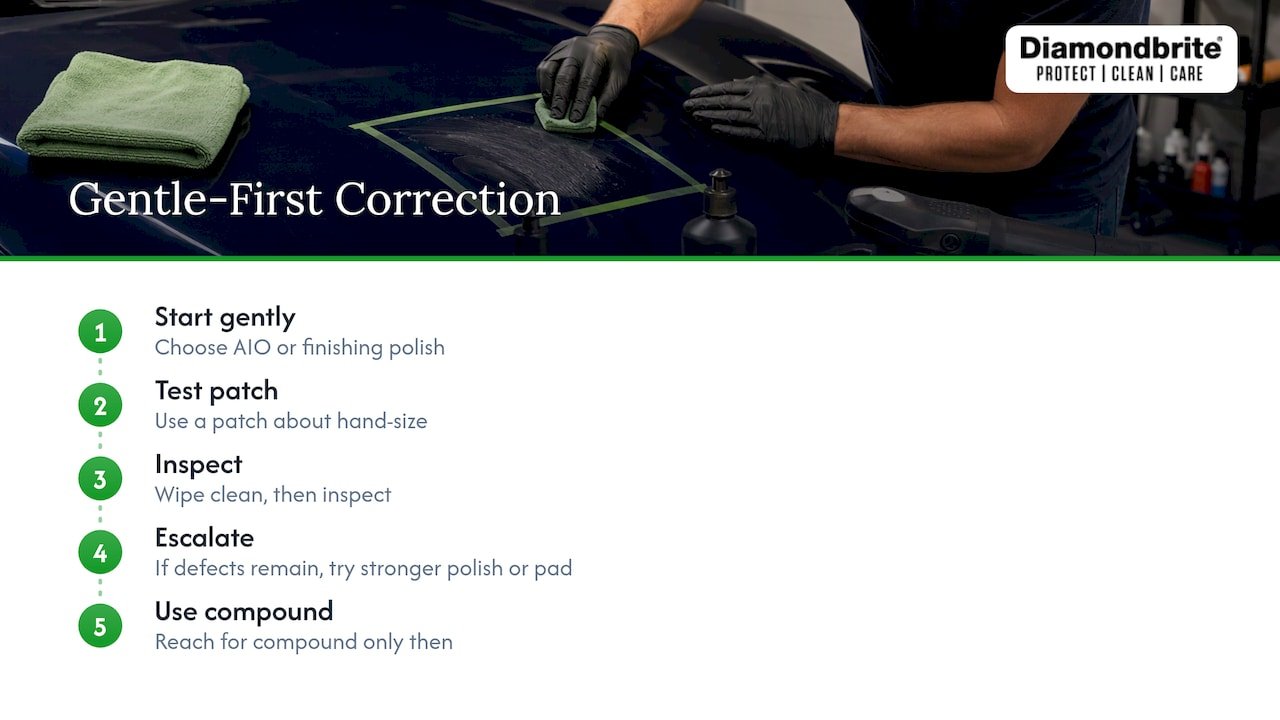
Compounding removes more clear coat than polishing does, and clear coat is a finite layer. Every panel you compound without needing to spends paint you cannot put back. That is why the sensible order is gentle first. Pick the AIO or finishing polish, run a test patch about the size of a hand, wipe it clean and inspect it. If the defect is still there, move to a stronger polish or pad. Only then reach for compound.
The product is only half of the result. Pad foam density, pad diameter and machine type change how aggressively the same product cuts, so a compound on a soft finishing pad behaves very differently from the same compound on a firm cutting pad. Change one variable at a time and note what happens.
When to use both
On properly neglected paint, the dependable route is two stages: compound on a cutting pad to remove the defects, then a finishing polish on a soft pad to restore clarity. A product tuned to cut hard cannot also be tuned to leave a perfect finish, which is why one product trying to do both jobs is a compromise on badly damaged paint.
An AIO still has a place in that routine. Once the paint is corrected, an AIO is a quick way to freshen gloss at intervals without taking the paint through a full correction again. Keeping that cycle gentle is how paint stays in good condition for years.
Applying either one safely
- Wash and dry first. Grit trapped under a pad scratches paint. Our car wash sequence keeps wheel dirt away from the bodywork.
- Work in the shade on cool paint. Heat dries polish too quickly and makes it harder to wipe off.
- Tape trim and badges. Abrasives can stain or scuff rubber and textured plastics.
- Use a small amount. A few pea-sized drops on the pad are enough. More product does not mean more cut.
- Work a small section at a time, roughly 50 cm square, with slow overlapping passes and light pressure. By hand, expect a gentler result than with a dual-action machine.
- Wipe off with a clean microfibre and inspect under good light before moving on.
- Protect the finish. Correction strips away old wax or sealant, so replace it, unless your AIO already includes a protective layer.
Matte and satin paint is the exception: abrasives would polish the surface smooth and shiny, so use a dedicated approach instead, as covered in our matte paint protection guide.
Does an AIO give lasting protection?
It gives a light layer, and how long it lasts depends on the formula, the weather and how you wash the car. Motorists in the UK deal with road salt in winter and strong sun in summer, so treating an AIO’s protection as short-term and topping it up is the realistic approach. If you plan to apply a ceramic coating, polish before ceramic coating so you seal in the finish you want, not the flaws.
While the paint cures between steps, you can finish the job inside with some vehicle interior cleaning so the whole car looks as good as the bodywork.
Keeping the finish after you polish
The best way to avoid compounding is to stop swirls forming. A two-bucket wash and careful blot drying do most of the work, as set out in preventing swirl marks without polishing. Ceramic shampoo and a glaze then add slickness and gloss between sessions. If you are unsure how a glaze differs from a polish, glaze vs polish explains the roles, and how to apply ceramic glaze shows the method. Once you have a ceramic layer, topping it up takes much less time than starting again.
Our view
Most paint we see owners worry about does not need a heavy cut. It needs a clean surface, a gentle polish if there is haze, and a protective layer that is easy to maintain.
That is how we think about ceramic car care at Diamondbrite: build a durable shield that keeps the finish glossy, so you spend your weekends enjoying the car rather than correcting it. Our ceramic glazes and shampoos are designed to make regular upkeep quick and cost-effective for everyday drivers, enthusiasts, motorcyclists and leisure vehicle owners alike.
Choose the lightest correction that works, protect what you have uncovered, and keep it clean with the right products. Your clear coat will thank you.
Will
Protect the finish you have just corrected
Once the paint looks right, keep it that way with our ceramic-infused care range, which covers cars, motorcycles, leisure vehicles and boats.
Browse the paintwork and ceramic ranges at Diamondbrite and pick the shampoo and glaze that suit your vehicle.
FAQ
Is rubbing compound the same as polishing compound?
Not quite. Rubbing compound usually means a coarser, more aggressive cutting product, while polishing compound is finer and aimed at refining. Both sit on a scale of cut, so check each product’s cut rating before you buy.
Can I use an AIO polish on a brand new car?
Yes, in most cases. New paint is usually in good condition, so a gentle AIO or finishing polish is a sensible choice if you want extra gloss and protection without taking off more clear coat than needed.
Should I compound or polish first?
Compound first, then polish. The compound removes the defects and leaves a slight haze, and the finishing polish refines that haze back to a clear gloss. If you only need gloss, skip the compound.
Can I apply AIO or compound by hand?
Yes, but expect gentler results than with a machine. Hand application suits light haze and gloss. For deeper defects, a dual-action polisher gives far more consistent results.