

The best saltwater protection for a boat is a habit plus a barrier. Rinse the whole boat with fresh water after every outing, keep a protective coating on the gelcoat and bare metal, and check your sacrificial anodes on a schedule. Seawater is harsh on metal and finish alike, but a simple routine keeps it under control.
TL;DR
- Rinse with fresh water after every saltwater trip, before salt dries and crystallises on the surface.
- Add a protective coating to the hull, topsides and bare metal so salt has less to cling to.
- Replace sacrificial anodes once they have wasted to about half their size.
- Flush the outboard, keep electrical connections tight and clean, and hose down the trailer.
- Check seacocks and fittings each season and replace doubtful ones with suitable marine-grade alternatives.
Table of Contents
- Why saltwater is so hard on boats
- Build the after-trip rinse routine
- Protect the finish with a coating
- Keep sacrificial anodes working
- Aluminium boats need extra care
- Outboards, seacocks and electrics
- Do not forget the trailer and the tow vehicle
- Our view: protection works best as a system
- Care for your boat with Diamondbrite
- A simple seasonal checklist
- FAQ
- Sources
Why saltwater is so hard on boats
Seawater conducts electricity well, which is why corrosion is worse in seawater than in freshwater. Corrosion is an electrochemical process. Where two different metals touch in a wet, salty environment, one gives way faster than the other. That is galvanic corrosion, and it is the reason a shiny new fitting can fail next to an older one.
Cracks and crevices make it worse. Places starved of oxygen, such as under washers, inside joints and behind clamps, can corrode even when the surface looks fine. Salt that dries on gelcoat and glass also does its own quiet damage: crystals are abrasive, so wiping a salty boat dry is a good way to scratch it.
That gives you three jobs: get the salt off, put a barrier between the boat and the water, and keep the metal protection system working.
Build the after-trip rinse routine
The single habit that matters most is rinsing. Rinse thoroughly before washing so salt is removed before it crystallises and scratches the surface. Only then wash gently with soapy water and rinse again with fresh water.
A routine that works for most UK owners:
- Hose first, touch later. Flood the decks, topsides, windows, rails and cleats with fresh water. Do not wipe anything yet.
- Wash while it is still wet. Grime is easier to remove before it dries, so do not leave the job until the weekend.
- Use a gentle, pH-balanced wash. A soft mitt and a quality shampoo lift the film without stripping protection. Our ceramic shampoo is designed to clean while leaving a ceramic-infused finish behind, which suits regular washing.
- Rinse with fresh water again. Pay attention to hinges, fixings and anywhere water pools.
- Dry with clean microfibre. This avoids water spots and leftover salt.
If the boat lives on a mooring and you cannot hose it every trip, rinse as often as you can reach it and do a full wash at least at the end of each week of use.
Protect the finish with a coating
A clean surface is only half the answer. A coating gives salt and spray something slippery to run off instead of a porous surface to bite into. Protective coatings isolate material from seawater and oxygen, and on bare aluminium, soft coatings such as waxes and lanolin-type products can extend protection against the environment.
For gelcoat and painted topsides, a ceramic-infused protectant builds a durable shield that makes each rinse easier and helps the surface keep its shine. The Marine range at Diamondbrite covers cleaning and protection for boats, so you can choose products for the surfaces you actually have.
Where to focus:
- Topsides and deck gelcoat: the most exposed to spray and UV.
- Windows and screens: salt film builds up fast and clouds visibility.
- Stainless rails and bare metal: these benefit from a soft protective layer after cleaning.
- Hull below the waterline: this is a separate job with its own timing, covered in our guide to cleaning your boat hull.
Reapply on a schedule rather than waiting for the finish to look tired. Water that stops beading and a surface that feels rough after washing are your cues.
Keep sacrificial anodes working
Anodes are made to corrode so your more expensive metal parts do not. Zinc, aluminium or magnesium types are used depending on the water. They only protect while there is enough metal left. The usual guidance in the boating press is to replace anodes once they have reduced by about 50% in size.
Practical points:
- Look at them at every haul-out or lift, and at the start and end of the season if the boat stays in the water.
- Do not paint over them. A coated anode cannot do its job.
- Make sure they are bonded and connected to what they protect.
For performance targets, the US standards body ABYC recommends a cathodic protection system that holds a negative shift of at least 200 mV relative to the least-noble metal being protected. If you want the system checked against that figure, ask a marine engineer or surveyor to test it.
Aluminium boats need extra care
Aluminium hulls and trailers suit many small boat owners, but dissimilar metals are the main risk. Fit only aluminium-safe antifouls: be very cautious with copper-based antifouls, because an epoxy barrier coating is integral to preventing localised galvanic corrosion. Flush bilges with a salt-removing wash and keep them dry, and use a soft protective coating on any bare aluminium.
If you are unsure which antifouling or primer is compatible with your hull, ask the boat’s builder or a marine paint specialist before you apply anything.
Outboards, seacocks and electrics
These are the places where corrosion hides.
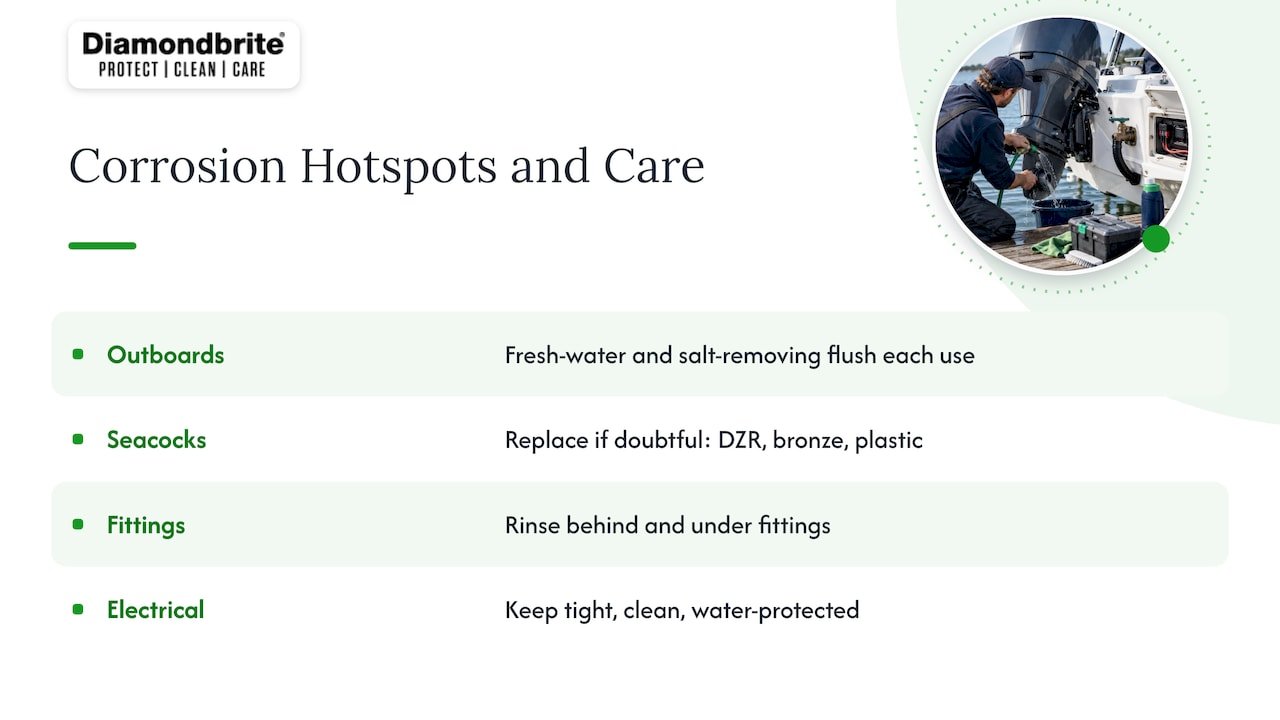
Outboards. Flush with fresh water and a salt-removing engine flush after each use, following your engine maker’s instructions.
Seacocks and through-hulls. Ordinary brass and some bronze alloys can corrode and fracture. If in doubt, replace seacocks with DZR brass, bronze or plastic alternatives. This is a safety item, not cosmetics, so have a surveyor or qualified engineer look at anything that is green, pink or crumbling.
Fittings and fasteners. Marine-grade stainless steels, duplex alloys and anodised aluminium resist chloride attack far better than standard grades. Stagnant seawater in crevices remains a hotspot even for these, so rinse behind and under fittings.
Electrical connections. Keep them tight, clean and protected from water ingress. Green or white crust on a terminal is a warning sign. This guide to battery terminal corrosion fixes explains how to clean terminals and when replacement makes more sense.
Do not forget the trailer and the tow vehicle
A trailer sits in salt at every launch. When you load the boat, hose down the trailer frame as well, and wash it while grime is still wet. Pay attention to leaf springs, couplings, lights and the winch.
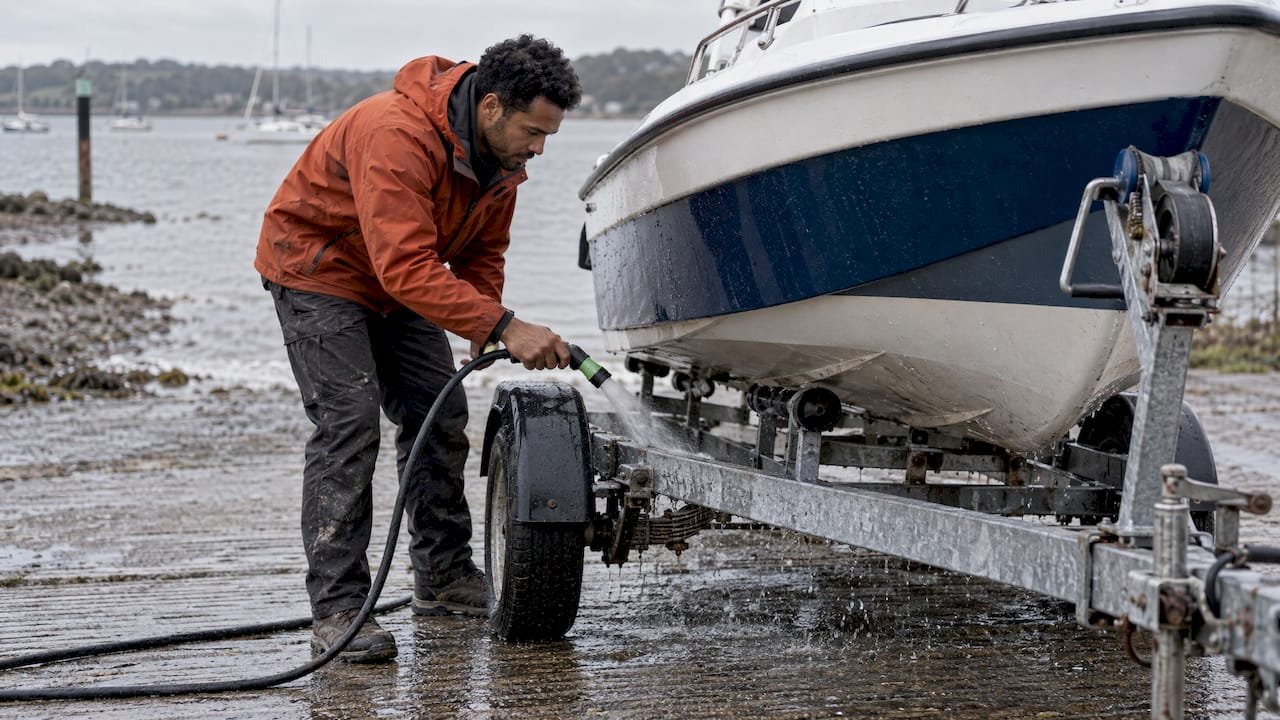
Brakes deserve a thought too. Getting wet at the ramp changes how a trailer and tow vehicle behave, and this advice on wet brakes at the boat ramp covers launching and retrieving safely.
Your car takes a share of the salt as well, from spray, ramp water and winter roads. Our guides to road salt protection and winter wash frequency cover the tow vehicle. If your boat is stored on a trailer or you also own a caravan, the caravan exterior routine uses the same wash-then-protect logic.
Our view: protection works best as a system
We see the same pattern in boat owners who write to us. The ones with the best-looking boats after years of salt are not doing anything exotic. They rinse every time, wash gently, and keep a protective layer on every surface they can reach.
That is why our ceramic-infused range is built around easy, repeatable care: a shampoo for regular washing and protective products that build a durable shield between the surface and the elements. Used little and often, they are designed to make each wash faster and each rinse more effective.
Our Marine, Leisure and Motorcycle ranges sit alongside our car products, so one routine can cover the boat, the trailer and the tow car. Start with the rinse, add a coating, and keep it up. That is what we recommend.
Will
Care for your boat with Diamondbrite
If you want one place to build a routine, our Marine range covers cleaning and protection for boats, with matching products for cars, motorcycles and leisure vehicles. Pick a wash, a protective product and the right tools for your surfaces, and you have the core of a saltwater routine.
Browse the Diamondbrite range and choose the products that match your boat and the way you use it.
A simple seasonal checklist
| When | What to do |
|---|---|
| After every trip | Fresh water rinse, flush the outboard, hose the trailer |
| Weekly in use | Gentle wash, dry with microfibre, check for salt crust on fittings |
| Start of season | Inspect anodes, seacocks, battery terminals and wiring; apply protective coating |
| End of season | Full wash, protect bare metal, flush bilges and dry, check anodes at haul-out |
FAQ
How often should I rinse my boat after saltwater use?
Rinse after every trip, ideally before the boat dries. Salt left to crystallise is abrasive and speeds up corrosion on metal. Follow the rinse with a gentle wash when time allows.
Does saltwater damage fibreglass boats?
Salt itself is mainly a problem for the finish, since crystals scratch gelcoat if wiped dry. The metal fittings, fasteners and engine are where corrosion bites hardest. Regular rinsing and a protective coating look after both.
When should I replace sacrificial anodes?
A common rule is to replace them once they have reduced by about half. Check them at every haul-out and at the start and end of the season. Never paint them, because a coating stops them working.
Can I use any antifoul on an aluminium boat?
No. Use only aluminium-safe antifouls, and be cautious with copper-based products. If you are unsure, ask the boat builder or a marine paint specialist before applying.