

The two bucket wash method uses one bucket of soapy water and one bucket of clean water, so the grit you lift off the paint never goes back into your shampoo. Parkers describes it as a wash bucket plus a rinse bucket, used to stop dirt being dragged across the paint and leaving tiny scratches. It costs very little, takes a few minutes longer than a one-bucket wash, and it is the simplest habit that protects your paintwork at home.
TL;DR
- Use one bucket for shampoo and one for rinsing your mitt, and put a grit guard in each.
- Rinse the car first, ideally with a pre-wash, so loose dirt is gone before the mitt touches the paint.
- Wash top to bottom, one panel at a time, and rinse the mitt in the clean bucket before every reload of shampoo.
- Rinse off all the soap and dry with a clean microfibre towel.
- Do the wheels with separate tools, so brake dust stays away from your paint.
Table of Contents
- Why two buckets protect your paint
- What you need
- How to set up your buckets
- The wash, step by step
- Is the two bucket method really necessary?
- Does it work for motorcycles and leisure vehicles?
- Our view: wash less aggressively, protect more
- Build your wash kit with Diamondbrite
- FAQ
- Sources
Why two buckets protect your paint
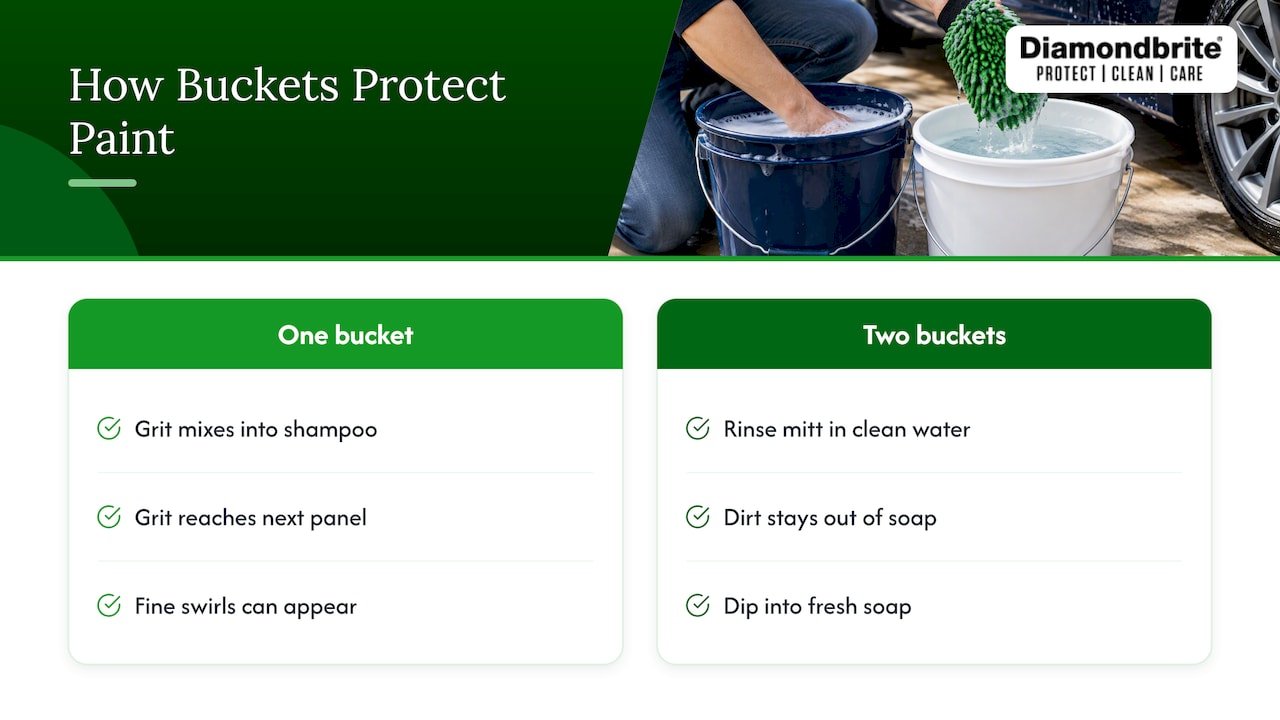
Every time you wipe a dirty panel, the mitt picks up grit. In a single bucket, that grit swims in your shampoo and goes straight back onto the next panel. That is how fine swirl marks appear, the spidery scratches you see in sunlight.
The method breaks that loop. You rinse the mitt in the clean bucket first, the dirt stays there, and only then do you dip into fresh soap. A Freightliner service bulletin from 2018 recommends the technique for the same reason: it keeps dirt taken from the vehicle from returning to the wash solution and being picked up again.
It matters most on darker colours and on cars that are not freshly polished, where swirls show up fastest. If you want the wider picture, our guide to preventing swirl marks without polishing covers what else helps.
What you need
The RAC’s car-washing advice lists the basics: two buckets, car shampoo, a wash mitt, a hose or pressure washer and a microfibre drying towel. Add these to make it work properly:
- Two grit guards. These sit at the bottom of each bucket and let dirt settle beneath the mitt’s reach.
- Two clearly marked buckets. Use different colours, or label them “wash” and “rinse”, so you never mix them up.
- A pre-wash product. A snow foam or pre-wash softens dirt before you touch the paint.
- Separate wheel tools. A brush and mitt used only on wheels and tyres.
- A spare mitt. Handy if you drop one on the ground. Never carry on with a dropped mitt.
Use a car shampoo, not washing-up liquid. Washing-up liquid is made to strip grease and can take protection off your paint as well as the dirt.
How to set up your buckets
Parkers’ setup advice is simple: fill both buckets with water, add the recommended amount of shampoo to the wash bucket only, and put a grit guard in each.
A few practical points:
- Follow the dilution on the shampoo label. More soap does not mean more cleaning, and it makes rinsing harder.
- Fill the wash bucket a little less than full so it does not slop over when you dunk the mitt.
- Keep the rinse bucket plain water, nothing else.
- Work in the shade if you can. Soap that dries on warm paint leaves marks.
The wash, step by step
1. Rinse and pre-wash
Start with the hose or pressure washer and rinse the whole car, top to bottom. Parkers suggests that, ideally, you apply a pre-wash before using the buckets to soften and break down dirt, which further cuts the risk of scratches. Our guides to a pre-wash and two bucket routine and the best car pre-wash for UK owners explain how long to leave it and what to look for. If your car has a coating, the pre-wash for ceramic coatings page covers the pH and the golden rule of never letting it dry.
2. Wheels first, with their own tools
Wheels carry the worst grit on the car. Clean them before the paint, using tools that never touch the bodywork. Our wash sequence guide explains why order matters, and the brake dust removal guide covers safe dwell times.
3. Wash from the roof down
Load the mitt in the soap bucket and wash one panel at a time, starting at the roof and working down. The lower sills and bumpers are the dirtiest, so they come last. The RAC advises washing in straight lines rather than circles, which helps make any marks less visible.
Use light pressure. The mitt and shampoo do the work, and pressing harder only drives grit into the paint.
4. Rinse the mitt, then reload
This is the step that makes it a two bucket wash. After each panel, dunk the mitt in the rinse bucket and rub it against the grit guard. Then wring it out and only then return it to the soap bucket. Parkers describes exactly this: clean the mitt against the grit guard before putting it back in the wash bucket, and repeat until the car is done.
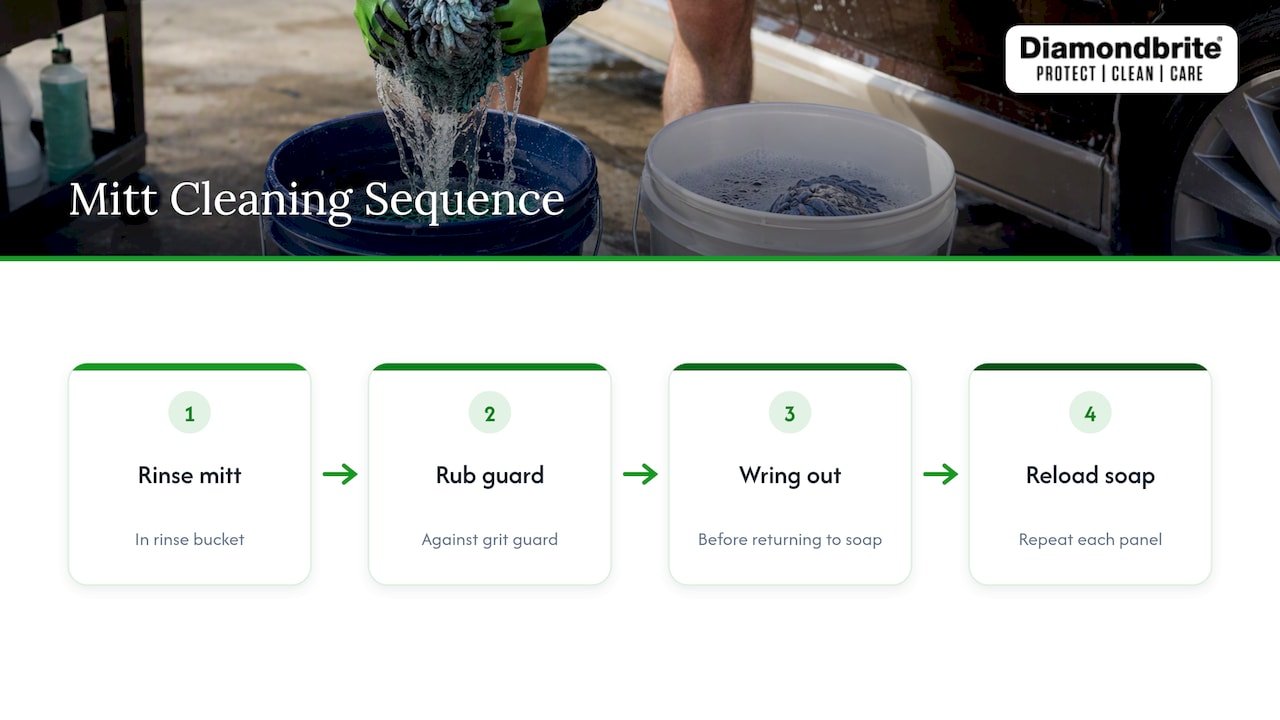
When the rinse water turns visibly grey, empty it and refill. That is the method working, not a sign you did something wrong.
5. Final rinse
Rinse all the soap off, again top to bottom. The RAC notes that soap residue can streak if it dries on the paint, so do not leave it to air-dry in patches. In hard-water areas, drying promptly also helps avoid marks, and our guide to removing water spots covers what to do if they appear.
6. Dry gently
Use a clean, soft microfibre drying towel. Lay it on the panel and pat or drag it lightly rather than scrubbing. If you would rather keep towels off the paint altogether, see our guide to drying a car with filtered air.
Is the two bucket method really necessary?
It is not a legal requirement and nobody will fine you for using one bucket. But if you wash by hand, it is the cheapest way to cut the main cause of wash-induced scratching. Parkers calls two buckets the most effective car-washing method, and says a third bucket is not really needed because the extra benefit is tiny.
Some enthusiasts prefer other approaches, such as a fresh mitt for each panel. These can work well too. What matters is the principle: never put a dirty mitt back into clean soap. If you use another method, keep that rule and make sure the car is pre-rinsed.
One exception: a third bucket for wheels is reasonable if your wheels are very dirty, though a separate brush and mitt that never touch the paint achieves much the same thing.
Does it work for motorcycles and leisure vehicles?
The principle applies to any painted or glossy surface that you wash by hand: bikes, caravans and motorhomes included. The same logic holds. Keep dirt out of your clean soap, work from the top down and keep wheel tools separate. On a motorcycle, use smaller buckets and a smaller mitt, and take care around the chain, brakes and exhaust, following your manufacturer’s handbook. For large caravans and motorhomes, work in sections so soap never dries on the surface.
Our view: wash less aggressively, protect more
We see the same pattern with most car owners: the wash is where paint gets damaged, and protection is what makes the next wash easier. A ceramic-infused shampoo leaves a slick surface behind, so the mitt glides and the dirt lets go with less effort. That is why we pair the two bucket method with ceramic-infused products rather than treating it as a stand-alone trick.
Our advice is practical. Pre-wash first, use gentle pressure, rinse your mitt every panel and dry carefully. If you do that, you will protect the finish far longer than any product alone can. You can read more on what a ceramic shampoo does for paintwork and how to keep gloss going without waxing over a coating.
— Will
Build your wash kit with Diamondbrite
If you are putting a two bucket kit together, our ceramic-infused shampoos, snow foams, wheel care and protection products cover each stage, for cars, motorcycles, leisure vehicles and marine. Pick a pre-wash, a shampoo and a protectant that work together, and your next wash gets quicker and safer.
FAQ
What is the two bucket method of car washing?
It uses one bucket of shampoo solution and a second bucket of plain water for rinsing your wash mitt. You rinse the mitt after each panel, so the dirt you remove stays in the rinse bucket and does not scratch the next panel.
What is the best way to wash my car at home?
Rinse the car, apply a pre-wash, then wash top to bottom with a two bucket setup and a clean mitt. Rinse off all the soap and dry with a soft microfibre towel. Clean the wheels separately with their own tools.
Do I need grit guards?
They are part of the standard setup. A grit guard sits at the bottom of the bucket, and you rub the mitt against it to release dirt, which then stays below the mitt. Without one, the method still helps, but it is less effective.
Should I use a third bucket?
Parkers says a third bucket is not really necessary for the paint because the benefits are minimal. A dedicated wheel bucket is only worth it if your wheels are very dirty and you do not have separate wheel tools.