

Yes, glaze goes on after polish. Polish corrects the paint, glaze adds depth and gloss on top of that corrected surface, and a sealant or wax goes over the glaze to protect it. Get that order right and each step does its own job. Get it wrong and you either waste effort or stop your protection bonding.
TL;DR
- Polish comes first. It is abrasive and levels the clear coat. Glaze is non-abrasive and sits on top, as RAC guidance on paintwork describes the two.
- The sequence is wash, decontaminate, polish, glaze, then sealant or wax.
- Glaze never replaces polish: it hides fine marks, it does not remove them.
- Do not put glaze over a sealant or a fresh ceramic coating. Glaze goes underneath protection, never on top.
- Glaze is optional on a daily driver and most worthwhile when you want show-level depth.
Table of Contents
- What polish and glaze each actually do
- The correct order, step by step
- Why glaze after polish helps
- Glaze versus sealant: which is which?
- Glaze before sealant, or glaze over sealant?
- Do you need a glaze at all?
- Our view: why we like a ceramic glaze
- Getting the products together
- Keeping the finish after you glaze
- FAQ
- Sources
What polish and glaze each actually do
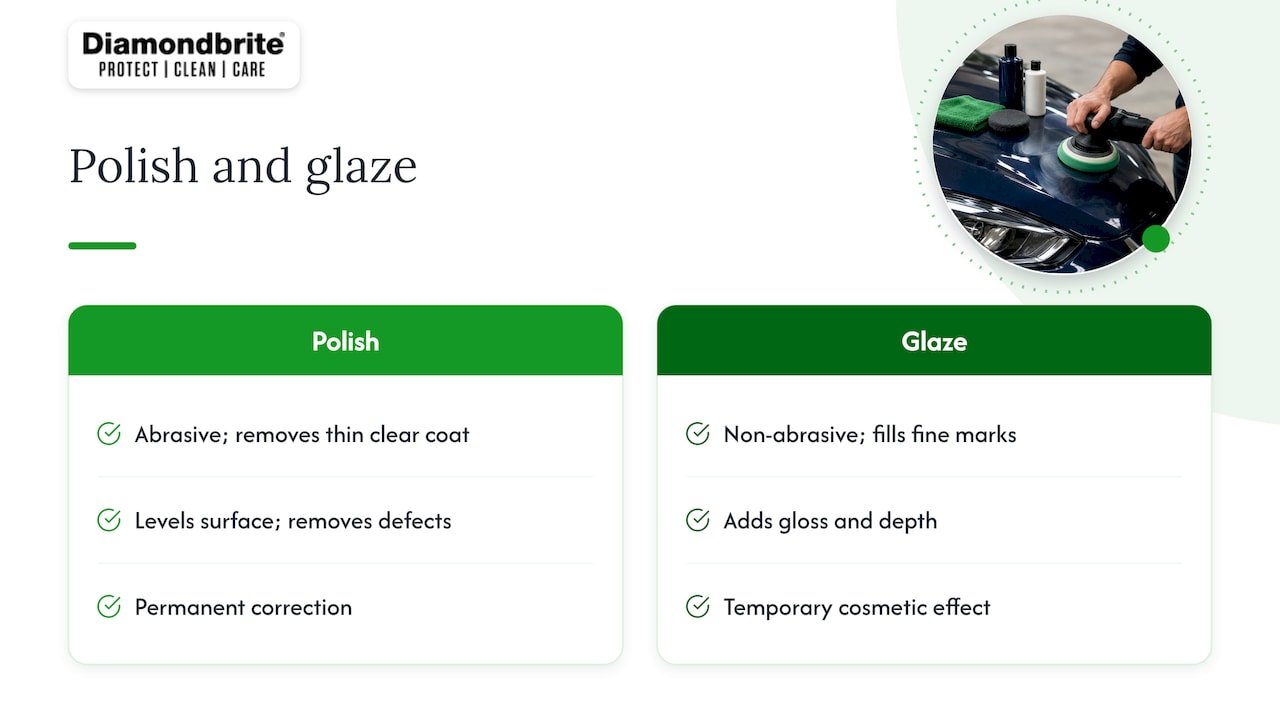
The two products get confused because both go on paint and both can make it look better. They work in opposite ways.
Polish is an abrasive. It removes a very thin layer of clear coat to level the surface, which is how it takes out light scratches and oxidation. That is why the effect is permanent: the defect is gone, not covered.
Glaze is non-abrasive. It fills microscopic pores and fine marks and adds gloss and depth, but the effect is temporary and cosmetic. RAC’s guide to removing scratches sets out this split between levelling and enhancing.
A simple way to remember it: polish is correction, glaze is refinement, sealant is protection. If you want the longer comparison, our guide on when to use glaze versus polish goes through it.
The correct order, step by step
The sequence below follows the one set out in RAC’s guide to washing your car, with polish and glaze added for a full detail.
- Wash. Use proper car shampoo, never washing-up liquid. Carwow explains that its harsh, high-pH detergents can damage paintwork. Wash wheels in the right order too: our wash sequence guide shows how to keep wheel grit off the paint.
- Decontaminate. A clay bar lifts the bonded grit that washing leaves behind. Polishing over it just drags it around.
- Polish. Work panel by panel until the defects you are targeting are gone. If swirl marks are your main problem, see how to remove swirl marks.
- Wipe down. Remove polish residue so the glaze goes onto clean paint.
- Glaze. Apply thinly, let it settle as directed on the bottle, and buff off.
- Protect. Finish with a sealant or wax.
The order matters because polishing leaves bare paint with nothing on it. Glaze and protection then restore what the polish took off the surface.
Why glaze after polish helps
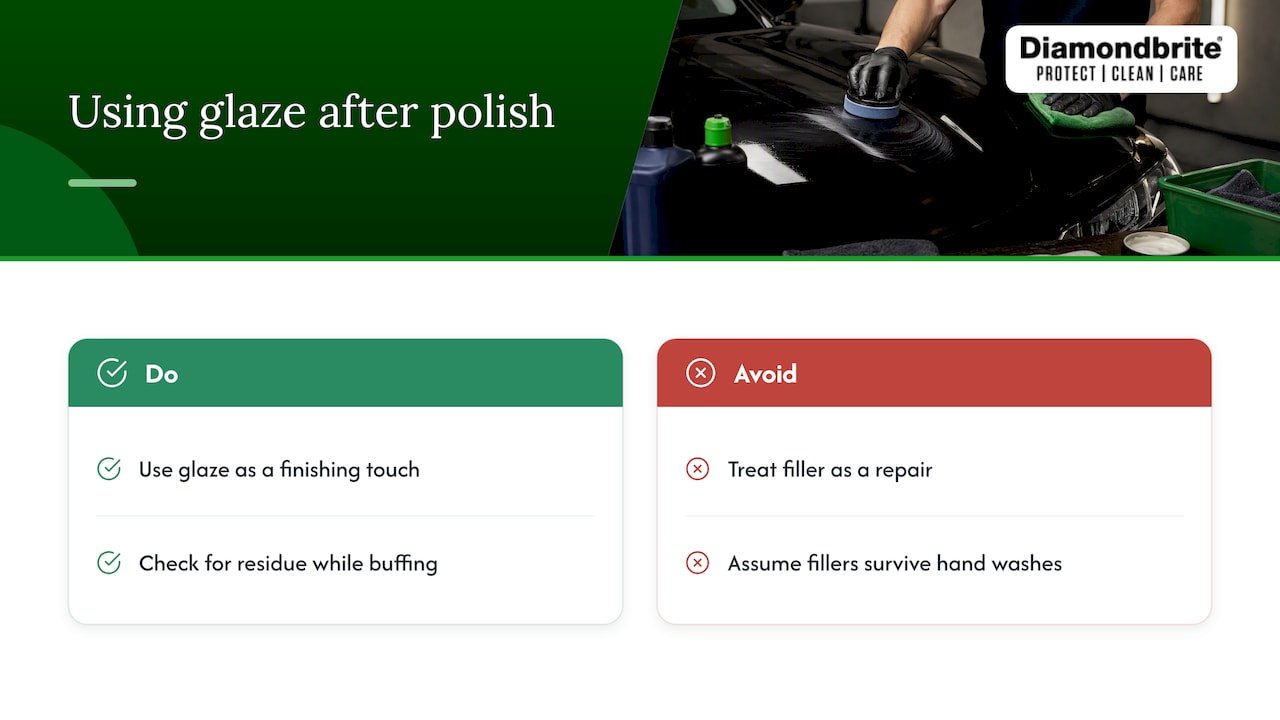
Heavy polishing can leave a slight haze, a finish that looks a touch flat even though the scratches have gone. A glaze fills the tiny peaks and valleys that remain, so the paint looks richer and wetter. Many detailers use it as the bridge between correction and protection.
It is also a useful check. If you can see leftover polish residue or oily smears as you buff the glaze, you know the surface was not fully clean before protection goes on.
There is a limit, though. A glaze can only mask. Which? tested car scratch removers and found that some repairs do not last long, with some products not surviving repeated hand washes. Treat any filler as a finishing touch, not a repair.
Glaze versus sealant: which is which?
They sit at different layers and do different jobs.
| Polish | Glaze | Sealant | |
|---|---|---|---|
| Job | Corrects defects | Adds depth and gloss | Protects the paint |
| Abrasive? | Yes | No | No |
| Order | First | Second | Last |
| Effect on defects | Removes them | Hides fine ones | Does not touch them |
A sealant protects. A glaze beautifies. If you only have time for one, choose the sealant, because protection is what keeps the paint healthy. If you want to compare sealants with longer-lasting options, read our guide to sealant versus ceramic coating.
Glaze before sealant, or glaze over sealant?
Glaze goes before sealant. That is the layered order: polish, glaze, sealant.
Putting glaze over a sealant is the mistake to avoid. A glaze is designed to fill and sit on the surface, so on top of protection it adds an oily layer that does little and can get in the way of the next wash and top-up. If your sealant is already on and you want more gloss, wash the car and use a product made to go over protection instead.
The warning is stronger with ceramic coatings. A coating needs to bond to the paint itself, not to a temporary filler. So if you want glaze, apply it to the polished clear coat first, then degrease thoroughly before the coating goes on. Many people skip glaze entirely before a coating for this reason. Our guide on whether to polish before ceramic coating covers the prep in more detail.
Do you need a glaze at all?
Not always. Skipping glaze is common on daily drivers. It earns its place in these cases:
- You want maximum depth for a car show, a sale or a special occasion.
- The paint is dark or has a slight haze after polishing.
- You enjoy the process and want the best finish you can get from a weekend’s work.
Skip it if you are short of time, if the car is going straight to a ceramic coating, or if you would rather put your effort into protection and regular washing. A glaze that fades in a few weeks is not worth a day’s work on a car that lives outside.
Our view: why we like a ceramic glaze
Traditional glazes were largely cosmetic. They looked good on the day and faded quickly, which is why many owners wrote them off. We think the better answer is a ceramic-infused glaze, which keeps the gloss and filling benefits but adds some of the durability people want from ceramic care, without needing to be a master detailer.
That matters for the everyday motorist. Most of our customers want a car that looks well kept without a whole weekend of work every month. A ceramic glaze after polishing gives you a deep finish, and a good routine of ceramic shampoo keeps it looking that way. Our write-up on what ceramic shampoo does for paintwork explains the maintenance side.
Our advice is simple: polish only as much as the paint needs, glaze thinly, protect properly, and wash with care. Fewer, better steps beat a cupboard full of products.
— Will
Getting the products together
If you want to try the sequence, our shop carries Ceramic Glaze and Ceramic Shampoo, along with paintwork, ceramic, wheel, glass and interior ranges for cars, plus motorcycle, leisure and marine care. Start with a ceramic glaze for the finish and a ceramic shampoo for the wash, and add the rest as your routine grows.
Keeping the finish after you glaze
The work after the glaze decides how long it lasts.
- Wash gently. Use a proper car shampoo and a clean mitt. Harsh detergents strip filler and protection together.
- Act quickly on contamination. Bird droppings are acidic and should be softened and lifted, not scrubbed dry. Carwow’s guide to removing bird droppings shows the safe way.
- Top up protection. Whatever you used over the glaze needs refreshing. If you move to ceramic, our guide to washing a ceramic-coated car covers routine care.
- Re-glaze when the gloss drops. It is a quick job on a clean surface and does not need polishing again.
FAQ
Is glaze the same as polish?
No. Polish is abrasive and removes a thin layer of clear coat to level the paint, which takes out light scratches. Glaze is non-abrasive and fills fine marks to add depth. Polish fixes, glaze finishes.
Do I have to apply sealant after glaze?
Yes, you should. Glaze is a temporary cosmetic layer and offers little protection on its own. A sealant or wax over the top protects the finish and the glaze underneath it.
Can I glaze a car that is already ceramic coated?
We would not. A glaze is built to fill and mask, and it does not belong on top of a coating. If you want a glaze, put it on polished bare paint, then degrease before the coating goes on.
Can I use glaze instead of polish to remove swirls?
Not for removal. A glaze hides light swirls for a while, but they return as it wears off. Polish is what takes them out, and glaze can follow to improve the look.
Sources
- How to remove car scratches: DIY fixes for car damage | RAC Drive
- How to wash your car | RAC Drive
- Does WD40 remove car scratches? And nine other things we learned testing car scratch removers | Which?
- Washing Up Liquid Could Damage Your Car Paintwork | Carwow
- How to Remove Bird Droppings Without Damaging Car Paint | Carwow