

Beading is the behaviour to want when you care how your car looks after rain or a wash, with tight, round droplets sitting proudly on the paint. Sheeting is the behaviour to want if you care about speed and cleanliness, with water running off in sheets and leaving fewer spots behind. Both point to a hydrophobic surface, so the real question is which task you’re doing right now.
TL;DR:
- Beading can come from thinning wax or greasy contamination, so check product age, paint feel, gloss, and consistency across panels before judging protection.
- For a fair driveway test, wash and dry the car, then mist a cool, shaded vertical panel; avoid leftover suds, wind, and hot paint.
- A pH neutral shampoo preserves existing protection, while clay or chemical decontamination every few months helps new coatings bond and level evenly.
- Spray toppers boost beading for only a few weeks, while cured ceramic glazes or maintenance sealants favor lasting sheeting when applied over clean, decontaminated paint.
Table of Contents
- 1. What is water beading?
- 2. What is water sheeting?
- 3. The surface science behind why paint beads or sheets
- 4. What beading or sheeting tells you about protection
- 5. Quick tests you can run on the driveway
- 6. Maintenance routines that favour sheeting or beading
- 7. Diamondbrite recommended routines and product types
- 8. Choosing appearance versus function
- How our products map to beading and sheeting
- FAQ
- Sources
1. What is water beading?
Beading happens when water refuses to spread out and instead draws itself into small, rounded droplets. That shape comes from a high contact angle between the water and the paint, which is a technical way of saying the water would rather hold its own shape than wet the surface. On a freshly waxed or ceramic-coated panel, this is usually the first thing you notice: the paint looks almost jewelled after rain.
You’ll recognise beading by a few visual cues:
- Droplets stay round and discrete rather than merging into a film.
- Water rolls off slowly, often pausing on sloped or flat panels.
- Beads cling stubbornly in shallow recesses like body lines and badge edges.
Beading is commonly produced by waxes, silicone-based sprays, certain polymer sealants and, sometimes, by a layer of old product or light contamination that happens to repel water without actually protecting the paint underneath.
2. What is water sheeting?
Sheeting is the opposite visual signature. Instead of forming beads, water spreads into a thin, continuous film that slides off the panel in one motion. Rather than lingering in rounded droplets, the water behaves almost like it’s being poured off a sloped roof, leaving the surface to dry far quicker and with less residue.
For anyone who washes their car regularly, sheeting is often the more useful behaviour on a practical level. During a rinse, sheeting clears soap and loose dirt off the panel fast, which matters because the less time water sits on paint, the less chance it has to dry into hard water spots and mineral deposits. On a daily driver that gets rained on and washed often, this translates into less time spent chasing spotting with a microfibre after every wash.
Sheeting tends to show up when a protective layer has levelled out evenly across the panel rather than sitting in an uneven film. Well-cured ceramic coatings, certain spray sealants, and polymer layers that have bonded properly to the paint all tend to encourage this flatter, faster water flow. You’ll typically see it on:
- A panel with a smooth, evenly applied sealant or coating rather than a patchy one.
- Glass and mirrors, where sheeting is especially valuable because it keeps visibility clear in rain.
- Surfaces that have been properly decontaminated before protection was applied, since trapped residue under a coating can disrupt how evenly it sheets.
The application process itself has a measurable effect on this. Research into coating methods for automotive steel panels found that film thickness and the way a coating is applied change the final surface finish, with smoother, more evenly applied films behaving differently from thicker or unevenly distributed ones, which is exactly why two cars with the “same” sealant can show different water behaviour depending on how well it was levelled during application, as described in research on automotive coating application methods.
3. The surface science behind why paint beads or sheets
The underlying principle is contact angle, which simply measures how tightly water clings to itself versus how much it spreads across a surface. A high contact angle means the water forms a tight, rounded bead because it has low affinity for the surface beneath it. A low contact angle means the water spreads thinly and sheets, because it wets the surface more readily.
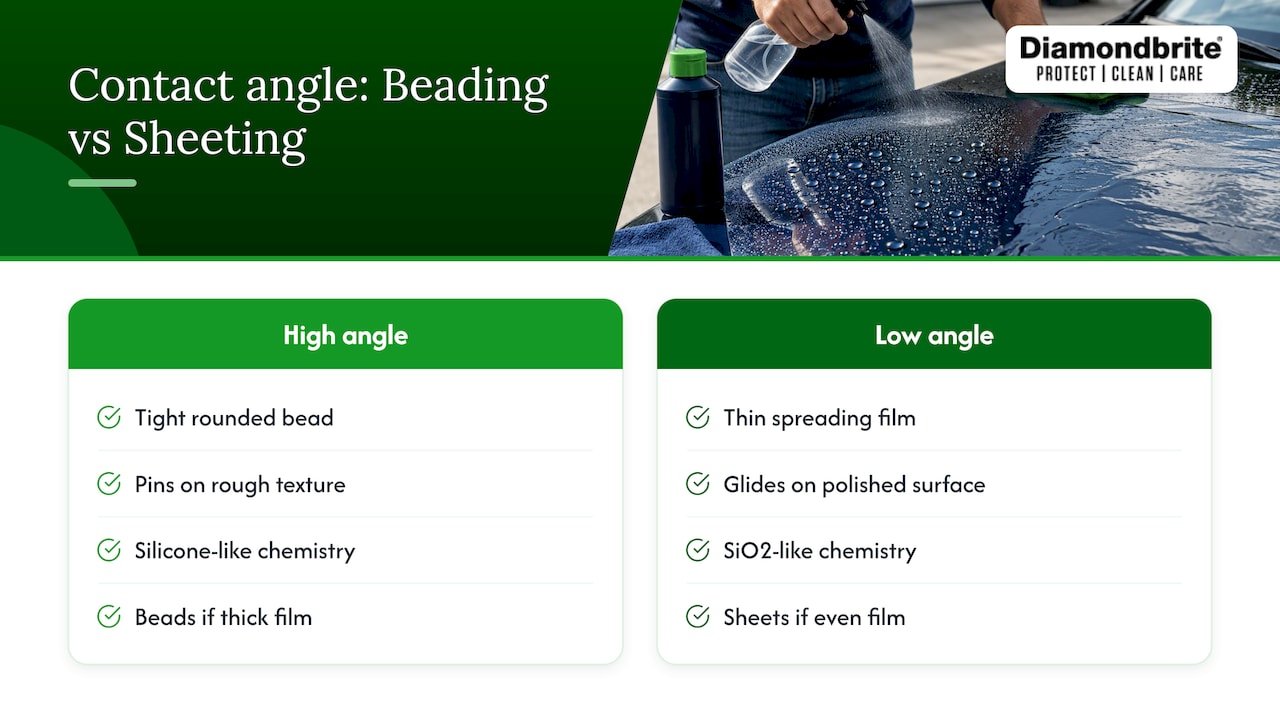
Microscopic texture plays a bigger role than most people assume. A surface that has been properly polished and levelled offers fewer tiny peaks and valleys for water to catch on, so a coating sits flatter and water glides off more uniformly. A rougher or less refined surface, even with the same product applied, can pin droplets in place and encourage beading rather than sheeting, regardless of what the coating is chemically designed to do.
Coating chemistry matters too. Silicone-based products tend to produce tight, glossy beads because of how they arrange themselves at a molecular level. Silica-based (SiO2) ceramic coatings often produce a flatter, more even film that favours sheeting once fully cured. Polymer sealants sit somewhere between the two, depending on formulation and how thoroughly they’re applied.
This explains a common source of confusion: the same product can behave differently on two cars. Coating application method and film thickness shift the final surface finish, so panel prep, polish level and even how the product was wiped down all influence whether you end up with beading, sheeting, or something in between.
4. What beading or sheeting tells you about protection
Neither behaviour is a guarantee on its own. A car can bead beautifully for weeks on a layer of old wax that’s thinning out, or even on a film of greasy contamination that happens to repel water without offering any real defence against UV, bird droppings or road grime. Beading looks reassuring, but it isn’t proof that the paint underneath is actually protected.
Sheeting is generally the more reliable everyday signal for maintenance purposes, mainly because it reduces the time water spends sitting on the panel, which lowers the chance of mineral deposits and water spotting setting in before you can dry the car.
Forum and community consensus consistently treats beading and sheeting as two sides of the same hydrophobic coin, used as shorthand for different outcomes rather than competing proof of protection, with beading read as aesthetic evidence and sheeting read as a sign of fast, clean rinse-off.
To judge the real condition of your protection, combine the water test with a few other checks:
- How recently was the product applied, and is it within its expected working life?
- Does the paint feel slick and smooth to a clean, dry hand, or slightly gritty?
- Is the gloss still deep and even, or has it started to look flat and tired?
- Does water behave consistently across every panel, or only in patches?
5. Quick tests you can run on the driveway
A simple mist test tells you almost everything you need to know, and it takes under five minutes.
- Wash and dry the car fully, then let the panel reach a normal, cool temperature out of direct sun.
- Mist a flat panel lightly with a spray bottle or a hose on low pressure from about 30 centimetres away.
- Watch the droplet shape: tight round beads mean a high contact angle, while a spreading film means sheeting.
- Tilt the panel slightly or angle the hose and time how long it takes water to clear.
- Check for spotting once the panel has air dried, which tells you whether water lingered longer than it should have.
Avoid testing straight after a snow foam session, since leftover suds can mimic beading temporarily. Testing in direct wind or on a sun warmed bonnet can also distort results, since both speed up evaporation before you get a fair read.
Pro Tip: Run the test on a shaded, vertical panel like a door, since horizontal panels like the bonnet can trap water regardless of coating condition.
6. Maintenance routines that favour sheeting or beading
Your weekly wash choices shape which behaviour you end up seeing. A snow foam pre-wash followed by a pH-neutral shampoo keeps existing protection intact, while a hydrophobic topper spray applied after drying gives an immediate, visible boost to beading if that’s the look you want before a show or a photo.
For longer-term results rather than a temporary boost, the type of protection you apply matters more than the wash itself:
- Spray sealants and toppers give a quick beading boost that typically fades within a few weeks.
- Ceramic glazes and cured ceramic coatings tend to settle into a flatter, more even sheeting pattern once fully bonded.
- Decontamination steps like a clay bar or iron remover before applying any protection help the product level out evenly across the panel, which is often the real reason two similar cars sheet differently.
Panel prep is the part most people skip. A coating applied over old wax, embedded tar spots or bonded contamination will never sit, cure or wet evenly, no matter how good the product is.
7. Diamondbrite recommended routines and product types
We build our own maintenance guidance around repeatable results rather than short-lived cosmetic effects. Our typical routine starts with a weekly wash using a pH-neutral shampoo designed to maintain the slickness of an existing coating without stripping it, followed by a periodic clay or chemical decontamination every few months to keep the surface level and free of bonded grime.
For longer-term sheeting, we recommend a ceramic glaze or maintenance sealant designed to cure into a flat, even film rather than a thick, patchy one. If showy beading matters more for a particular event, a lighter topper can give that look temporarily without disturbing the base coating underneath. Refreshing a maintenance sealant every few months helps keep protection consistent rather than letting it fade unevenly across panels.
8. Choosing appearance versus function
If you show your car or photograph it often, beading gives you that glossy, jewelled look that photographs beautifully in direct light. If you’re running a daily driver through regular rain and weekly washes, sheeting saves you time by clearing water fast and cutting down on spotting before you’ve even reached for a towel.
Most owners don’t have to choose permanently. A well-cured ceramic base that sheets reliably, topped occasionally with a spray booster before a show, gives you function most of the time and appearance when it counts.
— Will
How our products map to beading and sheeting
The product range is designed so you can choose the behaviour that suits what you’re doing with your car, rather than guessing at which product does what. Regular washing with a ceramic shampoo helps keep an existing coating performing well and supports consistent sheeting between applications, while ceramic glazes and paintwork sealants are formulated to cure into the flatter, even films that favour long-term sheeting and easier rinsing.
If you want a reliable starting point, a simple combination works for most cars:
- A ceramic shampoo for weekly maintenance washes that protect existing coatings.
- Application of a ceramic glaze every few months for lasting, even protection.
- Use of a quick topper spray before shows or photos if showy beading is the priority for that day.
Browse our full Automotive range to put together a kit that matches how you actually use your car.
FAQ
Is water beading or sheeting better?
Neither is universally better since both indicate a hydrophobic surface, but they suit different tasks. Beading looks more impressive for shows and photos, while sheeting is generally more practical for regular washing and rain, since it clears water faster and reduces spotting.
What to use instead of beading?
If beading isn’t giving you the practical results you want, a well-cured ceramic coating or sealant that favours sheeting is the usual alternative, since it clears water and dirt faster during washes and rain. Ceramic glazes and maintenance sealants tend to settle into this flatter, faster-draining finish once fully cured.
What is beading in construction?
In construction, beading refers to a different concept entirely: angle bead or plaster bead, a strip used to reinforce and straighten corners in plastering work. This is unrelated to water behaviour on car paint, as described in the Catnic angle bead datasheet.
What is beading of sheet metal?
In sheet metal and coating contexts, beading can refer to how a coating film sits unevenly during application, sometimes forming a thicker edge or bead where material accumulates. This is a manufacturing and application concern distinct from the cosmetic water beading seen on finished car paint, and relates to the film thickness and application issues covered in research on coating processes.
Which detailing accessories help maintain either behaviour?
Microfibre drying towels, pH-neutral shampoos and soft applicator pads all help preserve whatever coating you’ve applied, whether it favours beading or sheeting. For unrelated detailing gear decisions, such as choosing brake pads that won’t leave the wheels caked in dust between washes, a comparison of ceramic and metallic pad materials is a useful reference point.
Sources
- The development of surface treatments on galvanised steel products for the automotive industry utilising a chemcoater (project report)
- Catnic angle bead datasheet