

Use a dedicated iron or fallout remover first, let it react, then rinse thoroughly. If the paint still feels gritty afterwards, follow up with a clay bar using plenty of lubricant, then protect the finish with a sealant or maintenance product. Avoid harsh acidic cleaners on coated or delicate finishes, and always test a small area before treating the whole car.
TL;DR:
- Proper chemical decontamination with an iron or fallout remover is essential to dissolve rusting rail dust before it etches into the clearcoat, especially in damp weather.
- Testing a small section and using pH-neutral products is crucial to avoid damage on coated, matte, or sensitive finishes during the decontamination process.
- Clay bars or mitts should only be used when surface grit persists after chemical treatment, as they are the most abrasive step and can risk damaging the paint if misapplied.
- Wheel and alloy cleaning require gentle, pH-neutral fallout removers followed by soft brushes, avoiding harsh acids or abrasive tools on delicate or coated rims.
- Regular aftercare with ceramic shampoos, maintenance glazes, and wheel-safe cleaners prolongs decontamination effects and reduces the frequency of intensive cleaning.
Table of Contents
- What rail dust is and why it matters for your paintwork
- Prepare safely: washing, tools and checks before decontamination
- Method A: chemical decontamination with iron or fallout remover
- Method B: clay bar or clay mitt, and when you actually need it
- Treatment for wheels and alloys: safe cleaning for spokes, barrels and diamond-cut faces
- Stubborn marks, etching and when to choose machine polishing or a professional
- Aftercare and protection to reduce recurrence
- Publisher tips and practical cautions from Diamondbrite
- Author note: balancing DIY and professional services
- How Diamondbrite products fit the decontamination and maintenance workflow
- FAQ
- Sources
What rail dust is and why it matters for your paintwork
Rail dust is made up of tiny iron particles, usually airborne brake dust or fallout from railway lines, that land on your car and begin to oxidise. Once they start rusting, they bond to your clearcoat and show up as orange or brown speckling, often worse on the bonnet, roof and upper panels. Left alone, these particles do not just sit on the surface. The rusting process can etch into the clearcoat itself, leaving marks that polishing alone cannot shift.
It helps to know what you are dealing with before you start. Rail dust shares a surface with other contaminants, but each needs a different approach:
- Rail dust and brake dust: fine, rust-coloured specks that feel gritty under a fingertip, caused by iron particles.
- Tar: small black, sticky deposits that smear rather than feel gritty, usually from road resurfacing work.
- Tree sap: clear or amber patches, often tacky, that can discolour paint if left for weeks, as owners on the Volvo Owners Club forum have noted when dealing with sap stuck to bodywork.
- General road grime: a dull film across the whole car rather than isolated spots.
The industry treats rail dust primarily as a chemical problem rather than a polishing one, because chemical decontamination dissolves the iron before it has the chance to etch further. The longer contamination sits, especially in damp weather, the greater the risk of permanent marking, so prompt treatment is worth prioritising over a perfect wash day.
Prepare safely: washing, tools and checks before decontamination
Skipping preparation is the fastest way to turn a straightforward decontamination into a morning of swirl marks and regret. Start with a proper wash, ideally the two-bucket method, to lift loose grit before any chemical touches the paint. Never apply an iron remover to a dry, dusty car: you will grind particles into the clearcoat rather than lifting them off.
Gather your kit before you begin:
- A purpose-made iron or fallout remover.
- A pump sprayer or trigger bottle for even coverage.
- Soft microfibre cloths, kept separate from your general wash cloths.
- A clay bar or clay mitt with dedicated lubricant.
- Soft wheel brushes with different head sizes for spokes and barrels.
- Gloves and eye protection, since most fallout removers are chemically active.
Work in the shade and on a cool panel. Direct sun causes the product to dry too fast, which can leave residue marks rather than a clean reaction. If your car has a ceramic coating or a matte finish, check the product label for compatibility first and always test an inconspicuous panel such as a door shut face.
Pro Tip: Keep a cheap spray bottle of plain water on hand to re-wet the panel if the remover starts drying before you rinse, especially on warm days.
Method A: chemical decontamination with iron or fallout remover
This is the step that does most of the work, and it is worth doing properly. Wash and rinse the car first, then apply the iron remover panel by panel rather than coating the whole car at once, so it never dries before you can rinse it off.
- Spray an even coat across one panel, covering the affected area generously without flooding trim or rubber seals.
- Watch for the colour change: many pH-neutral iron removers turn purple or red on contact, which product testing confirms happens as the formula reacts with iron particles, showing you exactly where contamination sits.
- Leave the product to dwell for the time stated on the bottle, typically a few minutes, and never let it dry fully on the surface.
- Rinse with a steady hose or pressure washer before moving to the next panel.
A pH-neutral iron remover that turns purple on contact can decontaminate most of the paintwork with minimal agitation, reducing the need for a clay bar afterwards, according to Autocar’s own testing of popular wheel and fallout cleaners. That colour change is not just theatre: it is your visual confirmation that the chemistry is doing its job, and it tells you where to focus a second application if needed.
Gentle agitation with a soft microfibre cloth is fine once the product has had time to work, but avoid scrubbing hard, since you are trying to lift loosened particles rather than force them out. For wheels and underbody areas where grime is heavier, a soft brush can help work the product into tighter spaces.
Compatibility matters more than most people expect. Stick to pH-neutral or specifically labelled “safe for coatings” products if your car has a ceramic coating, as testing shows pH-neutral formulas carry less risk to adjacent paintwork than acidic options. Strong acidic cleaners, often marketed as fast-acting wheel cleaners, can strip wax, damage diamond-cut alloy faces and in some cases attack bare metal trim. If a product does not state its pH or its suitability for coated finishes, treat it with caution rather than assuming it is safe.
Method B: clay bar or clay mitt, and when you actually need it
Chemical decontamination handles most rail dust, but some particles bond so firmly that only physical removal will shift them. Before reaching for clay, run your fingertips lightly over the panel in a sandwich bag or clean plastic glove. If the surface feels silky smooth, you are done. If it still feels gritty or rough, that tactile “stiction” is your cue to clay.
Claying is a mechanical last resort, not a routine step, and it is worth treating it that way since it is the most abrasive part of this whole process.
- Wash and rinse the panel, then spray it generously with clay lubricant, never work it dry.
- Work on one small section at a time, roughly the size of a large book.
- Glide the clay back and forth with light pressure, letting the lubricant do the sliding rather than pressing down.
- Fold the clay regularly to expose a clean face and prevent dragging trapped grit across the paint.
- Wipe the panel dry with a clean microfibre cloth and move to the next section.
Pro Tip: Fold used clay into a ball rather than kneading it flat: this keeps a contaminated face from ever touching your paint twice.
Synthetic clay mitts work in a similar way and are often easier to handle on curved panels or around mirrors. One caveat worth knowing: if your car has a very new ceramic coating, check with the coating supplier before claying, since some coatings need a curing period before they can safely tolerate mechanical decontamination.
Treatment for wheels and alloys: safe cleaning for spokes, barrels and diamond-cut faces
Wheels usually carry the heaviest rail dust and brake dust load on the whole car, simply because they sit closest to the source and get baked by heat cycles. The same chemistry principle applies: spray a wheel-safe iron remover, let it react, then rinse, rather than reaching straight for a scrubbing brush.
- Choose a pH-neutral or wheel-specific fallout remover, especially if your alloys are lacquered, powder-coated or ceramic-protected, since testing shows these formulas clean effectively with less risk to the finish than acidic alternatives.
- Use soft detail brushes with narrow heads to reach spokes and inner barrels, where owners on detailing forums report agitation combined with chemical reaction clears baked-on deposits that spraying alone leaves behind.
- Avoid stiff wire brushes or abrasive pads entirely on diamond-cut faces, since the exposed metal has no lacquer protection and scratches easily.
- For deposits that will not shift after a couple of applications, repeat the gentle chemical treatment rather than stepping up to a stronger acid.
Some forum discussions flag homemade acid mixes, including hydrochloric acid or strong ammonia blends, as a quick fix for baked-on brake dust. The community consensus leans firmly against this: forum users warn that improvised acid hacks risk damaging paint and clearcoat, and purpose-made automotive removers achieve the same result without that risk. If a wheel still looks patchy after repeated gentle treatment, that is usually the point to call in a professional detailer rather than escalating the chemistry yourself.
Stubborn marks, etching and when to choose machine polishing or a professional
Not every mark comes off, and it helps to know the difference early rather than scrubbing the same spot for twenty minutes. Surface contamination usually wipes away or lifts with the chemical and clay steps above. Etching is different: run a fingernail gently over the spot, and if you can feel a dip or roughness that does not level out, the clearcoat itself has likely been affected.
- A spot that disappears after chemical decon and claying was surface contamination, not etching.
- A spot that remains visible as a dull or discoloured mark, even after claying, is likely etched into the clearcoat.
- Etched marks often show as a slightly different texture under raking light, even when the colour looks faint.
Machine polishing can remove light etching by levelling the clearcoat around the damaged area, but it works by removing a thin layer of clearcoat across the whole panel, which is why paint thickness checks matter before anyone starts. Too many passes, or too aggressive a compound, can thin the clearcoat to the point where it fails prematurely. If you are paying for correction work, ask for a paint thickness reading before and after, so you know exactly how much clearcoat has been removed.
For a few isolated etched spots, a competent detailer can usually correct them in a single session. Heavier, car-wide etching from months of neglected rail dust is a bigger job, and costs vary considerably depending on the extent of correction needed, so it is worth getting a quote based on an in-person inspection rather than a phone estimate.
Aftercare and protection to reduce recurrence
Once the contamination is gone, how you finish the job determines how long that result lasts. Rinse thoroughly after any chemical or clay work, since leftover residue can interfere with whatever protection you apply next. Dry with a clean microfibre towel or a dedicated drying aid, then take a moment to inspect each panel in good light for anything you missed.
- A quick detailer applied straight after drying adds a light barrier that makes the next wash easier and helps repel fresh fallout.
- A short-term sealant extends that protection for several weeks, giving you a buffer before the next deep decontamination is due.
- A ceramic maintenance product offers longer protection by reducing how easily new iron particles bond to the surface in the first place.
Certain ceramic shampoo and glaze products fall into this maintenance category, designed to top up protection between full decontamination sessions rather than replace the chemical and clay steps above. Pairing a proper decon with consistent aftercare is what actually keeps rail dust from building back up to the point where you need to repeat this whole process every few months.
Publisher tips and practical cautions from Diamondbrite
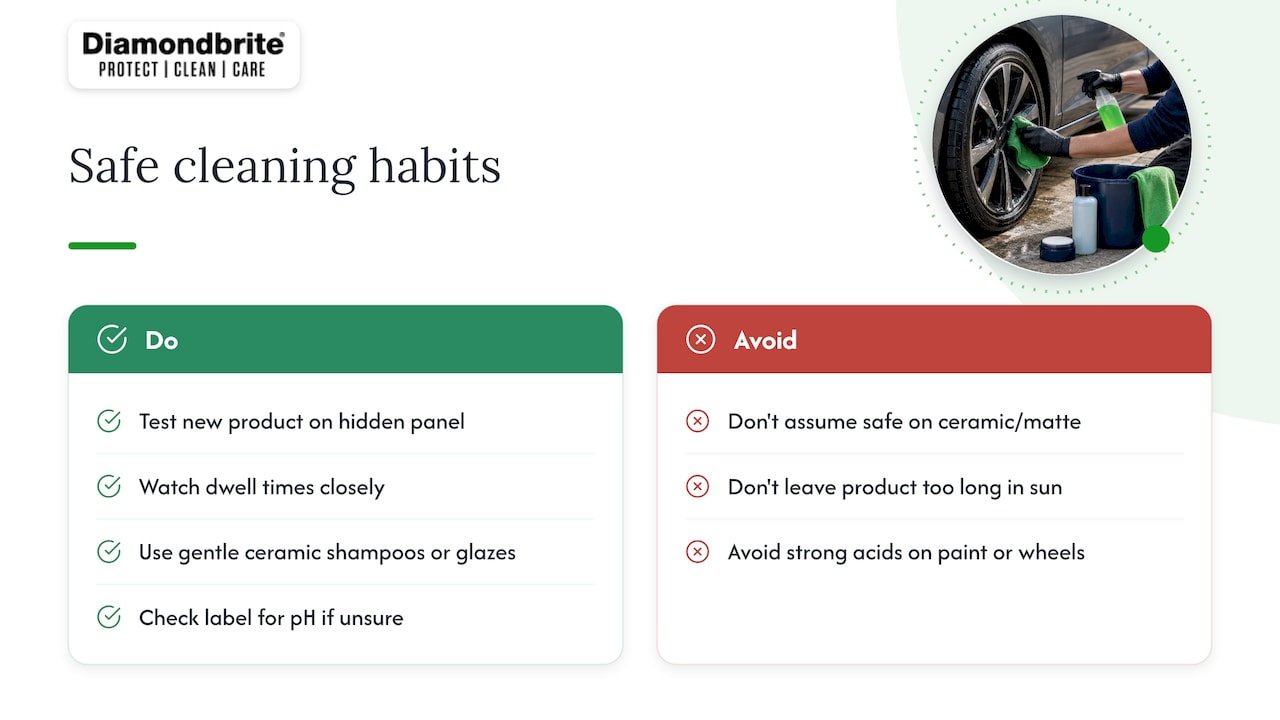
A few habits separate a clean result from a damaged one. Always test a new product on a hidden panel first, particularly if your car has any kind of coating, since not every iron remover is formulated to sit safely on ceramic or matte finishes. Watch dwell times closely rather than guessing: a product left too long in direct sun can dry onto the paint and become harder to rinse off than the contamination it was meant to remove.
Some ceramic shampoos, maintenance glazes, and wheel-safe cleaners follow this logic: gentle enough for regular use, but strong enough to slow how quickly fallout re-bonds to the surface.
Pro Tip: If you are ever unsure whether a cleaner is acid-based, check the label for a pH value. Anything well below 7 deserves extra caution on wheels and paint alike.
Author note: balancing DIY and professional services
My rule of thumb is simple. If the contamination is on the surface and lifts with a proper chemical decon and a clay bar, it is a DIY job and a satisfying one at that. If you can feel or see genuine etching, particularly on a car you plan to keep for years, that is when I would bring in a professional and ask for a paint thickness check before any correction work begins. It protects the clearcoat you have left and gives you a clear record of what was done.
If you would rather stay ahead of rail dust than chase it every few months, a maintenance routine with the right protection products is the easier long-term path.
— Will
How Diamondbrite products fit the decontamination and maintenance workflow
Once your paint and wheels are properly decontaminated, the next job is making that result last, and this is where How to Protect Your Car From Winter’s Worst Messes! offers practical protection advice relevant to post-decontamination care. Ceramic Shampoo keeps the surface slick between washes, reducing how tightly new fallout can bond. A maintenance glaze adds a light, renewable layer of protection on top of any existing coating, and wheel-safe cleaners let you keep alloys looking sharp without reaching for anything acidic.
- Use Ceramic Shampoo on your regular wash to maintain slickness and ease future decontamination.
- Apply a maintenance glaze every few weeks to top up protection on bonnet, roof and front-facing panels.
- Choose wheel-safe, pH-neutral cleaners if your alloys are coated or lacquered, to avoid stripping protection you have already applied.
You will find the full range, including Automotive Paintwork and Automotive Wheels products, on the Diamondbrite shop, where you can build a maintenance kit suited to how often your car picks up rail dust.
FAQ
How do you get rail dust off your car?
Spray a dedicated iron or fallout remover onto clean, cool paintwork, let it react (many products turn purple as they lift iron particles), then rinse thoroughly. If the surface still feels gritty afterwards, follow up with a clay bar and plenty of lubricant.
Will rail dust damage paint?
Yes, if left untreated. The iron particles oxidise and can etch into the clearcoat over time, especially in damp conditions, which is why prompt chemical decontamination matters more than scrubbing it off later.
What will dissolve brake dust?
A pH-neutral iron or fallout remover is the standard choice, since these formulas react chemically with the iron in brake dust and lift it without the harsher risks that acidic wheel cleaners carry for coated or lacquered alloys.
How do I remove road dust from a car?
General road dust usually comes off with a thorough two-bucket wash and does not need chemical decontamination. Rail dust and brake dust are different: their iron content means they need a dedicated fallout remover rather than shampoo alone.
Can I use a clay bar on a brand new ceramic coating?
It depends on the coating’s curing time, so check with the product supplier first. Clay bars are a mechanical step and some fresh coatings need time to harden before they can safely tolerate it.
Sources
- Autocar product test: What is the best alloy wheel cleaner?
- Rail dust and its removal
- Tree sap? – Volvo Owners Club Forum