

Polish corrects paint by gently abrading the clear coat to remove light defects; glaze contains no abrasives and simply masks them with fillers and oils. If your paint has swirls, haze or light scratches, reach for polish first. Save glaze for a temporary gloss boost or for situations where further correction genuinely isn’t worth the risk.
TL;DR:
- Polishing removes light defects by gently abrading the clear coat, providing permanent correction that lasts until new damage occurs.
- Glaze offers only a temporary gloss enhancement by filling micro-scratches and swirl marks with oils and fillers, which wash out within weeks.
- For genuine correction on damaged paint, starting with polish is recommended, and resorting to glaze is best for a short-term cosmetic boost or gentle softening.
- Repeated aggressive polishing can thin the clear coat, especially on older or previously corrected vehicles, making paint-thickness testing essential.
- Applying glaze before ceramic coatings can hinder proper bonding; proper cleaning and surface preparation are necessary for best long-term results.
Table of Contents
- Polish vs glaze: what each product actually does to your paint
- Polish vs glaze: what glaze does instead
- How polish and glaze compare on correction, permanence and finish
- How to decide between polish and glaze for your car
- The correct workflow: from wash to final protection
- What to watch out for: paint thickness and coating compatibility
- Practical tips from Diamondbrite on getting this right
- Is glazing obsolete now that ceramic coatings exist?
- Where Diamondbrite fits into your polishing and glazing routine
- Sources
- FAQ
Polish vs glaze: what each product actually does to your paint
Polish and glaze both promise a better-looking finish, but they get there through opposite mechanisms. Understanding that difference is the whole game when you’re choosing between them.
Polish contains fine abrasives suspended in a lubricating base. When you work it across the surface, those abrasives shave away a microscopic layer of clear coat, levelling out the peaks and troughs that scatter light and make your paint look hazy or swirled. This is genuine correction. The defect is gone because the damaged layer of clear coat has been removed, not covered up, according to Redline Car Garage’s breakdown of compound, polish and glaze.
Compounds sit a step above polish on the aggressiveness scale, carrying coarser abrasives that cut faster and deeper. That’s useful for serious defects, but it removes more clear coat per pass, so polish is usually the smarter starting point unless a compound is genuinely necessary.
A few practical points worth knowing before you pick up a pad:
- Polish removes a small, measurable amount of clear coat, so results are permanent until new damage occurs.
- Fine abrasives suit light swirls, water spots, and general dullness; they won’t touch deep scratches that reach through the clear coat.
- One well-executed polishing pass often restores gloss and depth without needing to compound first.
- Machine polishers give more consistent results than hand application, especially on larger panels.
If your paint looks tired rather than damaged, polish alone is often enough to bring back genuine clarity and reflection.
Polish vs glaze: what glaze does instead
Glaze works on the surface, not into it. Instead of abrasives, glazes rely on fine fillers, oils, and sometimes synthetic resins that sit inside micro-scratches and swirl marks, optically smoothing them out rather than removing them. The result can look remarkably close to a genuine correction, at least for a while.
That “for a while” is the catch. Because glaze doesn’t remove anything, its effect is entirely temporary. Washing, rain, UV exposure, and general road grime gradually strip the fillers away, and the underlying defects reappear exactly as they were, according to Detailed Image’s guide to glazes. Most glazes don’t last more than a few weeks under normal driving conditions, and layering on more glaze rarely improves things: it just adds another coat that will wash off at the same rate.
Where glaze earns its place:
- Adding depth and a “wet look” gloss before a show, meet, or photoshoot.
- Softening the appearance of very light imperfections on a car you don’t want to abrade further.
- Giving tired paint a quick lift between proper correction sessions.
- Providing a cosmetic finish on cars with thin or ageing clear coats where compounding carries real risk.
Glaze is a cosmetic tool, not a repair tool. Treat it that way and it does exactly what it’s meant to do.
How polish and glaze compare on correction, permanence and finish
Laid side by side, the differences between polish and glaze aren’t subtle once you know what to look for. The core distinction runs along a simple aggressiveness scale: compound → polish → glaze, moving from most abrasive to none at all.
Compound cuts fastest and deepest, removing significant clear coat to erase heavier defects, but it typically leaves behind a fine haze of its own that needs refining. Polish picks up from there, using much finer abrasives to remove that haze and any remaining light swirls, according to Detailed Image’s advice on when to glaze versus compound or polish. Glaze sits at the bottom of that scale, contributing zero correction and existing purely to dress the surface once the hard work is done.
Permanence is where the real gap opens up. Polish results last until new damage occurs, because the levelled clear coat doesn’t grow back defects on its own. Glaze results last only as long as the filler layer survives contact with water, sunlight and washing, which in practice means weeks rather than months.
The visual and tactile differences matter too:
- Gloss: Polish restores gloss by improving the clear coat’s actual surface geometry; glaze adds gloss by filling gaps with reflective oils.
- Colour depth: Polished paint tends to show clearer, sharper reflections; glazed paint often looks slightly softer or “wetter”, which some owners actually prefer.
- Wash durability: A polished finish holds its look through dozens of washes; a glazed finish can start fading its effect within the first two or three washes.
- Feel: Freshly glazed paint often feels slicker to the touch immediately after application, thanks to the oils sitting on the surface.
Neither is inherently “better.” They solve different problems, and the smart approach uses each for the job it’s actually built for.
How to decide between polish and glaze for your car
Before you commit to either product, spend five minutes actually inspecting your paint. Wash the car properly first; grime and old wax hide a huge amount of the truth about what’s underneath.
Check the paint under strong, raking light, ideally direct sun or a bright torch held at a low angle. Swirls and light scratches will jump out as fine lines crossing the reflection. Run a fingernail gently across a scratch: if it catches the nail, it’s likely gone through the clear coat and no polish will fix it. If your nail glides over smoothly, you’re dealing with a surface-level defect that polish can genuinely correct.
Pro Tip: Always run a test spot on a small, less visible panel (a door edge or inside the boot lid) before working the whole car. It tells you in two minutes whether polish alone will clear the defect, or whether you need to escalate, without risking the bonnet or roof, according to insight from Detailed Image’s professional advice.
A simple decision sequence to follow:
- Test spot with polish first. If it clears the defect and restores gloss, you’re done; no need to reach for anything stronger.
- Escalate to compound only if polish fails. If the test spot still shows haze or the scratch remains visible, a compound stage is genuinely needed before polishing again.
- Add glaze only for a cosmetic finish. Once correction is complete (or deliberately skipped), a light glaze layer adds a temporary gloss lift for show prep or a special occasion.
- Skip glaze entirely before protection. If a sealant or ceramic coating is going on afterwards, don’t glaze first: it can block proper bonding.
Certain scenarios tilt the decision one way or the other. Show prep and last-minute photoshoots are glaze’s natural home, since the boost only needs to last a day or two. Leased cars often benefit from polish for genuine correction, since you’re handing the car back and want defects actually gone, not temporarily hidden. Cars with thin or already-polished clear coats (older vehicles, or ones that have been corrected several times before) are prime candidates for glaze over further abrasion, since there simply isn’t much clear coat left to spare. Routine maintenance details usually need neither: a good wash and a spray sealant often suffice.
The correct workflow: from wash to final protection
Getting the sequence right matters as much as choosing the right product. Skipping steps, or doing them out of order, is how good products deliver disappointing results.
- Wash thoroughly, ideally using a pH-neutral shampoo and a two-bucket method to avoid introducing fresh swirls while you clean.
- Decontaminate with an iron remover and a clay bar or clay mitt to strip embedded contamination that washing alone won’t shift.
- Test spot a small panel to judge defect depth before committing to a full correction pass.
- Compound, only if the test spot shows the defect won’t clear with polish alone.
- Polish the full car to refine the finish and remove any remaining haze, working panel by panel with a machine polisher for consistency.
- Glaze, optionally, if you want an extra gloss lift for a short-term purpose.
- Protect with a sealant, wax, or ceramic coating to lock in the finish and add durability against UV and washing.
On pad speed and technique: a dual-action polisher on a medium speed with light to moderate pressure suits most polish jobs, while compounding usually needs a slightly higher speed and a firmer pad. Hand application works for glaze and light polishing but struggles to correct genuine swirls consistently, since it can’t generate the same heat and friction as a machine.
If a ceramic coating is on the agenda, skip glaze in the sequence altogether, according to Detail Planet’s guide on the correct order of compound, polish and glaze. Any oily residue left behind reduces the coating’s ability to bond properly with the paint.
What to watch out for: paint thickness and coating compatibility
Clear coat is a finite resource. Every polishing or compounding pass removes a small amount permanently, and repeated aggressive correction over the years can leave a car dangerously thin in places, especially around edges and high points that get worked more often during machine polishing.
If you’re at all unsure how much clear coat a car has left, a paint-thickness gauge removes the guesswork and tells you exactly where you stand before you start cutting. This matters most on cars that have already been corrected multiple times, or older vehicles where the paint has had decades of sun exposure.
Glaze brings its own compatibility issue: the same oils and fillers that make it look great can prevent sealants and ceramic coatings from bonding properly to the paint, according to Detail Planet’s coating-prep guidance. If you’ve glazed a car and then decide to coat it, you’ll need to strip that layer back off first.
- Degrease the surface thoroughly with a dedicated panel wipe or degreaser.
- Follow with an isopropyl alcohol wipe-down to remove any remaining oily residue.
- Confirm the surface is “squeaky clean” (water sheets rather than beads) before coating.
- Never apply a ceramic coating directly over a freshly glazed panel.
Deep RIDS (random isolated deep scratches), heavy oxidation, or paint that’s already been thinned by previous correction work are jobs for a professional, not a weekend polish session. A body shop can assess whether a panel needs spot-painting rather than further abrasion.
Practical tips from Diamondbrite on getting this right
Preserving what clear coat you have left should guide every decision you make. A single, well-executed polishing pass with a quality pad beats three aggressive passes chasing a stubborn mark. Always inspect your work at a low angle under bright light between passes, and stop the moment the defect has cleared rather than continuing “just to be sure.”
Test spots aren’t optional if you’re serious about protecting your paint long-term. Two minutes on a hidden panel tells you everything you need to know before you commit the whole car to a correction step you can’t undo.
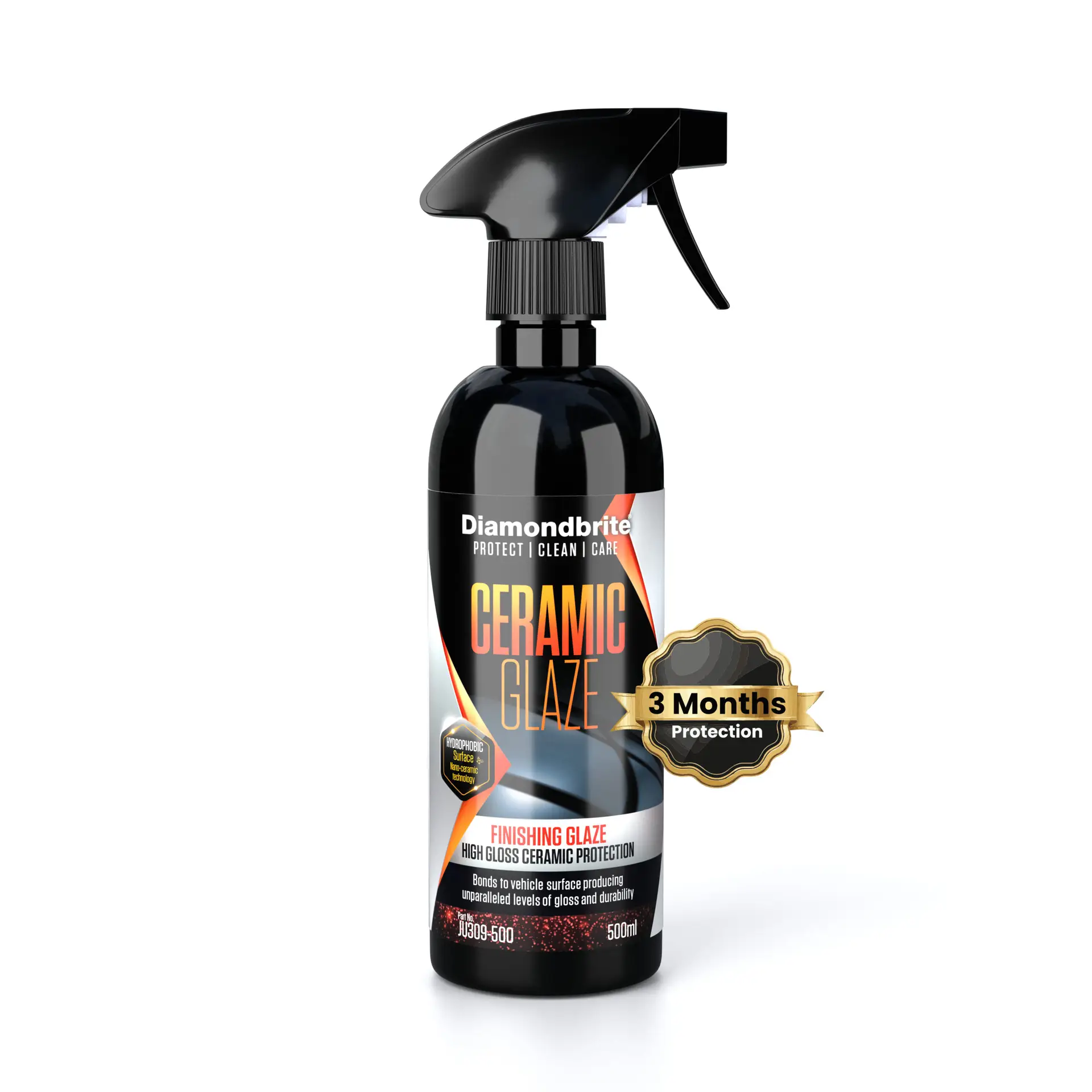
For a genuine short-term gloss lift, Diamondbrite Ceramic Glaze fits neatly into the workflow after polishing, particularly ahead of a show, meet, or sale where visual impact matters more than long-term durability. Once you’ve polished or glazed a car, keeping it clean without undoing that work matters just as much: a dedicated Diamondbrite Ceramic Shampoo helps maintain gloss between details without stripping away the finish you’ve just worked to achieve. For application notes specific to prepping paint before a ceramic coating, Diamondbrite’s own guide on polishing before ceramic coating is worth reading before you start.
Is glazing obsolete now that ceramic coatings exist?
Ceramic coatings have genuinely changed the maintenance conversation, offering gloss and protection that lasts years rather than weeks, and that shift has pushed glaze out of most everyday routines. But glaze hasn’t disappeared for good reason: it’s fast, it’s non-committal, and it’s still the safer cosmetic choice on thin clearcoat cars where further correction carries real risk, according to Jalopnik’s look at why detailers have moved away from routine glazing. My honest read is that glaze earns its keep in narrow situations, show prep and last-minute lifts especially, but genuine correction should always come first when the paint allows it.
— Will
Where Diamondbrite fits into your polishing and glazing routine
Diamondbrite’s Ceramic Glaze and Ceramic Shampoo cover exactly the two moments this whole comparison keeps circling back to: the quick, temporary gloss lift, and the ongoing maintenance that keeps your finish looking sharp between proper correction sessions. Unlike generic wax-based glazes that fade within a couple of washes, a ceramic-infused glaze gives you that same short-term boost with slightly more staying power against everyday grime.
If you’ve just finished polishing and want to add depth before a show or a sale, Diamondbrite Ceramic Glaze slots straight into that final step, and Ceramic Shampoo keeps the finish clean afterwards without stripping the gloss you’ve worked for. Browse the full range of paintwork products to build a routine that matches how you actually use your car, whether that’s weekend shows or daily driving. If you’re planning a longer-term upgrade rather than a one-off gloss boost, it’s also worth reading about interior ceramic coating options while you’re browsing, since paint correction and protection often go hand in hand with the cabin.
Sources
For deeper technical detail on abrasives, timing, and workflow, see Redline Car Garage’s compound, polish and glaze breakdown, Detailed Image’s guide to glazes, and Detail Planet’s correction sequence guide. For panel damage beyond what polishing can fix, Eurobahn Auto Body Shop’s bumper repair guide is a useful reference.
- Compound vs Polish vs Glaze: Which One Cuts What — Redline Car Garage
- Why Many Detailers Stopped Treating Cars Like Donuts And Don’t Glaze Them Anymore — Jalopnik
FAQ
Is glaze and polish the same thing?
No. Polish contains fine abrasives that remove a small layer of clear coat to correct defects, while glaze contains no abrasives and simply fills imperfections with oils and resins for a temporary cosmetic effect, according to Redline Car Garage.
Is polishing or ceramic coating better for cars?
They do different jobs: polish corrects existing defects in the paint, while a ceramic coating adds a durable protective layer on top of already-corrected paint. Most owners polish first, then apply a coating like Diamondbrite Ceramic Glaze or a full ceramic system to lock in that finish long-term.
Is it better to polish or wax your car?
Polish and wax aren’t competitors: polish corrects the paint, wax (or a ceramic sealant) protects it afterwards. Use polish when you see swirls or haze, and follow it with a wax, sealant, or ceramic product to preserve the result.
Which is better, glaze or gloss?
“Gloss” isn’t a separate product category. It’s the visual effect both polish and glaze can produce, though polish achieves it by correcting the surface and glaze achieves it by filling defects temporarily. For lasting gloss, polish followed by protection beats glaze alone, since glaze effects fade within a few weeks.