

For everyday maintenance washing, use roughly 1:100, which works out to 10–20 ml of concentrated shampoo per 5-litre bucket. For heavy soiling or a foam cannon pre-wash, move up to 1:10–1:20 depending on your equipment. If your car has a ceramic coating or paint sealant, stick with a pH-neutral shampoo and lean towards the weaker end of that range to protect what you’ve already applied.
TL;DR:
- Using a 1:100 dilution for everyday maintenance typically requires 10 to 20 ml of shampoo per 5-liter bucket to prevent wastage and grime buildup.
- Heavily soiled vehicles or foam cannon pre-washes often need a stronger mix, around 1:10 to 1:20, depending on dirt level and equipment.
- For ceramic-coated or sealed paint, only pH-neutral shampoos at weaker ratios (closer to 1:150 or 1:200) are safe to avoid eroding the protective layer.
- Applying shampoo after rinsing with cold water and using the two-bucket method prevents scratches and swirl marks caused by grit dragging.
- Household washing-up liquids are harmful for car paintwork and should be avoided, as they can strip wax, sealants, and coatings over repeated use.
Table of Contents
- What is the right car shampoo dilution ratio for each job?
- How do you calculate car shampoo dilution ratios?
- Mixing and applying your shampoo mix correctly
- Why washing-up liquid is the wrong shortcut
- Getting dilution right on ceramic-coated or sealed paintwork
- A few habits I stick to every wash
- Want a coating-safe shampoo already mixed to the right strength?
- Sources
- FAQ
What is the right car shampoo dilution ratio for each job?
Not every wash calls for the same mix. A quick weekly rinse needs far less product than a foam cannon tackling a car that’s just come off a muddy trail, and getting the ratio wrong in either direction wastes shampoo or leaves grime behind.
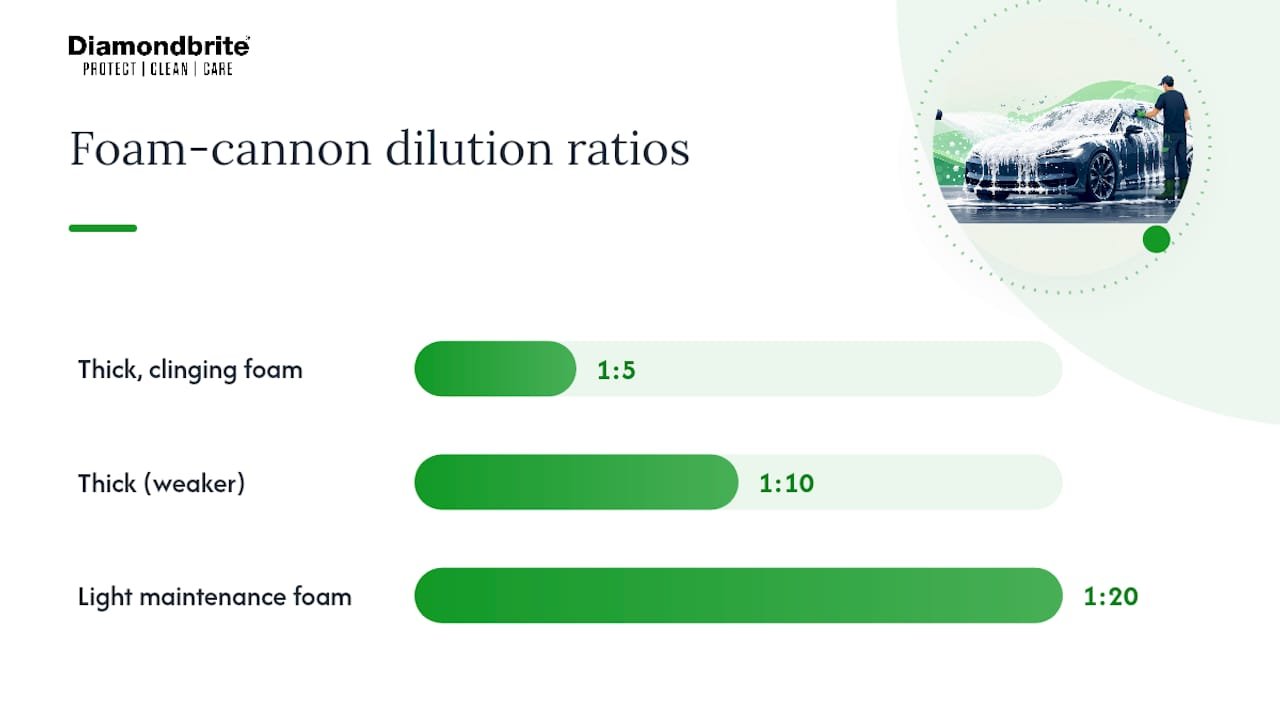
Here’s a working reference based on typical manufacturer ranges and the dosing figures used across the trade:
Many concentrated shampoos need only 10–20 ml per bucket, which surprises drivers used to glugging in a capful without measuring. Retailers publish dilution calculators precisely because concentration varies so much between products, from 1:10 for economy formulas to 1:100 or higher for premium concentrates.
Start weaker than you think you need. Test the foam and coverage on one panel, then strengthen the mix only if the dirt genuinely resists it.
How do you calculate car shampoo dilution ratios?
A ratio like 1:100 means one part shampoo to 100 parts water, but the maths trips people up when bucket sizes change. Here’s how to work it out properly.
- Understand the format. 1:100 equals 1% concentration. 1:20 equals roughly 5%. 1:10 equals roughly 9%.
- Use the formula. ml of shampoo = (1 ÷ (1 + X)) × total litres × 1,000, where X is the second number in your ratio.
- Work an example. For 1:100 in a 5-litre bucket: (1 ÷ 101) × 5 × 1,000 ≈ 49.5 ml. Most people round this down to 20–30 ml for lighter maintenance use.
- Try 1:20. In a 10-litre bucket: (1 ÷ 21) × 10 × 1,000 ≈ 476 ml.
- Try 1:10 for foam cannons. In a 1-litre foam bottle: (1 ÷ 11) × 1 × 1,000 ≈ 91 ml, topped up with water.
For daily use, skip the formula entirely and keep a dosing bottle marked at your usual measure. Most shampoo bottles already print manufacturer ratios on the label, and that’s always your starting point before any adjustment.
Mixing and applying your shampoo mix correctly
Add water to the bucket first, then pour in the shampoo. Doing it the other way round causes excess foaming and makes it harder to judge how much product you’ve actually added. Once mixed, label the container, especially if you keep a foam-cannon bottle and a bucket-wash bottle side by side.
The two-bucket method remains the safest bucket-wash technique: one bucket holds your soapy mix, the second holds clean rinse water for your mitt between panels. This stops grit picked up from the paintwork being dragged back through the wash mitt and grinding into the next panel, which is where fine swirl marks come from.
For foam cannons, ratios of roughly 1:5 to 1:10 for thick, clinging foam and 1:10 to 1:20 for lighter maintenance foam are common starting points. Warm water dissolves concentrate more effectively than cold, and using an internal agitator often produces denser foam without increasing your dose.
- Rinse the car cold before applying any shampoo, especially on a warm day
- Work in shade where possible, since hot panels flash-dry water and cause spotting
- Let foam dwell for a minute or two before agitation, not longer
- Rinse from the roof downward so dirty run-off doesn’t cross clean panels
Pro Tip: Keep a small labelled spray bottle mixed at your standard maintenance ratio. You’ll wash more often when the mix is already made up and ready to go.
Why washing-up liquid is the wrong shortcut
Reaching for kitchen washing-up liquid feels harmless, but it’s formulated to strip grease from plates, and that same chemistry attacks wax, sealants, and coatings on your car. Repeated use is genuinely linked to faded paintwork and even corrosion, with repair costs from paint damage running into the thousands.
A single wash with dish soap probably won’t ruin anything. The damage builds with repeated use, as the alkaline formula slowly breaks down protection layer by layer.
Household dish soap is tuned to cut grease fast. That’s exactly the wrong property for anything sitting on top of your paint that you actually want to keep.
Some guidance suggests non-abrasive dish soap can work in a genuine emergency, but car-specific shampoo should always be your default. Watch for dullness, patchy water beading, or streaking after a wash, all signs your protection is thinning. If you’re unsure whether a product is too harsh, test it on an inconspicuous panel like a door jamb before running it across the whole car.
Getting dilution right on ceramic-coated or sealed paintwork
Coated paint changes the rules slightly. A standard shampoo mixed too strong can gradually erode the hydrophobic layer you paid to have applied, so pH-neutral formulas are the safer default for anything ceramic-coated or freshly sealed.
- Favour the weaker end of any ratio range, closer to 1:150 to 1:200 for light maintenance on coated cars
- Check the label for wording like “coating safe” or “pH-neutral” rather than assuming any car shampoo will do
- Avoid anything marketed primarily as a “wax-stripping” or “deep-clean” shampoo on coated panels
- Rinse thoroughly between panels so soap doesn’t dry onto the coating in the sun
If you’ve had a coating applied and want a routine that keeps it performing for longer, the ceramic coating maintenance guidance covers washing frequency alongside dilution, and it’s worth reading before your next wash rather than after a problem shows up.
A few habits I stick to every wash
I never mix more solution than I’ll use that day. Diluted shampoo doesn’t keep well, and a fresh, correctly labelled mix in a small bottle beats a five-litre batch made three washes ago.
The two-bucket method with a proper wash mitt is non-negotiable for me, and in winter I rinse road salt off before it even gets near shampoo. Before trying any new product, I test it on one inconspicuous panel first. Reading the label sounds obvious, but it’s the step most people skip, and it’s the one that actually tells you the ratio the manufacturer intended.
— Will
Want a coating-safe shampoo already mixed to the right strength?
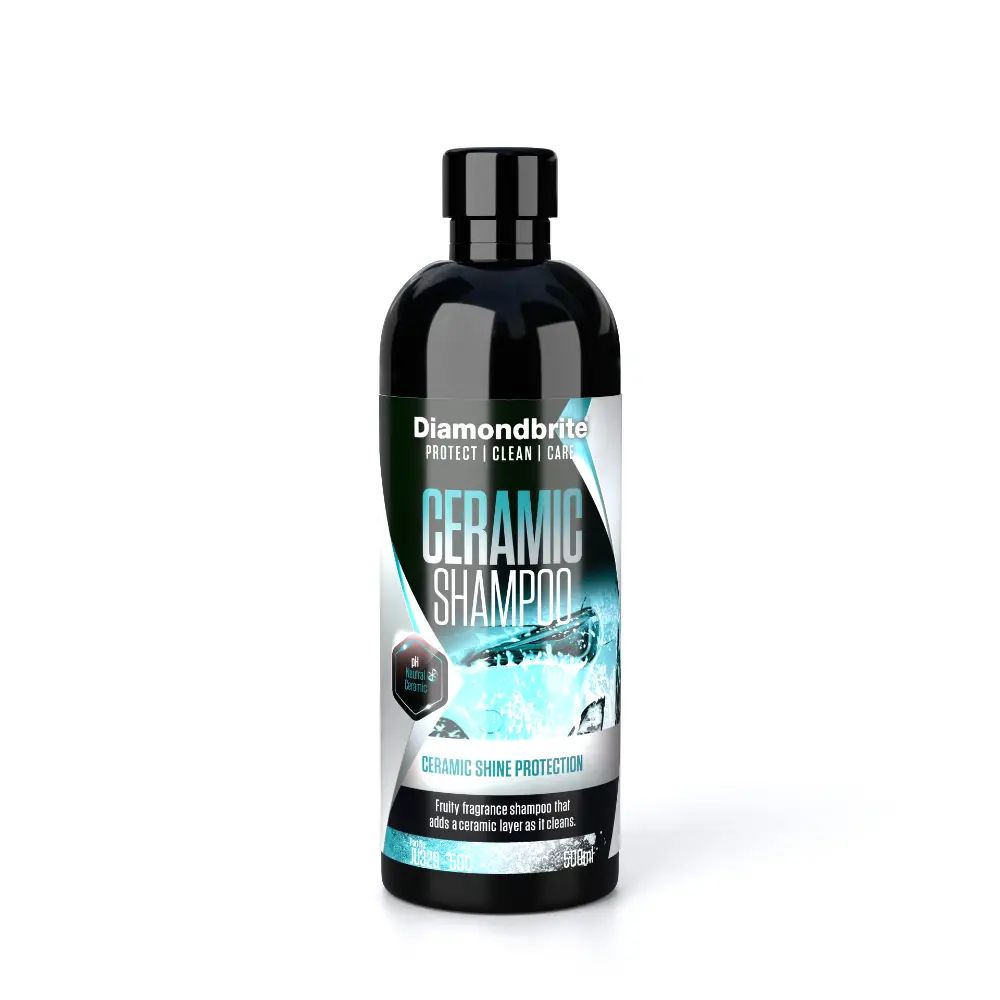
If measuring ratios and converting formulas isn’t how you want to spend your Sunday morning, a purpose-made pH-neutral shampoo removes the guesswork entirely. Diamondbrite’s pH-neutral car shampoo is formulated specifically for coated and sealed paintwork, so you’re not stuck fine-tuning a generic mix and hoping it’s gentle enough.
It’s built to work safely at a lower concentration than many household or generic shampoos, protecting the finish rather than slowly wearing it down wash after wash. Pair it with the ceramic shampoo benefits guide to understand exactly what it’s doing to your paintwork, then browse the full range on the official online shop and check the dosage instructions printed on the bottle before your next wash.
Sources
- Washing up liquid could damage your car paintwork | Carwow
- Can you use dish soap to wash a car? – Kelley Blue Book
- How to use foam cannon pressure washer: 2026 guide – Motor For Nerd
- Detailing product dilution ratio calculator
FAQ
What is the recommended dilution ratio for car shampoo?
Everyday maintenance washing typically uses around 1:100, roughly 10–20 ml per 5-litre bucket, while heavy soiling or foam cannon work often calls for 1:10 to 1:20. Always check the label first, since concentrated products vary widely.
Do you wet the car before foaming?
Yes, always rinse the car cold with plain water before applying foam or shampoo to lift loose grit and dust away from the paint. Skipping this step increases the risk of scratching during agitation.
Is it safe to use washing-up liquid as car shampoo?
Not for regular use. Washing-up liquid is alkaline and can strip wax, sealants, and coatings over time, leading to faded paint and, in some cases, corrosion.
What is the recommended dilution ratio for car soap?
It depends on concentration and job: light maintenance sits around 1:100, heavier dirt or foam cannon use runs from 1:10 to 1:50, and coated cars generally do best nearer the weaker end of that range with a pH-neutral formula.