

Two routes get water beading off your paintwork: a quick hydrophobic spray for instant shine and easy upkeep, or a proper ceramic coating for protection lasting years, not weeks. Weekend detailers who want visible results in ten minutes should start with a spray sealant. Owners who want to protect a car for the long term should look at Diamondbrite’s ceramic systems and factor in proper preparation.
TL;DR:
- Spray sealants offer easy, fast application with protection lasting a few weeks to months, making them suitable for quick upkeep tasks.
- Professional ceramic coatings provide long-term durability, lasting several years if surfaces are properly prepared and maintained.
- Proper surface preparation, including thorough cleaning and decontamination, significantly impacts coating longevity more than the product choice itself.
- Regular maintenance with pH-neutral washes and periodic top-ups preserves beading performance, especially for coatings exposed to harsh UK conditions.
- Combining a durable base layer with frequent spray top-ups creates an effective routine for long-lasting hydrophobic protection.
Table of Contents
- How does a hydrophobic car coating actually work?
- Which type of hydrophobic coating suits you?
- How do you choose and apply a hydrophobic coating?
- How do you maintain hydrophobic performance afterwards?
- Where does Diamondbrite fit into your options?
- What actually determines whether your coating lasts
- Ready to build your hydrophobic protection routine?
- Sources
- FAQ
How does a hydrophobic car coating actually work?
A hydrophobic car coating works by changing the surface energy of your paint, glass, or trim. Water naturally wants to spread across a surface. A coating disrupts that tendency, forcing water into tight beads that sit up rather than sheet flat, as Fast Car explains. That microscopic barrier is what stops grime bonding directly to your clear coat.
There is a difference between beading at rest and sheeting in motion. A parked car shows perfect round beads sitting proud of the surface. Get that same car moving and the water flattens into sheets, rolling backwards and off. Airflow does the work your washer jets can’t.
Most coatings will bond happily to:
- Painted bodywork, including clear coat and matte finishes with the right product
- Glass, including windscreens and side windows
- Plastic trim and some rubber seals, though results vary by formula
Work in the shade, avoid direct sun on warm panels, and keep the area ventilated when using sprays. Fumes from stronger sealants build up fast in an enclosed garage.
Which type of hydrophobic coating suits you?
Not every product on the shelf behaves the same way, and the differences matter more than most buying guides admit.
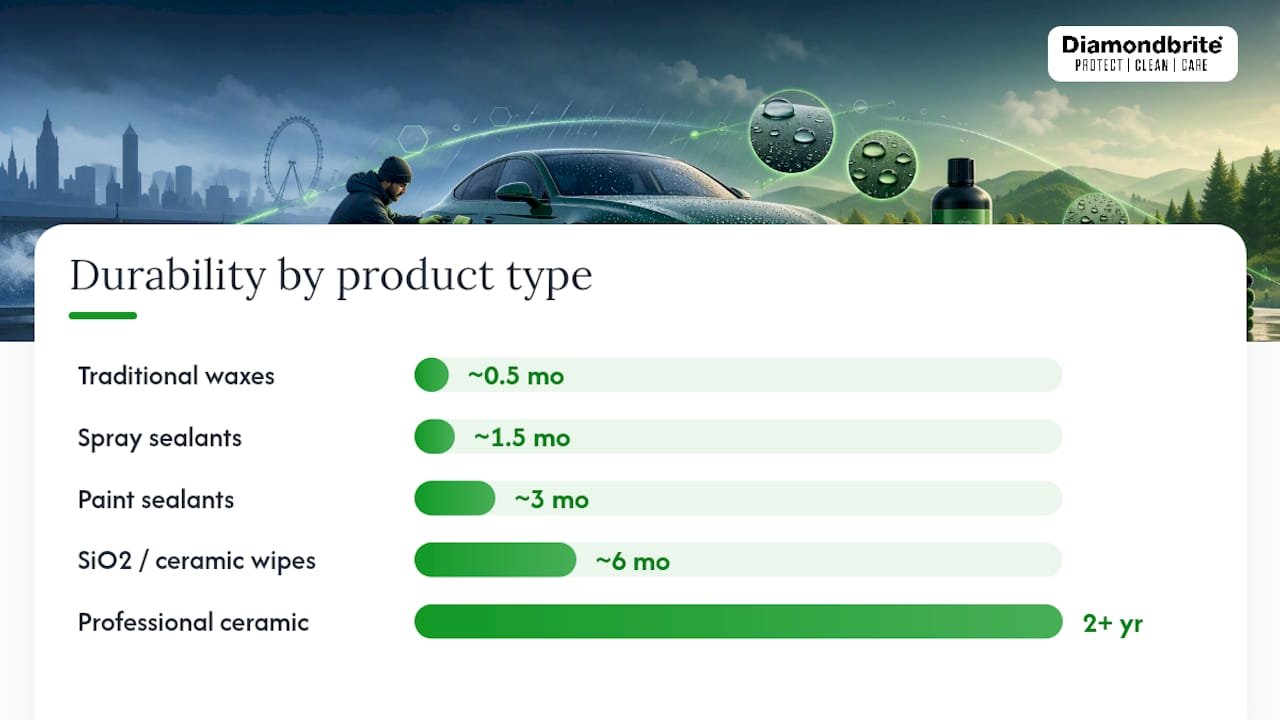
- Spray sealants are wipe or spray-and-rinse products with SiO2 or polymer content. Fast to apply, forgiving of mistakes, and typically good for weeks to a few months.
- Paint sealants sit a notch above sprays, offering a slicker finish and slightly longer protection, usually a few months with fair use.
- SiO2 and ceramic wipes/foams bond more firmly to the clear coat and can hold up for several months when applied correctly.
- Professional ceramic coating systems cure into a much harder, more durable layer and, prepared and applied properly, can protect for multiple years.
- Traditional waxes give a warm, deep gloss but the weakest durability of the group, often needing reapplication within weeks.
Independent testing backs this hierarchy up. Road & Track’s coating tests found consumer-level ceramic sprays, including hybrid formulas like Turtle Wax Hybrid Solutions, deliver strong beading and genuine ease of use, while professional-grade systems pulled ahead on long-term durability once properly cured.
The trade-off is real: easier products are easier to remove and forgive mistakes, but they fade fast. Harder ceramic coatings last years, but a poor application is much harder to correct without polishing.
How do you choose and apply a hydrophobic coating?
Work through this before you buy anything:
- Define your goal. A one-off valet before selling the car needs a different product to a daily driver you want protected for winters ahead.
- Set a budget. Spray sealants sit at the low end. Multi-year ceramic systems cost more but spread that cost over years, not months.
- Check your paint condition. Swirl marks, light scratches, or oxidation should be corrected before any coating goes on, since a coating locks in whatever is underneath it.
- Be honest about your risk tolerance. If you’ve never applied a coating before, a forgiving spray beats a high-solids wipe-on product that streaks if you hesitate.
Preparation decides most of the outcome. TidyRide’s research into UK coating durability found that poor surface prep, meaning leftover contamination or unresolved paint defects, is the single biggest reason coatings underperform. Wash thoroughly, clay bar to strip bonded contaminants, then decontaminate with an iron remover before anything else touches the paint.
For application, work one small panel at a time, out of direct sun, and let each section cure for the manufacturer’s stated dwell time before buffing or moving on. Rushing dwell time is one of the most common reasons a coating finishes patchy or fails early.
Pro Tip: Beginners get better results from hybrid SiO2 spray sealants than high-concentration wipe-on ceramics. Sprays bond quickly and forgive a slow hand, whereas stronger formulas can flash and streak before you’ve finished the panel.
Send the car to a professional instead if you spot heavy swirling, deep scratches, or a matte finish. Matte paint needs specific products and technique, and one wrong move can leave a permanent shine patch.
How do you maintain hydrophobic performance afterwards?
Beading fades faster than most owners expect, and it’s almost always down to washing habits rather than the coating failing outright.
- Use a pH-neutral shampoo and a two-bucket method, or a touchless wash if you want to avoid contact entirely.
- Avoid abrasive brushes, dishwashing liquid, and harsh degreasers, all of which strip hydrophobic layers faster than normal weathering.
- Top up beading every few weeks with a quick-detail spray rather than waiting for performance to disappear completely.
| Situation | What it means | What to do |
|---|---|---|
| Beading still tight, water still sheets at speed | Coating is intact | Maintain with pH-neutral washes and periodic top-ups |
| Beading flattens, water sits rather than rolls | Surface layer is wearing thin | Apply a spray topper or booster |
| Water spreads flat, no beading at all | Coating has failed | Decontaminate and reapply from scratch |
Real-world UK conditions, salted winter roads and coastal air especially, wear coatings faster than a lab test ever shows. That’s the gap between a magazine’s beading score and what you’ll actually see on your drive.
Where does Diamondbrite fit into your options?
Diamondbrite’s range gives you a practical route through both ends of this decision. Ceramic Shampoo works as your maintenance wash, cleaning without stripping whatever hydrophobic layer you’ve already built. Ceramic Glaze suits owners who want a longer-lasting layer of protection without committing to a full professional system.
- New to coatings and want low risk: start with a maintenance shampoo and a spray topper.
- Already have a coating and want it to last: pair regular Ceramic Shampoo washes with periodic top-ups.
- Want deeper, longer protection: Ceramic Glaze gives you more durability than a spray alone.
Pair either product with the right aftercare routine and you’re solving the two problems that actually shorten coating life: harsh washing and neglected top-ups.
What actually determines whether your coating lasts
Most buying guides treat longevity as a fixed number stamped on the bottle. It isn’t. The gap between a spray sealant’s “up to six months” claim and what you actually get on a UK driveway comes down almost entirely to two things: how well the paint was prepared beforehand, and how the car gets washed afterwards. Skip the clay bar stage and even a premium ceramic system will underperform its cheaper rival.
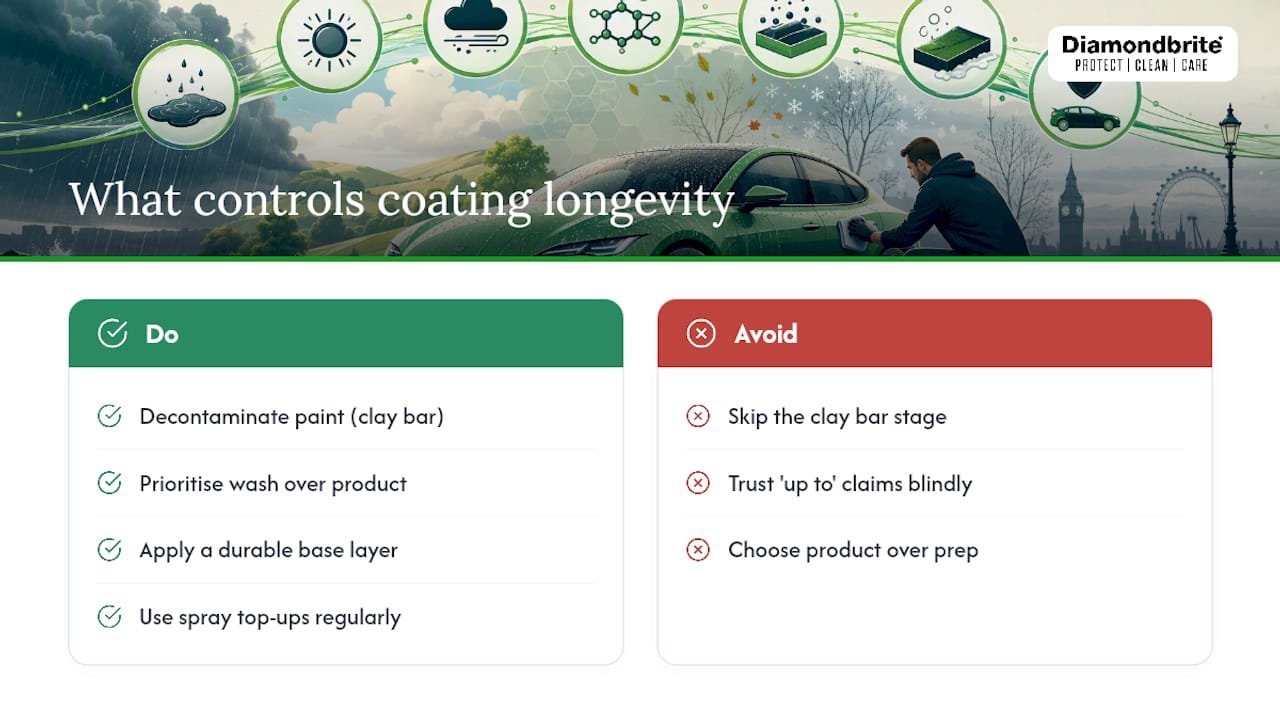
The conventional advice oversells durability and undersells prep. Nobody wants to hear that an hour of decontamination matters more than which bottle they buy, but it does. If you take one thing from this guide, prioritise the wash before the product. A brilliant coating on a contaminated surface fails faster than a mediocre one on clean paint.
Where the ceramic-versus-spray debate gets overcomplicated is the assumption you must pick a side. Most sensible owners run both: a durable base layer for the structure, topped up regularly with sprays to keep beading sharp between proper maintenance.
— Will
Ready to build your hydrophobic protection routine?
Some suppliers offer a direct route to genuine ceramic protection without booking a professional appointment or guessing which bottle on a shelf actually does what it claims. If you’re starting from scratch, pair a ceramic shampoo product for your regular wash with a spray topper to keep beading sharp between applications. If you want a longer-lasting base layer, a ceramic glaze product can build a more durable shield that outlasts a spray sealant by a wide margin.
Browse the full range at the Diamondbrite shop, and once your coating is on, follow the maintenance guide for keeping your ceramic coating in top condition to protect the investment you’ve just made. Both steps take minutes and set you up for a car that beads water for years, not weeks.
Sources
For more on the science and durability figures behind this guide, see Fast Car, Road & Track’s testing, and Summit Details on coating longevity.
- How Do Hydrophobic Car Detailing Products Work? | Fast Car
- Best Ceramic Coatings of 2026, Tested by Experts | Road & Track
- How Long Does Ceramic Coating Really Last in the UK? | TidyRide
FAQ
How long does hydrophobic coating last?
Spray sealants typically last weeks to a few months, SiO2 wipe-on products can reach several months, and professionally applied ceramic systems can last multiple years with correct prep and maintenance.
What is a good hydrophobic coating spray for cars?
Hybrid SiO2 spray sealants are a strong starting point because they bond quickly, forgive minor application mistakes, and produce visible beading within minutes. Diamondbrite’s Ceramic Shampoo paired with a spray topper gives beginners a low-risk way to build up protection.
What is the best hydrophobic spray for car windows?
Look for a dedicated glass-safe hydrophobic spray rather than a body-panel product, since some paint sealants leave a haze on glass. Ceramic-infused glass sprays improve visibility in rain by making water bead and clear at speed.
Does hydrophobic coating actually improve protection, or just looks?
It does both. The same surface-energy change that produces beading also stops contaminants bonding directly to paint, which is why coated cars typically stay cleaner for longer between washes.