

Yes, you can apply snow foam without a pressure washer, and it works better than most car owners expect. Your best options are a garden-hose foam cannon, a manual pump sprayer, a hose-end foam gun, or diluting the product into a wash bucket. Foam won’t cling quite as thick as it does off a pressure washer, so you’ll rely more on dwell time and hand-washing technique to get the same clean. The methods below show you how to get proper results with kit you may already own.
TL;DR:
- Thinner foam from low-pressure methods requires longer dwell times and careful timing to prevent dry residue and ensure effective cleaning.
- For regular use, a hose foam cannon or pump sprayer offers better foam thickness and coverage, but these still generate less clingy foam than pressure washers.
- Heavily diluting the snow foam product is necessary to improve adherence and distribution, especially when using a garden hose or manual sprayer.
- Proper manual washing with a lubricating, pH-neutral shampoo and two-bucket technique is more important for paint safety than foam thickness alone.
- Foam application should be followed by immediate rinsing within three to five minutes to minimize drying and residue issues.
Table of Contents
- What’s the best way to apply snow foam without a pressure washer?
- How do you use a garden-hose foam cannon effectively?
- How does a manual pump sprayer compare for snow foaming?
- What about hose-end guns and the bucket-and-mitt method?
- What dilution ratio and dwell time should you use without a pressure washer?
- How do you wash safely once the foam comes off?
- Diamondbrite’s recommendations for pressure washer free snow foaming
- Why the “you need a pressure washer” advice misses the point
- Keep your manual wash routine paint-safe with Diamondbrite
- Sources
- FAQ
What’s the best way to apply snow foam without a pressure washer?
Your choice depends on how often you wash your car and what you already have in the shed. Each method trades off cost, foam quality, and effort differently.
- Garden-hose foam cannon: cheapest dedicated tool, produces reasonable foam thickness, best for regular users who wash weekly.
- Manual pump sprayer: low cost if you already own one, gives you more control over coverage, best for occasional washes or smaller vehicles.
- Hose-end foam gun: quick and simple, foam is thinner and drains faster, suits a fast pre-wash rather than a full soak.
- Bucket and mitt with diluted foam: no extra kit needed, works as a contact-wash booster rather than a true “snow” foam, best when you’re short on time.
If you wash fortnightly and want the closest look to a pressure-washer finish, Autodoc’s roundup points to hose foam cannons and pump sprayers as the two most practical stand-ins. Bucket application uses more product per wash since you’re not diluting through a pressurised nozzle, so factor that into your running costs.
How do you use a garden-hose foam cannon effectively?
A garden-hose foam cannon looks similar to the pressure-washer version but relies on your tap’s water pressure rather than a pump, so it produces thinner, less clingy foam. That’s not a flaw to fight against. It’s simply a different tool that needs a different technique.
Mix your snow foam more diluted than the bottle’s pressure-washer instructions suggest. Lower water pressure can’t atomise thick concentrate properly, and a heavier mix at low pressure tends to run straight off the panel instead of clinging. Foam Fanatic’s hose guide recommends adjusting the cannon’s nozzle to its widest fan setting to spread thinner foam more evenly across larger panels.
- Attach the cannon to your hose and set the nozzle to a wide fan spray.
- Work from the roof downward in horizontal passes, overlapping each pass by roughly a third.
- Cover the whole car within two to three minutes so early panels don’t dry out before you finish.
- Leave the foam to dwell for the time stated on the bottle before rinsing.
Pro Tip: Wash on an overcast day or in the shade. Direct sun accelerates drying and turns thin hose-foam into a sticky film in minutes, especially on dark paint.
A hose cannon is worth buying if you wash regularly and want a proper foam stage without spending on a pressure washer. If you only foam a handful of times a year, a pump sprayer does a similar job for less outlay.
How does a manual pump sprayer compare for snow foaming?
A pump sprayer gives you the most control of any low-pressure method, because you’re manually building the pressure and aiming the nozzle yourself. Look for one with an adjustable cone or fan nozzle and at least a 5 litre tank. Anything smaller means repeated refills on a full-size car.
- Choose a sprayer with a chemical-resistant seal, since some snow foam concentrates degrade cheap rubber gaskets over time.
- Dilute more heavily than the label’s foam-cannon ratio. Pump sprayers can’t whip air into the mix the way a cannon does, so a thinner solution spreads more evenly.
- Test your mix on a small panel first, checking after a minute for streaking or a tacky feel before committing to the full car.
- Work in sections rather than foaming the whole car at once: pre-rinse a panel, foam it, move on, then circle back to rinse in the order you started.
Pro Tip: Pump the handle a few extra strokes before each panel. Pressure drops fast in these sprayers, and the last squirt of a tank is often a weak dribble that won’t lift dirt.
Switch to a bucket method if you find yourself refilling more than twice for one car. At that point, the sprayer is costing you more time than it saves.
What about hose-end guns and the bucket-and-mitt method?
A hose-end or trigger foam gun is the cheapest route into snow foaming, often costing less than a bottle of shampoo. Water passes through a foaming attachment as it leaves the hose, so the foam is thinner and drains faster than anything a cannon produces, but it still loosens surface grime before you touch the paint.
- Attach the gun to your hose, apply in the same overlapping passes as a cannon, and rinse within a minute or two before it runs off.
- For bucket-and-mitt, add diluted snow foam to your wash water instead of standard shampoo, using it as a contact-prep step rather than a true foam soak.
- Keep the mitt moving in straight lines rather than scrubbing in circles, since diluted foam offers less lubrication than a full foam blanket.
These suit anyone washing on a budget or without much storage space. GardenerBible’s guide confirms bucket and hose-gun methods both work as genuine alternatives, provided you don’t expect pressure-washer-level dwell time from either.
What dilution ratio and dwell time should you use without a pressure washer?
Pressure-washer dilution charts assume the machine is doing part of the cleaning work through sheer force. Take that force away and a heavy mix just sits there, drying faster than it cleans. That’s why every low-pressure method benefits from starting more dilute than the bottle suggests, then strengthening the mix only if the first pass leaves the car visibly dirty.
- Test a small, inconspicuous panel first and check it after 60 seconds for tackiness or streaking.
- If the foam is still fluid and easy to wipe after a minute, your dilution is roughly right.
- Aim to rinse within 3 to 5 minutes on a mild day, sooner in direct sun or wind.
- Watch for foam turning matte or losing its sheen. That’s your cue it’s starting to dry, and it needs rinsing immediately.
Manufacturers have noticed the demand for better low-pressure results too. Autoglym’s Polar Foam Sprayer is a purpose-built battery sprayer designed to lay a thicker foam blanket without any pressure washer at all, which tells you the low-pressure market is now serious enough to warrant dedicated hardware.
How do you wash safely once the foam comes off?
Foam is only half the job. The manual contact stage matters more when you haven’t got a pressure washer doing the heavy lifting, so get this part right and you’ll avoid most of the swirl marks people blame on snow foam itself.
- Pre-rinse thoroughly before foaming to remove loose grit that would otherwise get dragged across the paint by your mitt.
- Use two buckets, one with clean rinse water and one with shampoo, and rinse your mitt in the clean bucket before reloading it each time.
- Choose a soft microfibre wash mitt over a sponge, which traps and grinds grit far more easily.
- If you spot sticky patches once you’ve rinsed, they’re dried residue rather than dirt. A dedicated pre-wash or clay treatment lifts these safely without scrubbing.
Diamondbrite’s recommendations for pressure washer free snow foaming
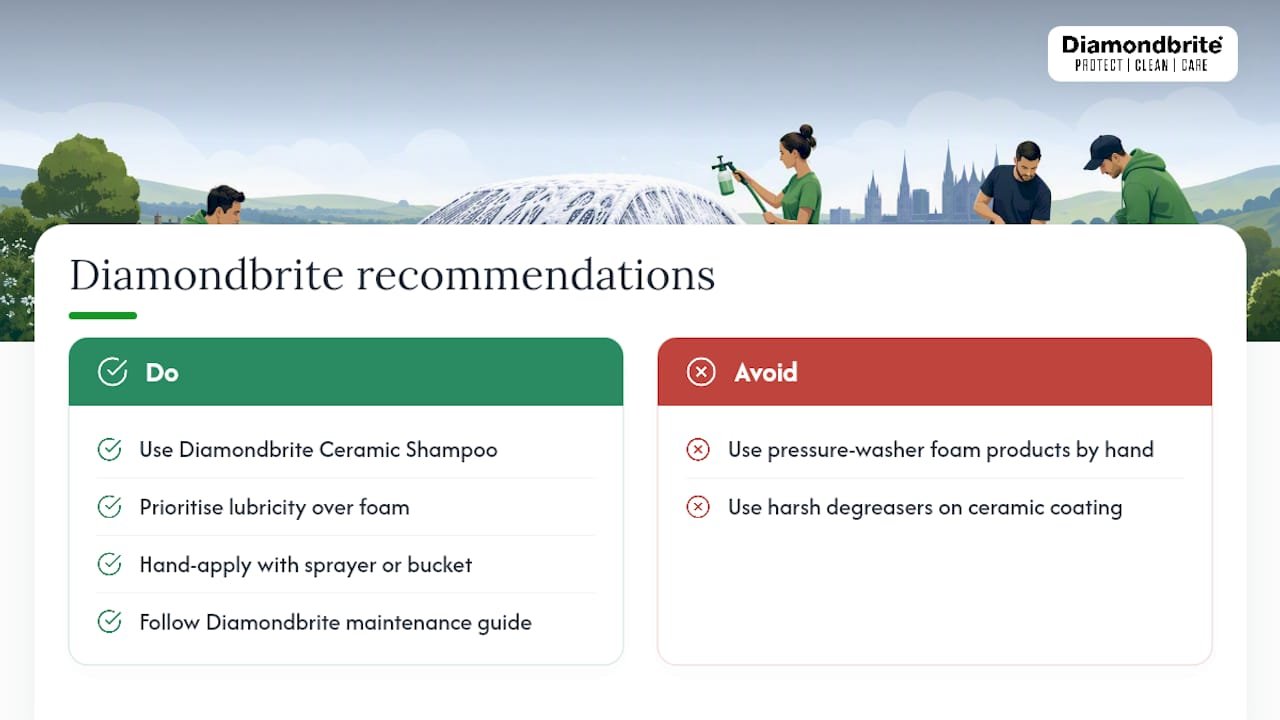
Diamondbrite’s Ceramic Shampoo suits manual and low-pressure application well, because its formula is built around lubricity rather than the thick, clinging foam a pressure-washer product relies on. That matters when you’re hand-applying with a sprayer or bucket, where slip protects the paint more than foam volume does.
If your car already carries a ceramic coating, stick to pH-neutral products during pre-wash. Harsh degreasers strip coating durability faster than normal wear does. Diamondbrite’s ceramic coating maintenance guide covers the full pre-wash routine in more depth, including how often to reapply protection after repeated manual washes.
Why the “you need a pressure washer” advice misses the point
Most snow foam advice fixates on cannon pressure and foam thickness, as if a wall of white lather is the whole job. It isn’t. Snow foam is a surfactant carrier designed to buy you contact time before you touch the paint, and a thinner foam from a hose cannon or pump sprayer still does that job, just over a shorter window.
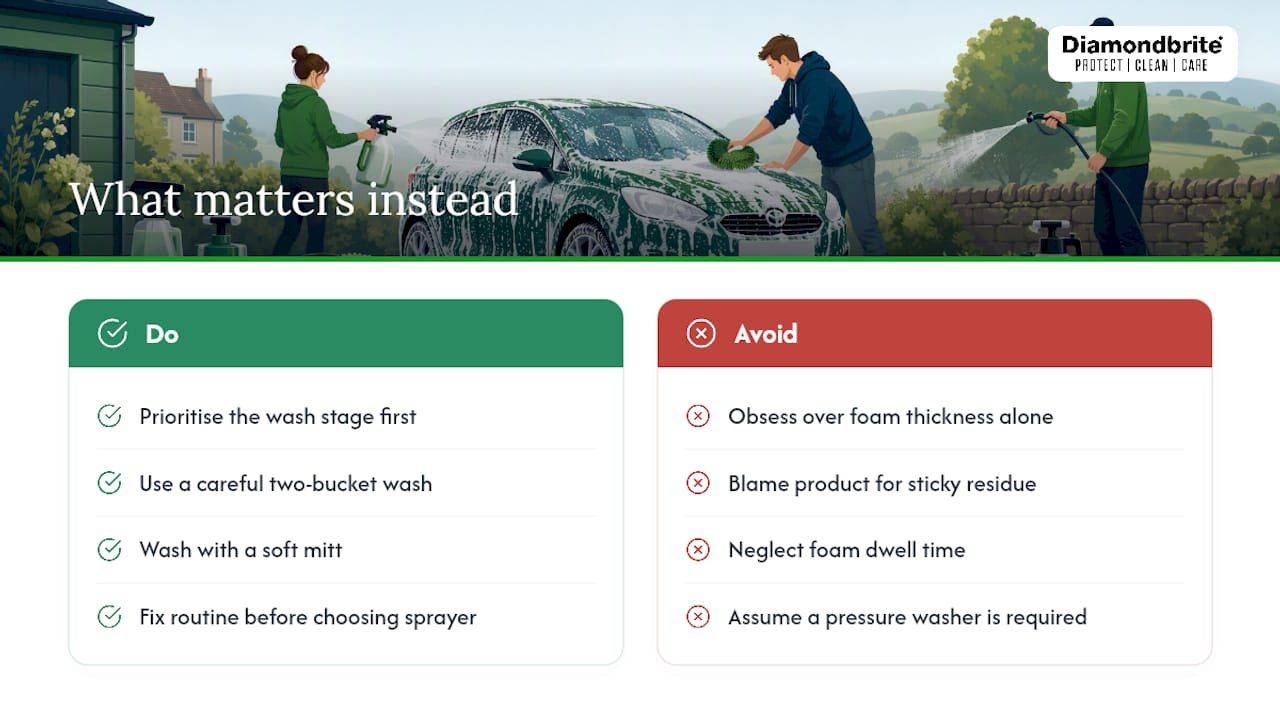
Where conventional advice really falls short is dwell time. Forums and buying guides obsess over dilution ratios but barely mention that low-pressure foam dries faster and needs rinsing sooner, which is exactly when most people end up with sticky residue and blame the product rather than their timing.
If you’re setting up a manual routine, prioritise the wash stage over the foam stage. A careful two-bucket wash with a soft mitt will do more for your paint than any amount of foam thickness. Get that right first, then worry about which sprayer gives you the prettiest lather.
— Will
Keep your manual wash routine paint-safe with Diamondbrite
Diamondbrite’s Ceramic Shampoo is built with the manual washer in mind. Its slick, ceramic-infused formula gives you more lubricity per pass than a standard shampoo, so a bucket, sprayer, or hose cannon routine still protects your paint even without a pressure washer’s extra rinse power.
For a full manual routine, pair it with a proper pre-wash step. Starter combinations are available that cover foaming, contact washing, and aftercare in one order, so you’re not guessing which products play well together. Head to the Diamondbrite shop to pick a shampoo suited to your wash frequency, and check the site’s best car pre-wash guide if you want to build out a complete kit before your next wash day.
Sources
- Applying Snow Foam Without a Pressure Washer
- Can you use snow foam with a hose?
- Can You Use Snow Foam Without A Pressure Washer? Find Out – GardenerBible
FAQ
Can I spray foam without a pressure washer?
Yes. A garden-hose foam cannon, manual pump sprayer, or hose-end foam gun will all produce usable foam, though it’s thinner and drains faster than a pressure-washer’s output.
What’s the best snow foam to use without a pressure washer?
A shampoo built for lubricity rather than pure foam thickness works best, since manual and low-pressure methods rely more on slip during the contact wash. Diamondbrite’s Ceramic Shampoo is designed with this kind of application in mind.
Can any car shampoo be used as snow foam?
Not really. Standard shampoo isn’t formulated to foam thickly through a cannon or sprayer, so results will be watery and less effective at lifting grime before you touch the paint.
Can you use snow foam with a hose?
Yes, either through a dedicated hose foam cannon or a basic hose-end foaming attachment. Expect thinner foam than a pressure washer produces, so dilute your mix more and rinse sooner before it dries.