

A genuinely eco-friendly car wash does two things at once: it uses a low-water or biodegradable method, and it stops dirty water from reaching a surface drain. Get those two right and everything else, including which product or service you choose, falls into place.
You have several practical options, depending on how dirty your car is and what equipment you have to hand:
- Waterless spray wash for light dust and pollen, no rinsing required.
- Rinseless shampoo for a slightly grubbier car with minimal water.
- Two-bucket method with grit guards for a full wash that still limits water use and paint damage.
- Steam cleaning for tougher grime without a hose.
- A licensed commercial eco wash for heavy contamination or when you can’t guarantee safe drainage at home.
The one rule that overrides all of them: never let wash water run into a road drain. That water usually goes straight to a river or stream untreated, so it needs containing, redirecting to the foul sewer with permission, or running through a recycling system instead.
Key Takeaways
An eco-friendly car wash means containing wash water and choosing a low-water or biodegradable method, never one without the other.
| Point | Details |
|---|---|
| Containment beats product choice | Never let wash water run into a surface drain, regardless of which shampoo you use. |
| Match method to dirt level | Waterless suits light dust; two-bucket or steam suits heavier grime and mud. |
| Biodegradable isn’t the whole story | Oil, brake dust, and heavy metals in runoff stay toxic even when surfactants meet legal standards. |
| Check labels properly | Look for phosphate-free, pH-neutral, and clear dilution instructions before buying. |
| Use a waterless product for maintenance | Diamondbrite’s Xpress Wash and Wax – Waterless! removes the drainage question for light, regular washes. |
Table of Contents
- Eco-friendly car wash methods compared
- How do you wash your car at home without wasting water?
- When should you book a professional eco car wash instead?
- What’s actually in your wash water, and how do you keep it out of rivers?
- How do you choose a genuinely eco-friendly car wash product?
- Why official guidance matters more than marketing claims
- Wash smarter with Diamondbrite’s waterless range
- Sources
- FAQ
Eco-friendly car wash methods compared
Choosing between waterless, rinseless, bucket washing, steam, and a commercial eco wash comes down to how dirty your car actually is, not which method sounds greenest on the label.
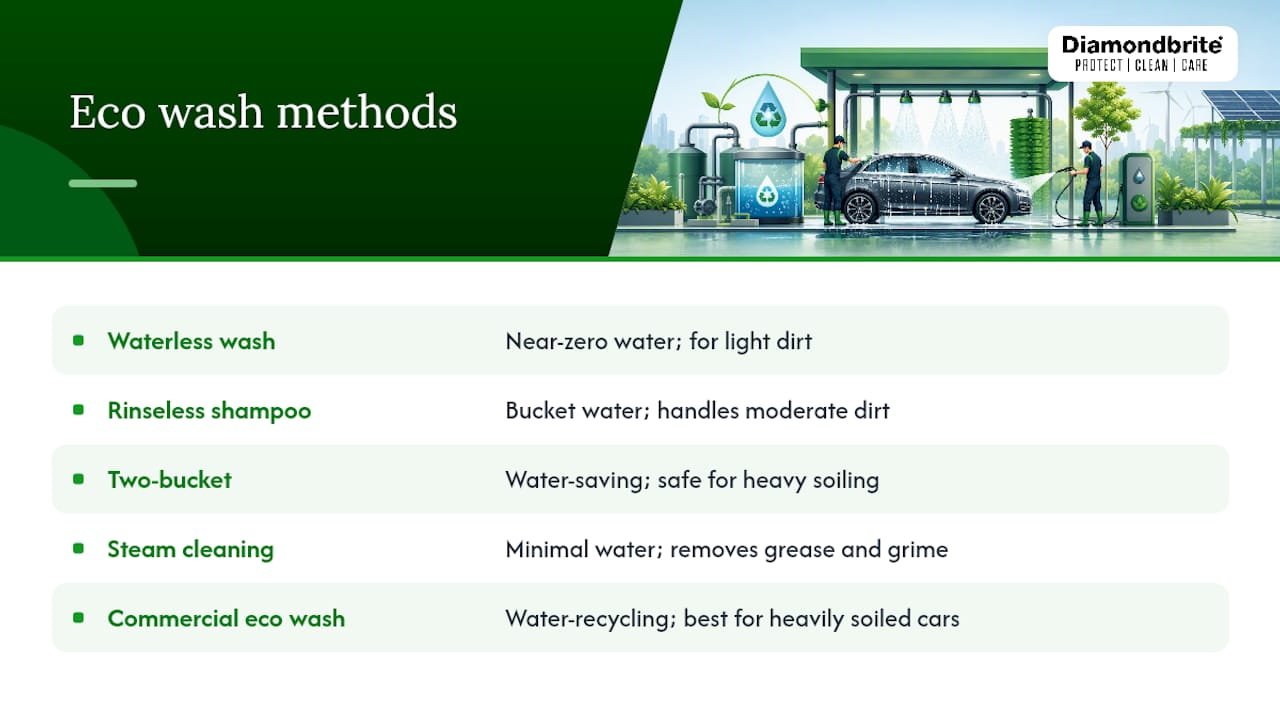
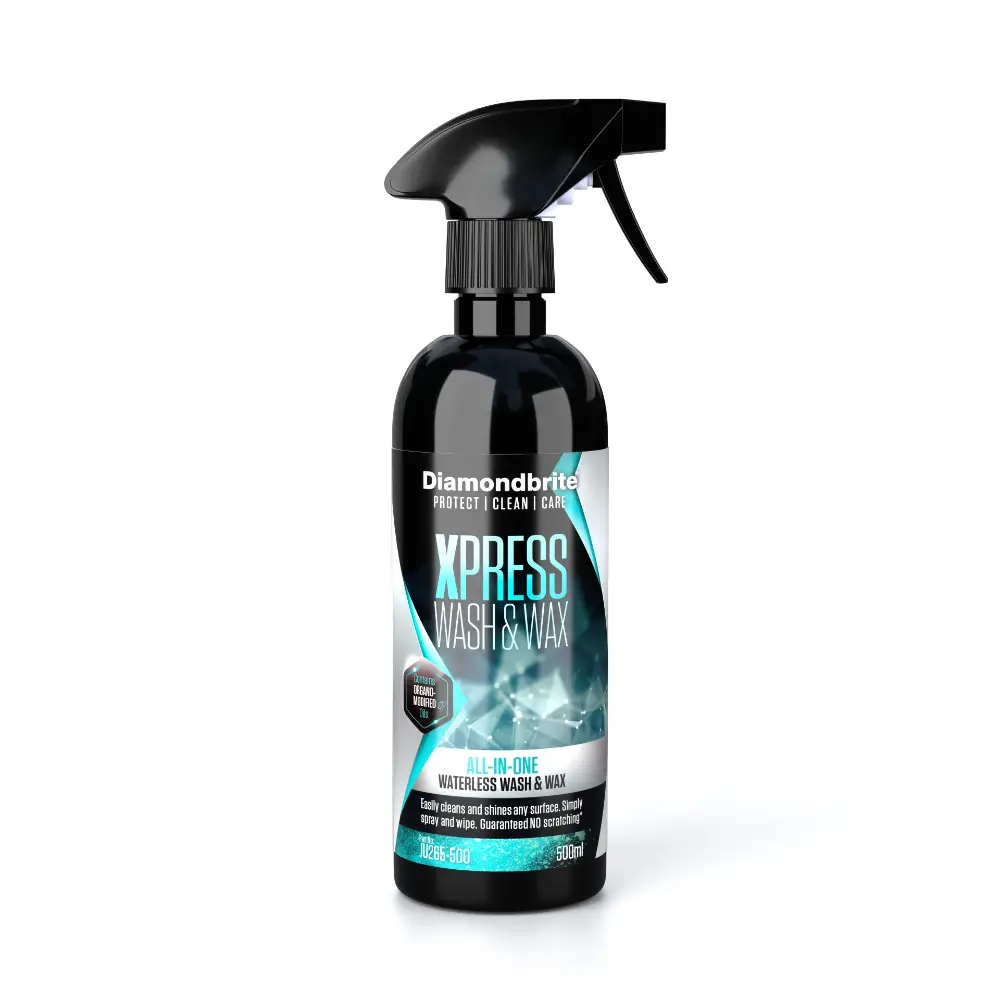
Waterless wash products use a spray lubricant that lifts light dirt so you can wipe it off with a microfibre cloth. Water use is close to zero. It’s brilliant for weekly maintenance on a car that’s already fairly clean, but wipe caked mud or road salt off with one and you risk dragging grit across the paintwork.
Rinseless shampoo works differently: you dilute a concentrated formula into a bucket, wash panel by panel, and wipe away rather than rinse. It uses a fraction of a traditional wash’s water, roughly a bucket or two rather than a running hose, and copes with moderate dirt better than a pure waterless product.
The two-bucket method with grit guards is still the benchmark for a proper wash with real water savings compared with a hosepipe running for twenty minutes. It handles heavier soiling safely because the grit guard traps abrasive particles before they reach your wash mitt.
Steam cleaning cuts water use dramatically while lifting grease and grime that waterless products can’t touch, though the equipment costs more and takes longer to master.
Commercial eco washes with recycling systems are the strongest option for heavily soiled vehicles, since automated sites often reuse a large share of their water rather than drawing fresh supply for every car, unlike a garden hose left running on the driveway.
DIY methods cost very little beyond the product itself, typically a few pounds per wash. Professional eco washes cost more per visit but remove the guesswork around drainage and disposal entirely.
How do you wash your car at home without wasting water?
Rinseless and waterless methods suit light to moderate dirt: dust, pollen, light road film, the everyday grime a car picks up on a weekly commute. Skip them entirely if your car is caked in mud, road salt, or anything gritty. Wiping abrasive dirt with a cloth, however soft, is how swirl marks and fine scratches end up in your paintwork.
Here’s a routine that keeps water use low and pollution risk near zero:
- Rinse loose dirt first with a pressure washer or watering can if you have moderate soiling. This removes grit before it ever touches a cloth.
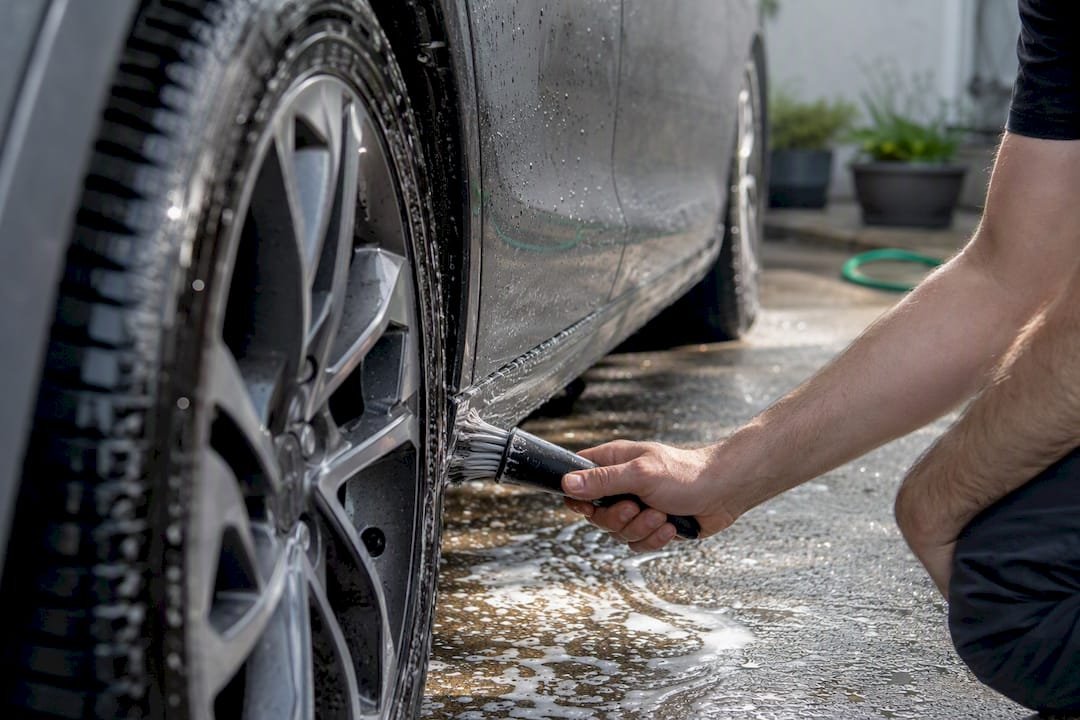
- Work wheels first, using a separate bucket and mitt. Wheels carry brake dust and road grime you don’t want cross-contaminating your paintwork sponge.
- Mix your rinseless or waterless product according to the label. Over-diluting weakens the lubricating film that protects paint from your wipe.
- Wash one panel at a time, folding your microfibre cloth to a clean face frequently rather than dragging a dirty patch across the next panel.
- For the two-bucket method, dunk your mitt in a rinse bucket fitted with a grit guard before reloading it with shampoo. The guard traps grit at the bottom instead of letting it sit in suspension.
- Dry with a separate clean microfibre rather than letting water evaporate and leave mineral spots.
- Contain or redirect wastewater. If you’re on a driveway that drains to the road, use a wash mat or divert water onto a lawn or gravel bed rather than letting it flow to the gutter.
Your kit list stays simple: two or three microfibre cloths, a grit guard, a pH-neutral or biodegradable shampoo, and a trigger sprayer for waterless jobs. A soft detailing brush for wheels and door shuts earns its place too, as CarJourney’s detailing process guide explains well.
Pro Tip: Pre-loosen heavy debris around wheel arches and lower sills with a soft brush before you wipe. It cuts scratching risk far more than switching products ever will.
When should you book a professional eco car wash instead?
Some jobs genuinely need equipment you won’t have at home. Caked mud after a muddy track, underbody road salt in winter, or an engine bay that needs degreasing all call for pressure and containment beyond a bucket and hose. If your driveway drains straight to a road gutter, that’s also your cue to use a professional site rather than risk sending dirty water into a watercourse.
Before you book, ask the operator a few direct questions:
- Do you recycle or treat your wash water, and how?
- How is surface runoff captured on site?
- Does your wastewater go to the foul sewer with water company consent?
- What chemicals do you use, and are they biodegradable and phosphate-free?
Watch for red flags too. A vague “we’re eco-friendly” with no detail on containment or disposal usually means there isn’t any. Sites without a wash bay, drain covers, or a visible collection point for wastewater are the ones the Environmental Audit Committee flagged as posing the greatest pollution risk, precisely because there’s nowhere for the dirty water to go except into the drain.
What’s actually in your wash water, and how do you keep it out of rivers?
Wash water isn’t just soap and mud. It carries engine oil residue, brake dust, heavy metals from wheels and bodywork, and surfactants from your shampoo, and that mix is genuinely toxic to aquatic life even when the shampoo itself is biodegradable. Biodegradable only means the surfactant breaks down over time. It says nothing about the metals and oil travelling alongside it.
One detail worth knowing: UK Detergents Regulations already require surfactants to meet a legal biodegradability standard before a product can be sold, so “biodegradable” on a label is a baseline requirement, not a marketing flourish.
NetRegs and GPP13 guidance sets out the practical rule: never let runoff enter a surface water drain. Use a designated wash bay, a recycling system, or discharge to the foul sewer with your water company’s permission. If you’re washing on a permeable surface such as gravel or grass as a last resort, that’s acceptable, but it’s not a substitute for proper containment where drainage runs to a road. Silt traps help catch sediment before it reaches any drain, but they need emptying and disposing of responsibly, not left to overflow.
How do you choose a genuinely eco-friendly car wash product?
Look past the packaging and read what the label actually states. A trustworthy biodegradable car shampoo tells you its surfactant is biodegradable, confirms it’s phosphate-free, states a pH-neutral formulation, and gives clear dilution instructions rather than a vague “a small amount goes a long way.”
pH-neutral matters more than most buyers realise if your car has a ceramic coating. Harsh alkaline shampoos strip the coating’s hydrophobic properties over time, whereas Diamondbrite’s guidance on pH-neutral shampoo for ceramic-coated cars explains why a neutral formula preserves that protection wash after wash.
For quick maintenance washes between full cleans, a proper waterless product does the job without a bucket in sight. Diamondbrite’s Xpress Wash and Wax – Waterless! is built for exactly that: light dust, pollen, and road film, wiped away with a lubricating spray that adds a wax finish as you go. Reach for it between full washes, not as a substitute for a proper rinse when your car is genuinely dirty.
- Check for biodegradable surfactants and phosphate-free formulation.
- Confirm pH-neutral if you have a ceramic coating.
- Look for clear dilution ratios, not marketing language.
Pro Tip: Keep a waterless product in the boot. It turns a five-minute pollen wipe-down into a habit rather than a chore you keep putting off.
Why official guidance matters more than marketing claims
Most of the “eco car wash” advice online treats every green-labelled product as equally trustworthy, and that’s where it falls short. The real dividing line isn’t biodegradable versus not; it’s whether the water ever reaches a drain. A shampoo can meet every legal standard under the Detergents Regulations and still cause harm if you rinse it straight into the gutter.
That’s why NetRegs and GPP13 guidance deserves more attention than it gets in most car care content. It’s not exciting reading, but it’s the difference between a wash that’s genuinely low-impact and one that just feels virtuous. I’d argue the biggest overlooked factor is containment, not product choice. You can use the greenest shampoo available and still pollute a stream if the water runs off your drive unchecked.
My honest priority order for readers: sort drainage and containment first, pick a low-water method second, and only then worry about which specific biodegradable shampoo sits on your shelf. Get the first two right and you’re already ahead of most driveway washes in the UK. That’s also why a genuinely waterless product earns its place in a routine, not as a gimmick but as the simplest way to remove the drainage question entirely.
— Will
Wash smarter with Diamondbrite’s waterless range
If containing wash water feels like more hassle than you want most weekends, the simplest fix is removing the water altogether. Diamondbrite’s Xpress Wash and Wax – Waterless! gives you a proper maintenance wash with zero runoff to manage, no hose, no bucket, no drain to worry about, just a spray and a microfibre cloth. It’s formulated to lift light dirt and pollen while leaving a wax finish behind, which makes it genuinely useful rather than a stripped-down compromise.
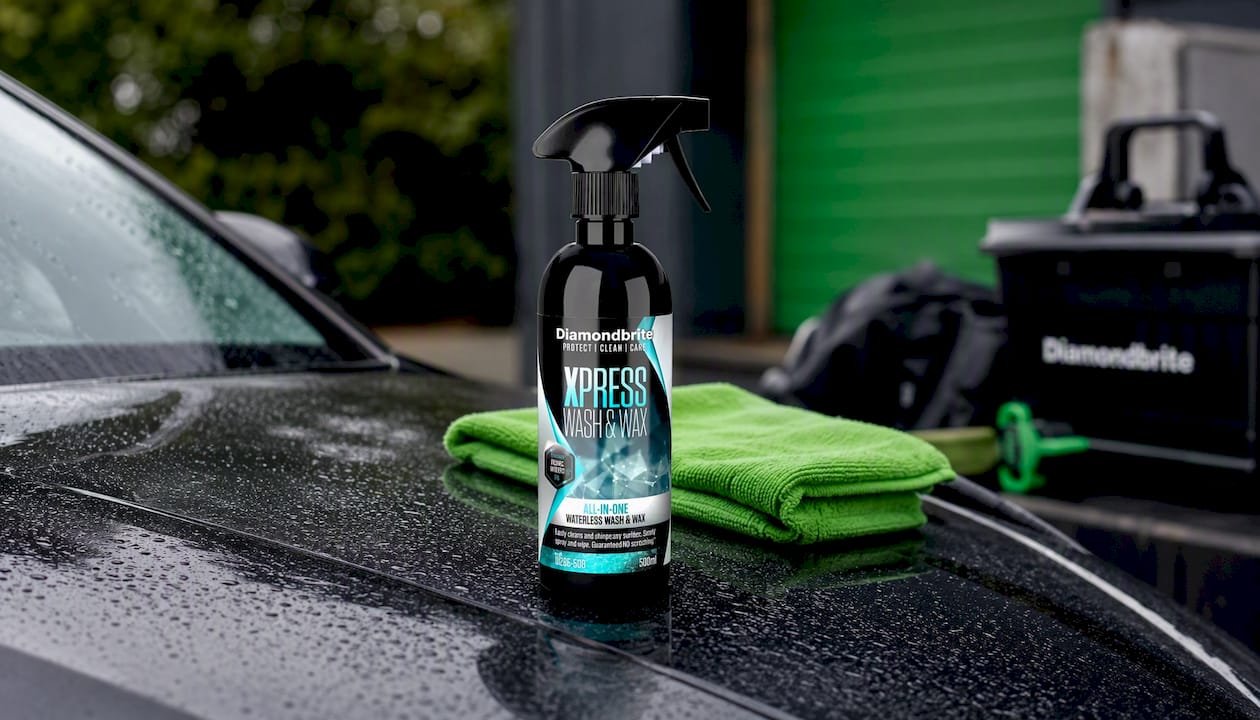
It suits anyone who washes their car weekly and wants that routine to stop being an environmental question mark. Pair it with Diamondbrite’s pH-neutral shampoo range for deeper cleans between waterless top-ups, and you’ve got a full routine that respects your paintwork and your local watercourse. Head to the Diamondbrite shop to pick up a bottle and see which product suits your next wash.
Sources
- Guidance for Pollution Prevention: vehicle washing and cleaning (GPP13)
- Environmental Audit Committee: evidence on hand car washes (CIWEM response / inquiry)
- The Detergents (Amendment) (EU Exit) Regulations 2019 — explanatory material
FAQ
Are car washes environmentally friendly?
It depends entirely on drainage and product choice. A commercial wash with water recycling and foul sewer discharge is typically lower impact than an uncontrolled driveway wash, according to evidence given to the Environmental Audit Committee.
Is there an environmentally safe car wash soap?
Look for a shampoo that’s biodegradable, phosphate-free, and pH-neutral, which also protects ceramic coatings better than harsher formulas. UK Detergents Regulations already require a biodegradability standard for surfactants before sale.
What is the least damaging car wash?
For your paintwork, the two-bucket method with grit guards carries the lowest scratching risk for a full wash. For the environment, a licensed commercial eco wash with water recycling and proper drainage tends to cause the least harm overall.
What is a good alternative to a traditional car wash?
A waterless spray wash, such as Diamondbrite’s Xpress Wash and Wax – Waterless!, works well for light maintenance without water or drainage concerns. For heavier dirt, rinseless shampoo or a mobile steam service are practical alternatives that still limit water use.