

For UK boat owners who want durable above-waterline protection, Diamondbrite’s ceramic-infused marine protection products are the recommended starting point. A properly applied marine ceramic coating builds a hard, hydrophobic shield over gelcoat and painted topsides, delivering UV resistance, salt repellence, and noticeably faster rinse-downs. Realistic performance in active UK saltwater use can last from several months up to two years, depending on exposure and surface preparation.
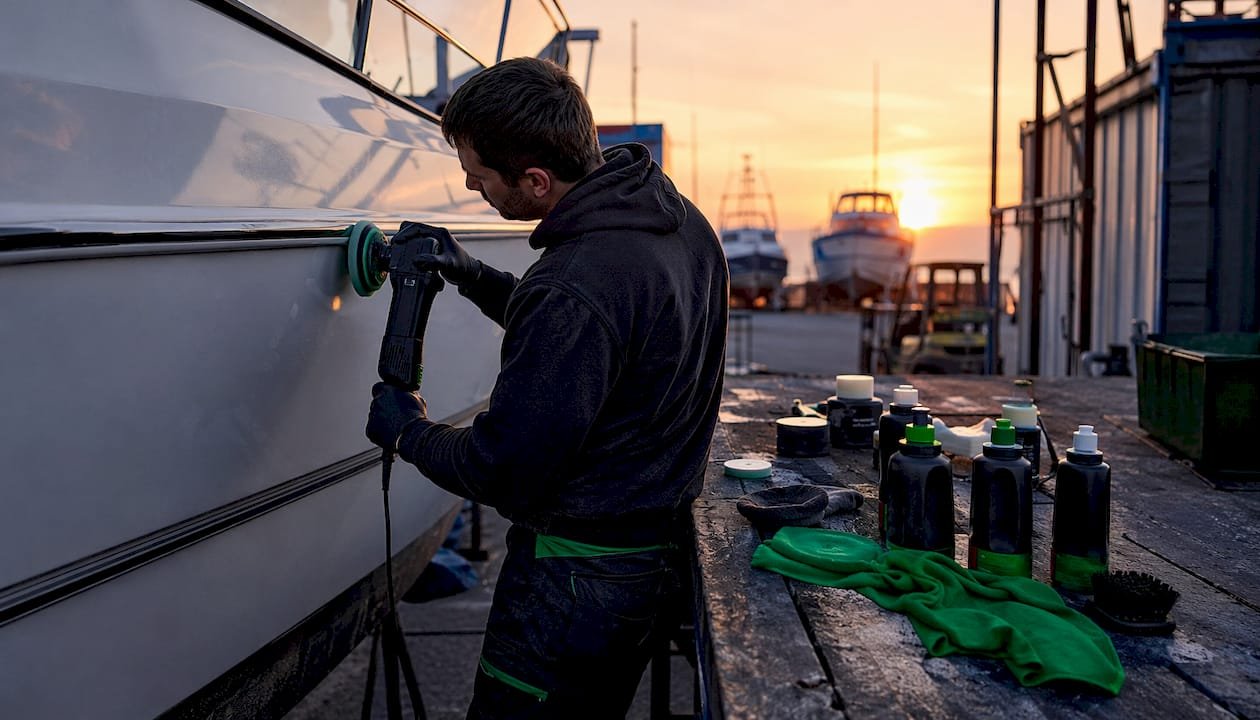
The single most important caveat: prep is everything. No ceramic product, regardless of brand, will perform on contaminated, waxy, or oxidised gelcoat. Get the surface right first, and the coating will reward you. Skip that step, and you are sealing the problem in.
Diamondbrite formulates its products in the UK, which means the chemistry is developed with British conditions in mind, not the Florida sun or the Mediterranean. That distinction matters for UV stabilisation and salt resistance in the grey, tidal waters most UK sailors actually sail in.

Table of Contents
- What does the Diamondbrite marine ceramic range cover?
- Why choose a ceramic coating instead of traditional wax?
- What does a ceramic coating actually protect, and what won’t it do?
- How do you choose the right product and prepare your boat’s surface?
- Step-by-step application and curing guide
- How long does a coating last, and what does upkeep look like?
- Why marine-specific formulations outperform automotive coatings on boats
- Key takeaways
- The case for getting the prep right, not just the product
- Diamondbrite marine ceramic products: kits, coverage and where to buy
- Useful sources and further reading
What does the Diamondbrite marine ceramic range cover?
Diamondbrite’s ceramic-infused product range extends beyond automotive use to cover marine vessels, with formulations suited to gelcoat topsides, painted hulls, glass, and stainless running gear. The core of the marine offer sits within the Ceramic Glaze and ceramic protection system, which can be applied as a standalone treatment on lightly weathered surfaces or as a finishing layer after a full correction polish on more weathered hulls.
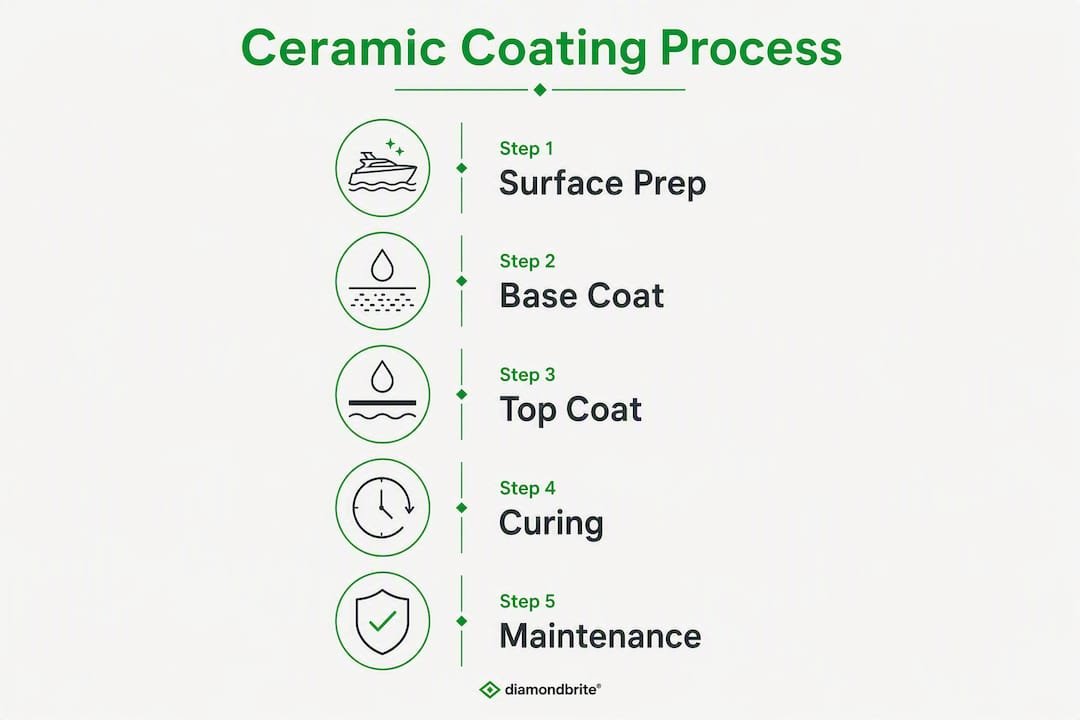
Multi-stage marine systems are common practice in the industry: a base coat bonds into porous gelcoat while a top coat delivers the hydrophobicity and gloss you actually see and feel. Diamondbrite’s ceramic system follows this layered logic, with the glaze providing the protective bond and the ceramic shampoo maintaining the hydrophobic layer between full treatments.
| Product | Best suited for | Coats | Claimed protection |
|---|---|---|---|
| Ceramic Glaze | Gelcoat, painted topsides, glass | 1–2 | — |
| Ceramic Shampoo | Maintenance wash, hydrophobic top-up | N/A (wash) | Extends coating life |
| Ceramic Spray | Quick top-up between full treatments | 1 | Boosts existing coating |
Coverage per application varies with surface porosity. Industry guidance for marine ceramic products puts typical coverage at roughly 200–350 sq ft per 100ml, depending on whether you are applying a base or top coat and how porous the gelcoat is. For a 20–30ft boat, a single 250ml bottle of ceramic glaze is usually sufficient for topsides. A 30–40ft boat with more freeboard and a larger cockpit surround will typically need 500ml or two bottles to cover all above-waterline surfaces properly.
Diamondbrite products are available directly through the Diamondbrite online shop, with no minimum order and UK dispatch. Maintenance sprays and ceramic shampoos are stocked alongside the full ceramic glaze kits, so you can set up a complete aftercare routine in a single order.
Why choose a ceramic coating instead of traditional wax?
Wax has served boat owners well for decades, and it still has a place. But the comparison is not really close once you factor in the conditions UK boats face: tidal salt exposure, strong UV in summer, and the kind of green algae growth that appears on anything left in a marina for more than a fortnight.
The core benefits of a marine ceramic coating:
- UV and oxidation resistance. The cured SiO2 layer is significantly harder than wax, which means it resists the UV degradation that turns gelcoat chalky and dull.
- Hydrophobicity. Water beads and sheets off the surface rather than sitting and soaking in. After a day’s sailing, a quick freshwater rinse removes most salt and grime without scrubbing.
- Gloss retention. Ceramic holds its depth of shine significantly longer than wax, which typically dulls within a couple of months under saltwater exposure.
- Chemical resistance. Bird droppings, fish blood, diesel residue, and algae release far more easily from a coated surface than from bare or waxed gelcoat.
- Longer intervals between full treatments. Marine wax needs reapplication a few times per year in active use; a well-applied ceramic coating can last about one to two years before a full recoat is needed.
The trade-offs are real, though. Ceramic costs more upfront, both in product and in the preparation time required. It is also stricter: wax is forgiving of a slightly dusty surface; ceramic is not. And ceramic does not replace regular washing. It makes washing faster and easier, but you still need to rinse after every outing and wash with pH-neutral soap regularly.
Pro Tip: Liveaboards, boats moored in tidal estuaries, and any vessel that spends the summer in high-UV coastal waters will see the clearest return from ceramic. If your boat is trailered, stored under cover, and only used on freshwater lakes a handful of times a year, traditional wax remains perfectly cost-effective.
What does a ceramic coating actually protect, and what won’t it do?
Marine ceramic coatings protect above-waterline surfaces only. They create a hydrophobic, UV-resistant, chemically bonded layer on gelcoat, painted topsides, glass, and stainless steel, making those surfaces easier to clean and slower to oxidise. They are not antifouling treatments and will not prevent barnacle or weed growth on the submerged hull.
Applying any ceramic coating below the waterline is a mistake. The coating has no antifouling chemistry, and worse, it can trap contaminants and moisture against the hull substrate, making future remediation significantly harder. Your antifouling paint goes below the waterline; your ceramic coating goes above it. These are two separate systems with two separate jobs.
Surfaces well suited to ceramic coating:
- Gelcoat topsides and hull sides (above waterline)
- Painted superstructure and cabin sides
- Windscreens and portlights
- Stainless steel stanchions, rails, and cleats
- Aluminium trim and fittings
Surfaces to avoid or treat separately:
- Teak decking (ceramic does not bond well to open-grain wood and can cause uneven darkening)
- Non-skid deck areas (coating reduces grip, which is a safety issue)
- Submerged hull (use antifouling paint, not ceramic)
- Running gear below the waterline requires separate consideration
One nuance worth knowing: a hydrophobic coating on propellers and shafts can slow the initial settlement of sessile organisms on fast-moving components, because the slick surface gives fouling less to grip. This is not the same as antifouling, but it is a useful secondary benefit on running gear that spends time stationary in the water.
How do you choose the right product and prepare your boat’s surface?
Start with an honest assessment of your gelcoat’s condition. Run your hand across the topsides: if it comes away with a white, chalky residue, the surface is oxidised and needs compounding before any coating goes on. Applying ceramic to oxidised gelcoat is counterproductive. The coating bonds to the oxidation layer, not the gelcoat beneath, and when that layer breaks down, the coating comes with it.
For a lightly weathered boat with good gloss, a single-stage polish and IPA wipe is sufficient prep. For anything with visible chalking, fading, or swirl marks, a full machine compound and polish cycle is required first.
Pre-application checklist:
- Wash the hull thoroughly with a degreasing boat wash and rinse completely
- Assess oxidation: perform a rub test with a white cloth; heavy chalk means compound first
- Machine compound with a rotary or dual-action polisher and cutting pad if correction is needed
- Follow with a finishing polish to restore gloss
- Wipe all surfaces with isopropyl alcohol (IPA) on a clean microfibre cloth to remove all polish oils and residue
- Check ambient temperature: most marine ceramics apply best between 10°C and 25°C, out of direct sunlight
- Check humidity: avoid application in rain or heavy damp; condensation on the surface will prevent proper bonding
Questions to ask your supplier or detailer before committing:
- How many coats does this system require, and what is the recoat window?
- What is the minimum cure time before water exposure?
- Is a maintenance spray available, and is it compatible with this coating?
- What does the protection period cover, and under what conditions?
One red flag: any product claiming 5+ years of protection for a boat in constant saltwater use. Real-world marine lifespan for active UK boats runs 9–24 months. Claims beyond that are marketing, not chemistry.
Step-by-step application and curing guide
The critical stages are decontamination, correction and polish, IPA wipe, panel-by-panel coating application, flash and buff, and then a controlled cure period before any water exposure. Get those stages in the right order and the coating will bond correctly and last.
Wash and decontaminate. Rinse the hull with fresh water, then wash with a pH-neutral boat shampoo. Use a clay bar or marine decontamination product on any areas with embedded salt, tar, or oxidation residue. Rinse again and allow to dry fully.
Compound and polish (if required). Use a dual-action or rotary polisher with an appropriate cutting compound to remove oxidation, then follow with a finishing polish. Work in sections of roughly 60cm x 60cm. Wipe residue with a clean microfibre cloth before moving on.
IPA wipe-down. Mix isopropyl alcohol at roughly 70% concentration and wipe every surface you intend to coat. This removes all remaining polish oils and is the final step before application. Do not skip it.
Apply the ceramic coating panel by panel. Apply a few drops of product to an applicator block wrapped in a suede or microfibre cloth. Work in small sections (roughly 50cm x 50cm). Use overlapping straight passes, not circular motions.
Allow to flash. Wait for the coating to haze slightly on the surface. Flash time varies by product and temperature but is typically 1–3 minutes in UK ambient conditions. Do not let it dry too long before buffing.
Buff off with a clean microfibre. Use a soft, dry microfibre cloth to remove the haze with light pressure. Flip the cloth frequently.
Cure before water exposure. Allow a minimum of 24 hours before any water contact, with 48 hours being the recommended target. Wait 5–7 days before performing a soap wash to allow full cross-linking of the coating.
Safety and site notes: Work in shade or indoors. Direct sunlight accelerates flash time unpredictably and makes buffing difficult. Wear nitrile gloves throughout. Ensure ventilation if working in an enclosed space such as a boat shed. Keep product away from eyes and skin.
How long does a coating last, and what does upkeep look like?
In real UK saltwater use, expect 9–24 months of meaningful protection from a well-applied marine ceramic coating. The lower end applies to boats moored year-round in tidal estuaries with heavy salt exposure and minimal maintenance. The upper end is achievable on boats that are rinsed after every outing and treated with a maintenance spray quarterly.
Coverage examples for common UK boat sizes:
| Boat length | Approximate topside area | Product needed (ceramic glaze) | Estimated DIY cost |
|---|---|---|---|
| 20–25ft | 15–18m² | 250ml (1 bottle) | £30–£60 |
| 26–30ft | 20–30m² | 500ml (2 bottles) | £60–£110 |
| 33–39ft | 30–40m² | 500–1,000ml | £90–£170 |
Professional application, which includes full machine correction, decontamination, and coating, typically runs £500–£1,500 for a 22–26ft boat depending on the condition of the hull and the number of correction stages required. Larger or heavily oxidised boats can cost more. DIY product costs are a fraction of that, but the prep work is the same.
Practical maintenance routine:
- Rinse with fresh water after every outing, particularly after saltwater use
- Wash with a pH-neutral marine shampoo every 2–4 weeks during the sailing season
- Apply a ceramic maintenance spray every 3 months to restore hydrophobic performance
- Avoid pressure washing directly onto coated surfaces at close range
- Do not use alkaline or acidic cleaners, which will degrade the coating faster
Coated boats shift from heavy correction cycles to frequent light rinses. That is the real maintenance benefit: less scrubbing, less compounding, and a hull that looks presentable with minimal effort between seasons.
Why marine-specific formulations outperform automotive coatings on boats
Using an automotive ceramic coating on a boat is a common and costly mistake. Automotive-grade ceramics commonly fail on boats within months because they are not engineered for the combination of constant UV, salt spray, thermal cycling, and hull flex that marine surfaces experience.
Marine formulations include three things automotive products typically lack: higher UV stabiliser concentrations, increased flexibility to accommodate hull movement under sail or power, and salt-resistant chemistry that prevents the coating from becoming brittle and delaminating in tidal conditions.
The chemistry difference is not subtle. A gelcoat hull flexes as it moves through water, especially on GRP sailing yachts. An automotive ceramic, optimised for a rigid steel or aluminium car panel, can micro-crack under that flex within a single season. A marine-grade formulation is engineered to move with the substrate rather than against it, which is why the protection period is meaningfully longer even in harsher conditions.
Multi-layer marine systems reinforce this further. The base coat penetrates and bonds to porous gelcoat, filling microscopic voids and creating a stable foundation. The top coat then delivers the hydrophobicity and gloss. Single-layer automotive formulas applied to gelcoat often sit on the surface rather than bonding into it, which is why they wash off or delaminate far sooner. Understanding the differences between marine paint systems helps clarify why the substrate matters as much as the product itself.
Diamondbrite’s ceramic formulations are developed in the UK, where the chemistry accounts for the specific demands of British coastal and tidal environments, not the year-round sunshine of warmer markets.
Key takeaways
Marine ceramic coating is the most durable above-waterline protection available for UK boats, but it only performs as well as the surface preparation beneath it.
| Point | Details |
|---|---|
| Above-waterline only | Ceramic coatings protect topsides, glass, and running gear; never apply below the waterline. |
| Prep determines performance | Oxidised or contaminated gelcoat must be compounded and polished before any coating is applied. |
| Realistic lifespan | Expect 9–24 months in active UK saltwater use, depending on exposure and maintenance. |
| Maintenance still required | Rinse after every outing, wash with pH-neutral soap, and apply a maintenance spray quarterly. |
| Diamondbrite for UK boats | Diamondbrite’s ceramic-infused marine products are formulated in the UK and available directly from the Diamondbrite online shop. |
The case for getting the prep right, not just the product
There is a tendency in the marine detailing world to treat ceramic coating as the answer to a neglected hull. It is not. The coating is the reward for doing the hard work first.
What strikes me most when looking at how UK boat owners approach ceramic protection is the gap between expectation and preparation. Owners will spend considerable money on a quality marine ceramic product, then apply it over a hull that has not been properly decontaminated or corrected. The result is a coated hull that looks good for six weeks and then begins to peel or haze, which puts people off ceramic altogether. The product did not fail. The process did.
The other thing worth saying plainly: marine-specific chemistry is not a marketing distinction. Automotive ceramics are engineered for rigid panels in road conditions. A GRP hull in a tidal estuary is a fundamentally different substrate in a fundamentally different environment. Buying a marine-formulated product from a trusted UK brand like Diamondbrite, and following the prep steps properly, is the difference between a coating that lasts a season and one that lasts two years.
Sensible expectations matter too. No ceramic coating is maintenance-free. The maintenance routine for a coated boat is lighter than for an uncoated one, but it still exists. Rinse, wash, top up. Do that consistently, and the coating will go the distance.
Diamondbrite marine ceramic products: kits, coverage and where to buy
Diamondbrite’s ceramic-infused marine protection range gives UK boat owners a direct, cost-effective route to professional-grade above-waterline protection, without the professional price tag.
For a 20–25ft boat, a single bottle of Diamondbrite Ceramic Glaze covers the topsides in one or two coats, with the Ceramic Shampoo handling maintenance washes through the season. For a 26–35ft boat, a two-bottle kit with a ceramic maintenance spray gives you the full system: initial protection, hydrophobic top-up, and a pH-neutral wash routine in one order. If your hull is heavily oxidised, book a professional machine correction first, then apply the Diamondbrite ceramic system yourself once the gelcoat is restored.
Order applicator pads and a set of quality microfibre cloths alongside your ceramic kit. These are not optional extras; they are part of the application system. Diamondbrite’s support team can advise on product selection for your boat’s size and surface condition.
Browse the full range and order direct at the Diamondbrite online shop.
Useful sources and further reading
The technical claims in this article are drawn from the following sources. Where specific figures appear (coverage rates, cure times, cost bands), the source is linked directly in the relevant section above.
- Best Ceramic Coating for Boats: Does It Actually Replace Wax — Power and Motor Yacht Central: covers above-waterline limitations, running gear benefits, surface prep failures, and professional cost bands.
- Marine Paint Systems Explained — Mazza Marine: technical background on marine coating systems and substrate compatibility.
- Diamondbrite Online Shop — primary source for product specifications, kit sizes, and UK availability.