

For a ceramic-coated car, a pH neutral car shampoo formulated specifically for SiO2 coatings is the correct choice. It cleans effectively while staying within the pH 6–8 window that protects ceramic coatings from accelerated breakdown. Diamondbrite Ceramic Shampoo is the recommended UK-available option.
Quick answer:
- Use a shampoo with a near-neutral pH, avoiding household dish soap or heavy degreasers
- Pair it with the two-bucket wash method and a quality microfibre mitt
- Diamondbrite Ceramic Shampoo is formulated for coated cars and developed in Loughborough
Table of Contents
- Why does pH matter so much for ceramic-coated cars?
- How to choose a genuinely coating-safe pH neutral shampoo
- How to wash a ceramic-coated car without causing damage
- How do you test a shampoo’s pH before using it on your car?
- Diamondbrite Ceramic Shampoo: does it meet the checklist?
- What does “pH neutral” actually mean on a car shampoo label?
- Key takeaways
- The case for keeping it simple
- Diamondbrite Ceramic Shampoo: where to buy and what to pair it with
- Useful sources
Why does pH matter so much for ceramic-coated cars?
Ceramic coatings rely on a network of Si-O-Si (siloxane) bonds to build their durable shield over your paintwork. When you wash with a highly alkaline cleaner above pH 10.5, those bonds begin to hydrolyse — the silica network progressively breaks down, and your coating loses its water-beading and gloss performance faster than it should. Household dish soaps and aggressive degreasers above pH 11 are particularly damaging; they can saponify waxes and accelerate this breakdown with every wash.
A near-neutral wash chemistry prevents that accelerated hydrolysis. Coating manufacturers consistently specify near-neutral maintenance washes for exactly this reason.
What to avoid on a ceramic-coated car:
- Household dish soap (typically pH above 11, with aggressive surfactants)
- Heavy degreasers or traffic film removers used at full concentration
- Acidic wheel cleaners applied to painted surfaces
- Any product labelled “wash and wax” — these deposit fillers that mask hydrophobic performance and clog the SiO2 layer
Pro Tip: pH alone does not tell the whole story. A shampoo sitting at pH 7 can still strip a coating if it uses aggressive anionic surfactants such as sodium lauryl sulphate (SLS) or linear alkylbenzene sulphonate (LAS). Check the surfactant class, not just the pH number.
How to choose a genuinely coating-safe pH neutral shampoo
The decisive check is this: look for a pH near neutral paired with gentle, amphoteric surfactants such as betaines or alkyl polyglucosides (APGs), rather than aggressive anionics. A product that ticks both boxes is genuinely coating-safe; one that ticks only pH is not.
Buying checklist:
- pH confirmed as near neutral on the SDS (safety data sheet) or technical spec sheet
- Surfactant family: betaines or APGs listed, no SLS or LAS as the lead surfactant
- Lubrication additives present (polymer or glycol-based) to reduce mitt friction
- Biodegradable formulation and chelating agents for hard-water areas
- Clear dilution guidance published by the brand
Red flags on the label:
- “Wash and wax” or “gloss enhancer” — filler deposits interfere with the coating
- “Heavy degreaser” or “traffic film remover” — pH likely too high for regular use
- No SDS available — a reliable purchase check is to review the SDS: section 9 shows pH and section 3 lists surfactants
- High foam volume marketed as the main benefit — foam is a visual proxy; the surfactant system and lubricity package determine real cleaning performance
- No dilution ratio stated — concentrated products without guidance are easy to misuse
How to wash a ceramic-coated car without causing damage
Follow a gentle, contact wash routine using a pH balanced car wash product and the two-bucket method. This approach, recommended by detailing experts, keeps swirl marks to a minimum and preserves coating life wash after wash.
What you need:
- Two buckets, each fitted with a grit guard
- High-quality microfibre wash mitt
- Clean microfibre drying towels
- pH neutral shampoo at the correct dilution
Step-by-step wash routine:
- Pre-rinse the car thoroughly with a hose or pressure washer to remove loose dirt and grit before any contact
- Fill bucket one with your shampoo solution at the recommended dilution; fill bucket two with clean rinse water
- Load the mitt from the shampoo bucket and work from the roof downwards in straight, overlapping passes — never circular scrubbing
- Rinse the mitt in the clean-water bucket after each panel, then reload from the shampoo bucket
- Rinse the car panel by panel as you go, or fully at the end, using a free-flowing hose to sheet water off
- Dry immediately with a clean microfibre towel or a dedicated drying towel to prevent water spots
Rinseless or waterless chemistries are a different formulation category and are not a direct substitute for contact washing when the goal is gentle maintenance of a ceramic coating.
Dilution and frequency: For maintenance washes, a typical dilution is 1:500–1:1000 (follow the brand’s guidance). Most daily drivers benefit from a wash every one to two weeks; cars exposed to road salt in winter should be washed more frequently to prevent salt contamination sitting on the coating.
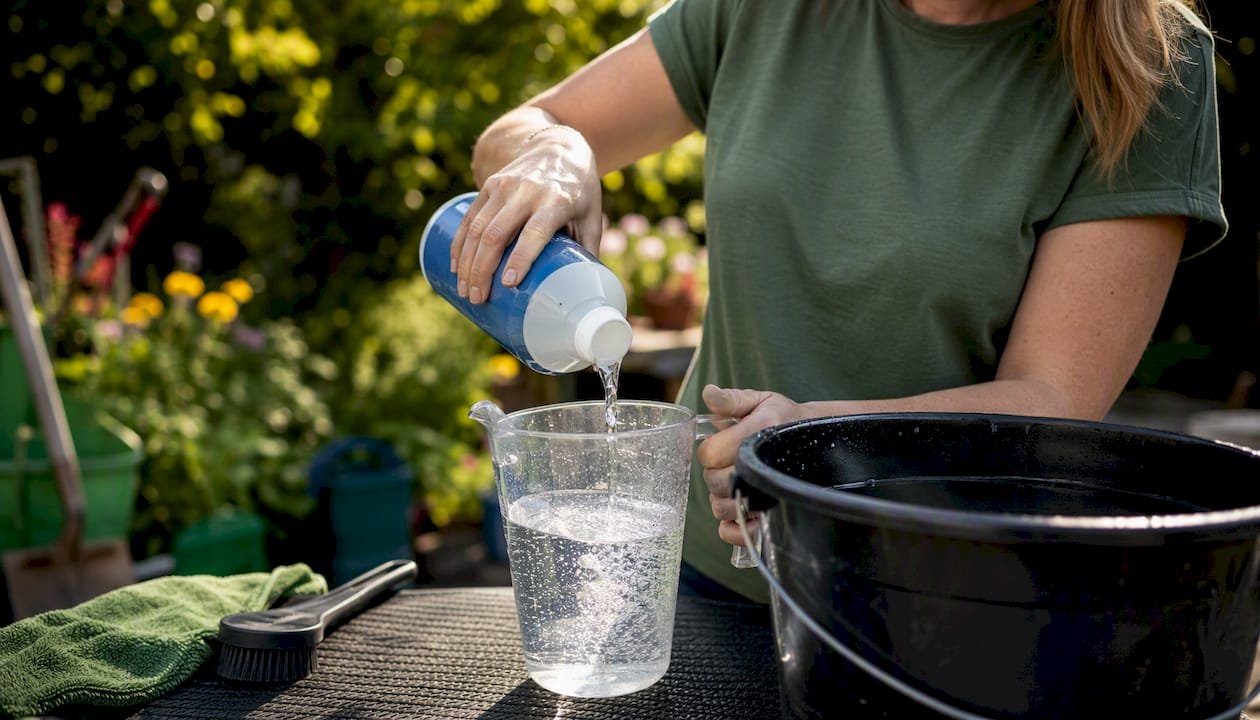
Pro Tip: Good lubrication in the shampoo is what separates a safe wash from a scratchy one. If you notice the mitt dragging on a panel, add more shampoo solution — never push through with a dry or under-lubricated mitt.
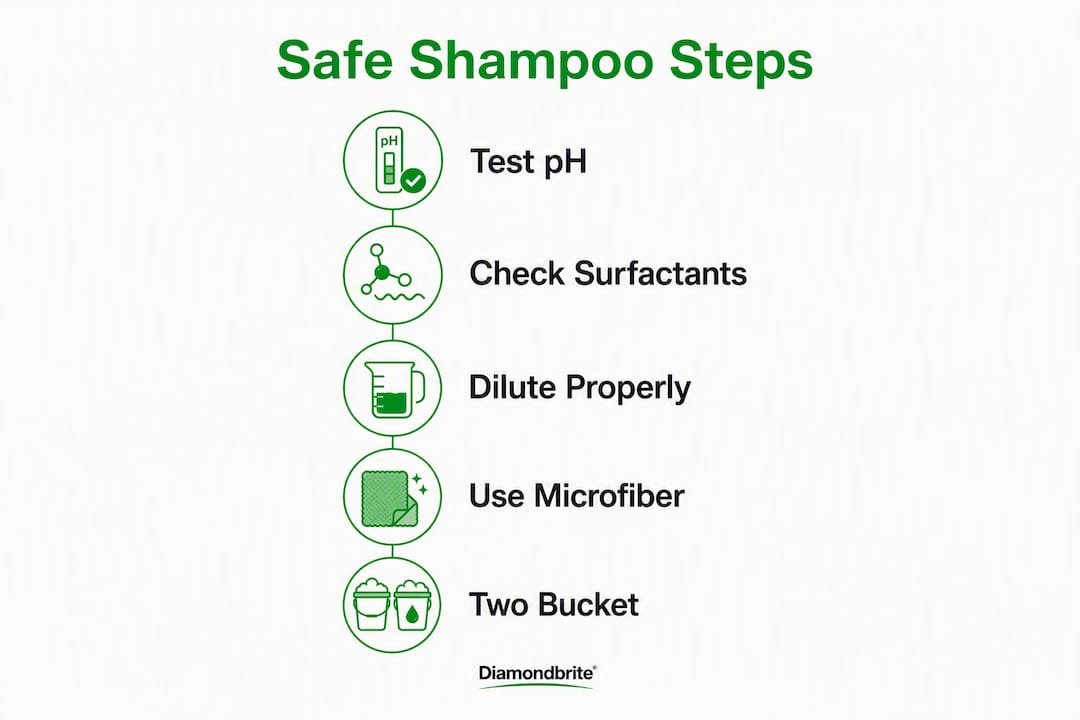
How do you test a shampoo’s pH before using it on your car?
Use pH strips or a digital pH meter, and always do a small panel test before applying any new product to the full car.
Testing steps:
- Dilute the shampoo to your intended wash concentration
- Dip a pH strip or meter probe into the solution and record the reading
- Apply the diluted solution to a small, inconspicuous panel
- Rinse thoroughly and observe the surface after 24 hours for any film, reduced water beading, or change in gloss
What to use:
- pH strips: inexpensive, available from most chemists or online; accurate enough for a quick check
- Handheld digital pH meter: more precise, worth owning if you test products regularly
- Spot test location: a lower door panel or sill, away from direct sunlight during testing
Even if the pH reads within the 6–8 window, a product with aggressive anionic surfactants can still cause problems. If the spot test shows reduced repellency or a hazy film after rinsing, avoid the product regardless of its pH reading.
Diamondbrite Ceramic Shampoo: does it meet the checklist?
Diamondbrite Ceramic Shampoo is formulated specifically for ceramic-coated cars and meets the pH and surfactant criteria set out above. Every formulation is developed and tested in Diamondbrite’s Loughborough R&D facility, which means the chemistry is engineered for coating safety rather than adapted from a general-purpose cleaner.
How it aligns with the buying checklist:
- pH formulated within the coating-safe near-neutral range
- Gentle surfactant profile designed to clean without stripping the SiO2 layer
- Lubrication additives included to protect against wash marring
- Clear dilution guidance provided with the product
- SDS available for buyers who want to verify ingredients independently
| Wash type | Suggested dilution |
|---|---|
| Maintenance wash | Follow recommended dilution |
| Deeper clean | Follow recommended dilution |
Detailing round-ups consistently find that true pH neutral shampoos improve gloss and reduce the need for correction when used as part of regular maintenance. Diamondbrite’s track record of customer satisfaction reflects exactly that outcome. Owners of motorcycles and leisure vehicles will find the same gentle chemistry applies to their coated surfaces — the maintenance principles for powersports vehicles follow the same pH-safe logic.
What does “pH neutral” actually mean on a car shampoo label?
pH is a scale from 0 to 14. Pure water sits at 7, which is neutral. A car shampoo labelled “pH neutral” or “pH balanced” typically means it has a pH close to neutral in the approximate range 6 to 8, close enough to neutral that it will not aggressively react with protective coatings, paint clearcoats, or rubber trims.
The label itself is not regulated, so “pH neutral” is a marketing claim unless the brand publishes an SDS or technical data sheet confirming the actual value. Products at pH 6.5–7.5 are genuinely neutral; products at pH 8.5–9 are mildly alkaline and may be marketed as neutral without technically being so. It is important to verify with the SDS or a pH meter rather than relying solely on the front-of-pack claim.
Key takeaways
A pH neutral car shampoo formulated for ceramic coatings, used with the two-bucket method and a microfibre mitt, is the most reliable way to maintain coating performance without causing wash-induced damage.
| Point | Details |
|---|---|
| pH window | Choose a shampoo confirmed at pH 6–8 via SDS or meter — not just the label claim |
| Surfactant check | Avoid SLS or LAS as lead surfactants; look for betaines or APGs instead |
| Two-bucket method | One bucket for shampoo solution, one for rinsing the mitt — reduces swirl marks significantly |
| Avoid dish soap and degreasers | Products above pH 11 progressively strip the silica network in ceramic coatings |
| Diamondbrite Ceramic Shampoo | Formulated for coated cars, developed in Loughborough, and available from the Diamondbrite online shop |
The case for keeping it simple
There is a tendency in the detailing world to overcomplicate maintenance. Owners invest in a premium ceramic coating and then agonise over a dozen different shampoos, each with bold claims on the label. The reality is more straightforward: a shampoo that sits at pH 6–8, uses gentle surfactants, and provides good lubrication will protect your coating reliably. The two-bucket method does the rest.
What often gets overlooked is winter washing. Salt and road grime are more corrosive to a coating’s surface than most owners realise, and skipping washes through January and February because it is cold is one of the fastest ways to shorten coating life. A quick, properly diluted wash every week or ten days through winter, followed by a thorough rinse, keeps contamination from bonding to the silica layer. Modern OEM clearcoats and aftermarket SiO2 systems both respond well to this approach.
Diamondbrite Ceramic Shampoo: where to buy and what to pair it with
Diamondbrite Ceramic Shampoo delivers exactly what this guide recommends: a coating-safe pH range, gentle surfactants, and the lubrication your mitt needs to glide without marring. It is developed in Loughborough and available directly from the Diamondbrite online shop.
For owners who want to go further, pairing the Ceramic Shampoo with Diamondbrite Ceramic Glaze gives you a maintenance wash plus a top-up layer of SiO2 protection in a single session. The combination keeps water beading strong between full coating applications. Visit the Diamondbrite shop to see current product bundles and pick the pack that suits your wash cadence.
Useful sources
- pH-Balanced Car Shampoo: How it protects paint and coatings — technical explanation of pH, hydrolysis, and surfactant chemistry
- What’s actually in your car shampoo: ingredient guide — SDS reading guide and surfactant breakdown
- How to wash and maintain a ceramic coated car — two-bucket method and tool recommendations
- Maintenance guide: how to wash and maintain a car with a ceramic coating — wash-and-wax product warnings
- Best pH neutral shampoos for perfect car washes — practical round-up of coating-safe shampoos
- Always request the SDS for any shampoo before purchase and verify pH in section 9 and surfactants in section 3